Closure of women’s political clubs in France
The Second SexThe closure of women’s political clubs in France marked a decisive reversal within the French Revolution: women who had organized and learned politics were excluded from the institutions where public authority was exercised. The episode illustrates how women’s political agency could be welcomed as part of revolutionary upheaval yet suppressed when it challenged the prescribed division between public citizenship and domestic responsibility.
Organization and Confrontation
Women’s clubs had emerged as places where women could learn politics and participate in revolutionary life. Their activities were constrained by class as well as sex: working women could join public unrest, while bourgeois women were often bound to family life and lacked an independent economic basis for collective action. Women’s clubs, moreover, were frequently absorbed into organizations dominated by men.
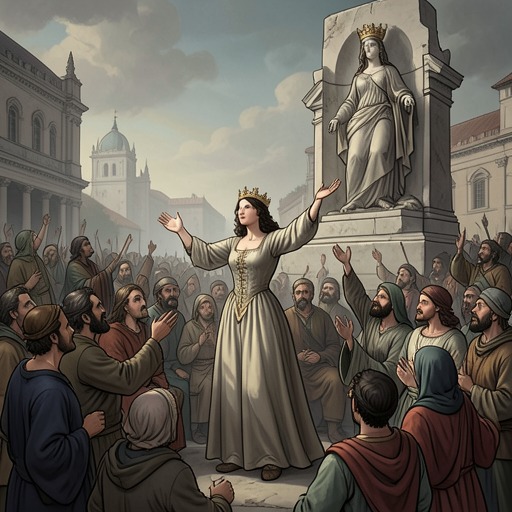
On 28 Brumaire, 1793, Rose Lacombe, president of the Society of Republican and Revolutionary Women, led a delegation that forced its way into the Conseil Général. The prosecutor Chaumette responded by arguing that women should not abandon their sex for men’s roles, assigning childcare, household work, and the cares of motherhood to them instead. The confrontation made the dispute concrete: women were not merely asking to participate in politics in principle; they were asserting a right to enter a governing assembly and to act collectively.
Closure and Political Exclusion
The authorities barred women from entering the Conseil Général. Soon afterward, women were also excluded from the clubs in which they had acquired political experience. The two exclusions worked together: women lost access both to a formal political body and to the associational spaces that had helped them organize and develop political knowledge.
The closures followed a wider pattern of limited revolutionary gains. The Revolution had abolished masculine privilege in inheritance in 1790, making girls and boys equal in succession, and established divorce in 1792, loosening marital bonds. Yet these changes did not secure women’s continued participation in public political life. The suppression of their clubs demonstrated that legal reform and revolutionary mobilization did not, by themselves, dislodge the gendered boundaries on citizenship.
Historical Significance
The episode belongs to a history in which women’s political interventions were repeatedly restricted even when they took part in events alongside men. Women had helped drive demonstrations, and a handful of political women had acted prominently, but their influence did not translate into durable institutional power. The clubs’ closure exemplifies the author’s broader argument that women’s history was shaped by decisions made within male-controlled political structures rather than by women as an autonomous political group.
The closure also sharpens the contrast between women’s potential for action and the domestic role imposed on them. Political participation offered a route beyond confinement to repetitive household labor; the authorities’ response redirected women toward precisely those domestic duties. In that sense, the episode was not only an administrative prohibition but a contest over who could appear as a political subject and who would be assigned to the private sphere.