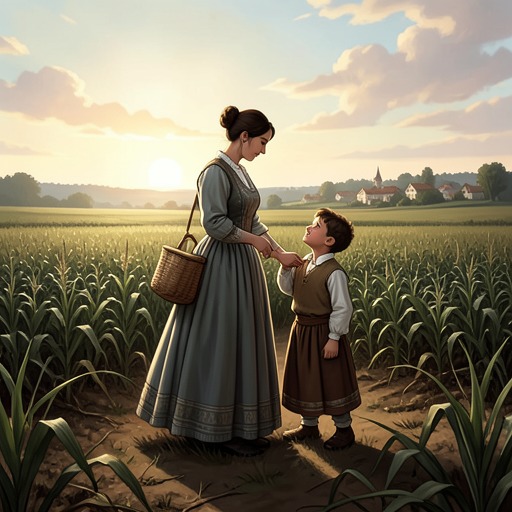
Daichi mother
The Second SexMother Earth is not simply a benevolent image of fertility. In the book’s account of patriarchal mythology, she names the natural ground on which human life depends and the maternal power that makes life possible, while also carrying the fears men attach to birth, bodily dependence, and mortality. The figure’s doubleness—nourishing and threatening, a source of life and a destination in death—gives it force as an image of nature and as a way of interpreting women’s historically constructed position.
Fertility, Nature, and Dependence
In the imagery the book traces, creation is often organized as a gendered opposition: man is associated with active form and seed, woman with earth and water, which receive and nourish what is planted. Yet the receiving ground is not dispensable. It shelters the seed, gives it substance, and makes growth possible. This is why the image cannot be reduced to passivity: even when a patriarchal account assigns the initiating role to men, human flourishing remains dependent on the maternal element it seeks to subordinate.
The image also gathers together the resources on which people live. The book recalls the continuing veneration of fertility goddesses after the Great Mother’s supposed dethronement, including the belief that prosperity and harvests depended on Cybele. Its examples of reverence for earth—from an Indian prophet’s prohibition against injuring the ground to the Baidya’s opposition to plowing it—show that the maternal earth could be understood as a vulnerable relation deserving protection, not merely as material to be used. In such traditions, the land’s fertility carries ethical weight because it is the condition of shared life.
That dependence can also become a longing to return. The mother is figured as a root drawing nourishment from the cosmos, a spring that offers both water and milk, and a renewing mixture of earth and water. This romantic vision makes maternal nature a refuge from the separateness of individual existence. It promises restoration through reunion with life’s sources, even as that promise threatens the independence a person has sought to establish.
Birth, Mortality, and the Dark Mother
The same maternal ground that sustains life reminds human beings that they are born into bodies and will die. The book describes man’s revolt against his carnal condition as a wish to imagine himself as pure spirit, unconfined by the body, place, or time. In this perspective, the womb becomes an emblem of unwanted dependence, and the fact of having been engendered becomes a reminder of mortality. Mother Earth therefore carries a darkness that is not separate from her fertility: life begins in the material world to which the dead return.
The account connects this anxiety to customs surrounding birth. In some societies, the placenta was carefully destroyed or cast away because it represented the newborn’s dependence; eliminating it symbolically severed the individual from the living substance in which formation had occurred. The stigma of childbirth then fell on the mother. Ancient codes required purification after birth, and later rural customs preserved similar practices. These examples show how anxiety about origin could be translated into rules that marked maternal bodies as impure, turning a shared condition of human life into a burden assigned to women.
The book extends the association between generation and death through representations of fate and mourning. Women appear as the Parcae and Moirai, who weave the thread of life but also cut it; in many popular representations, Death itself is female. Mother Earth is consequently both the beginning and the end of human existence: she receives life, but also engulfs the bones of those who die. The image’s power rests in this conjunction rather than in a single, stable meaning.
The Other Face of the Mother
The dark image does not cancel the possibility of renewal. Death may also be imagined as a new birth: the dead hero is restored in spring, and myths of a sun god swallowed by the sea and emerging again turn engulfment into regeneration. The book presents this hope as part of the same ambivalence that makes maternal nature frightening. People want to assert a distinct, individual existence, yet also wish to cross the boundaries of the self and return to the Whole. Woman, as the figure associated with nature, is made to embody both the limit and the imagined passage beyond it.
This structure helps explain why women can be represented at once as a source of life and as a threat. In the book’s interpretation, the fear directed at women often reflects men’s horror of their own bodily contingency, projected onto the maternal figure. The resulting myth does not describe women as autonomous subjects so much as translate male unease about dependence, birth, and death into an image of feminine nature. Mother Earth is therefore central to the book’s critique of the myths through which patriarchal society turns women into symbols and then uses those symbols to justify social arrangements.
Historical and Social Significance
The book distinguishes this maternal symbolism from women’s actual social position. Reports of a former reign of women, or of a golden age under matriarchy, do not establish that women once stood as men’s equal partners. The presence of Mother Earth or a goddess may signal extraordinary power, but symbolic power is not the same as political authority. The text argues that society remained organized through male authority and that women often served as goods or intermediaries in relations between male groups, rather than participating as independent subjects in reciprocal relations.
That distinction matters because an exalted image can coexist with subordination. The mother may be revered as the source of fertility while women themselves remain under male guardianship; the goddess can be celebrated without granting women control over law, property, or social authority. The figure thus offers no simple historical proof of female emancipation. It instead reveals how reverence for a maternal principle may preserve women as symbols while leaving their concrete circumstances unchanged.
The same difference between symbol and situation informs the book’s account of labor. The burdens of reproduction vary with social arrangements: repeated pregnancies imposed without support weigh heavily, while reproductive choice and assistance with pregnancy and childcare can make maternal duties more compatible with work. In modern conditions, machines can also lessen the practical force of differences in muscular strength. These points prevent Mother Earth from becoming an explanation of women’s fate as a timeless biological destiny; the social meaning and consequences of reproduction depend on economic and historical conditions.
The book also challenges any account that would explain women’s oppression solely through technology or property. A change in tools can alter the economic value of labor, and private property can transform domestic relations, but neither alone explains why one group claims sovereignty over another. The author insists that the desire to dominate the Other is part of the history that makes such changes oppressive. Mother Earth therefore stands at the intersection of nature and history: she is invoked as a natural symbol, but the meanings attached to her and the social consequences imposed on women are shaped by human relations and institutions.
Myth as a Social Instrument
Mother Earth belongs to a wider repertory of myths through which patriarchal society gives its imperatives an appealing, memorable form. Such myths can take hold even among people whose daily lives are governed by material needs, because they let particular experiences appear as expressions of timeless ideas. A man’s quarrel with a woman, for instance, can be turned into a claim about feminine nature; a companion can instead be idealized as harmony, repose, or Mother Earth. In either case, the myth substitutes a ready-made absolute for attention to the particular person and the actual relation.
The maternal image is therefore both emotionally powerful and politically useful. It can express dependence on the earth, longing for renewal, and fear of death; it can also disguise social arrangements as eternal truths about women. The book’s decisive distinction is between the figure and the women made to bear its meanings. Mother Earth is a cultural image whose contradictions expose the tension between men’s dependence on life and their wish to escape that dependence, while the history of women cannot be inferred from the image alone.