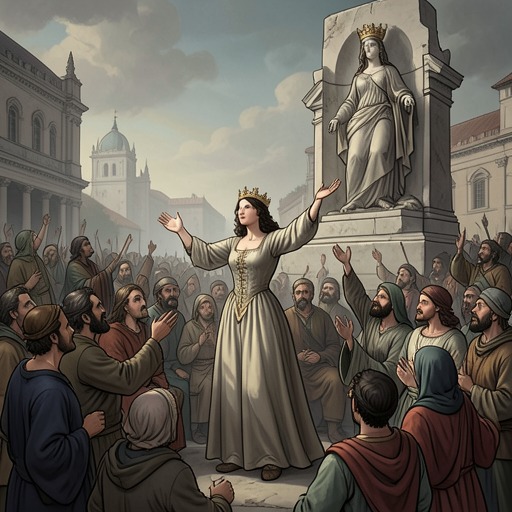
Declaration of the Rights of Woman and of the Female Citizen
The Second SexThe Declaration of the Rights of Woman and of the Female Citizen is presented as Olympe de Gouges’s 1791 intervention in the French Revolution: a demand that women’s rights be recognized on terms equivalent to those asserted for men. Its significance lies both in the breadth of that claim and in the sharp contrast between revolutionary language about freedom and women’s exclusion from political authority.
Revolutionary context
The French Revolution did not, in Simone de Beauvoir’s account, transform women’s condition. It was a bourgeois revolution, conducted almost exclusively by men, and it preserved the institutions and values of bourgeois society. Women participated in revolutionary events, but participation did not mean control over the movement or its gains. Working women joined demonstrations, including the march to Versailles in search of the king’s family; women’s presence in public action, however, did not translate into a share of political power.
Women’s circumstances differed by class. Under the ancien régime, working women could run businesses and exercise trades, and their material independence gave them greater freedom of movement and behavior than bourgeois women generally enjoyed. Yet working-class women’s claims remained limited, while bourgeois women were integrated into family life and lacked an economic basis for collective solidarity. The Revolution therefore offered no unified route from women’s activity to women’s political authority.
The declaration and its demand
In 1791, Olympe de Gouges proposed the Declaration as an equivalent to the Declaration of the Rights of Man. It demanded that masculine privileges be abolished. The proposal made the contradiction in revolutionary universalism concrete: a declaration of rights that treated men’s claims as universal left women’s status unchallenged unless women themselves were named as rights-bearing political subjects.
The document belonged to a small but visible current of feminist argument. Similar ideas appeared in the 1790 satire Motion de la pauvre Javotte, while de Gouges also founded the newspaper L’Impatient. These efforts were abortive despite Condorcet’s support. De Gouges was eventually executed, an outcome that stands in stark contrast to the ambitious equality asserted in her political proposal.
Exclusion from revolutionary politics
Women’s political organizing encountered direct resistance. Women’s clubs were often absorbed by men’s clubs; when Rose Lacombe, president of the Society of Republican and Revolutionary Women, and a delegation of women forced their way into the Conseil Général in 1793, the prosecutor Chaumette argued that women should remain within the roles assigned to them by nature, including childcare and household work. Women were barred from the assembly and soon excluded even from the clubs where they had learned political practice.
Some legal changes did occur: in 1790, masculine privilege in succession was abolished, placing girls and boys on equal terms in inheritance, and the 1792 divorce law loosened marital ties. Beauvoir characterizes these gains as feeble. The failure of the declaration was thus part of a broader pattern: women could act in revolutionary society, but class divisions and gender exclusion prevented their claims from becoming a durable, independent political force.
Place in Beauvoir’s historical argument
Beauvoir treats the declaration as evidence of women’s protest against a political order authored by men, not as proof that women had thereby become a unified historical subject. In her account, women lacked the shared organization and independent material basis that might allow them to act collectively; their movements often depended on concessions or support from men. She accordingly places de Gouges among isolated women who protested their situation while emphasizing how little control women held over the larger course of history.
The declaration also exemplifies Beauvoir’s broader argument that women’s history has been written by men and that political and legal arrangements reflect male interests. Its demand for equality opposed the claim that women’s subordinate position was natural or inevitable. Yet the Revolution’s outcome showed the limits of rights language when women remained excluded from the institutions that decided how those rights would be defined and enforced.