French Revolution
The Second SexThe French Revolution was a turning point that promised political transformation but did not emancipate women. In The Second Sex, Simone de Beauvoir traces how women’s participation in the upheaval met the barriers of class and sex, how feminist demands were suppressed, and how the post-revolutionary settlement reimposed patriarchal authority through law. The revolution’s legacy is therefore not a simple advance or reversal: it reveals how freedom proclaimed in universal terms could coexist with women’s exclusion from the rights and institutions that defined it.
Participation and unequal stakes
Before and during the Revolution, working-class women took part in economic life in ways that could give them considerable practical independence. Women ran businesses and worked as laundresses, shop assistants, and other tradespeople; women of modest means could move through public spaces and exercise a degree of control over their lives. Rural women were indispensable to agricultural work and often exercised authority within the household, though their labor and the burdens of motherhood made their circumstances difficult. These differences mattered: women were not a single political or economic class, and the freedoms available to a working woman did not erase the disadvantages imposed on women as a sex.
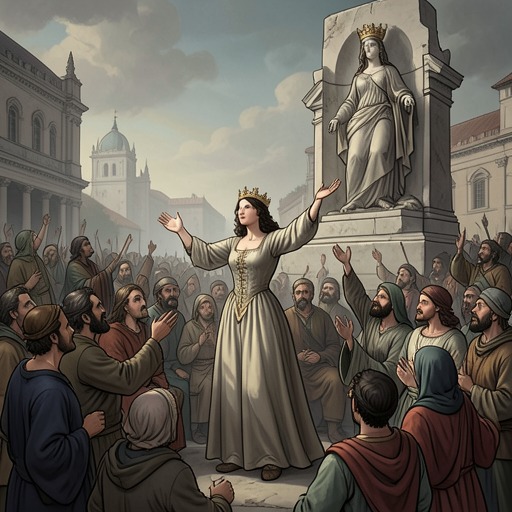
Women were visibly present in revolutionary demonstrations. In October 1789, they marched to Versailles to bring the royal family back to Paris, a protest remembered through the demand for the baker, his wife, and their little boy. Yet taking part in events did not mean controlling them or sharing equally in their gains. De Beauvoir’s account emphasizes the double constraint: working-class women could be obstructed by class, while women from politically active classes were pushed aside because they were women.
Feminist claims and political exclusion
Some women from the bourgeoisie embraced the cause of freedom, and women’s political writing made the contradiction between revolutionary principles and women’s status explicit. In 1791, Olympe de Gouges proposed a declaration of women’s and female citizens’ rights parallel to the declaration of men’s rights, calling for masculine privileges to be abolished. Her intervention belonged to a broader but fragile current of feminist argument; despite support from Condorcet, these efforts failed to establish women’s political equality, and de Gouges was executed.
Women also organized collectively. Women’s clubs often merged with men’s organizations and came under male control. In 1793, Rose Lacombe, president of the Society of Republican and Revolutionary Women, led a delegation that forced its way into the Conseil Général. The prosecutor Chaumette responded by assigning women domestic and maternal duties, treating political activity as a denial of their sex. Women were barred from the assembly and soon excluded even from the clubs where they had learned politics. The episode makes the limits of revolutionary inclusion concrete: women could make claims in public, but male authorities determined whether they were entitled to remain there.
Reforms and the post-revolutionary reversal
The Revolution brought some changes to family law. In 1790, masculine privilege in succession was abolished, giving girls and boys equal standing in inheritance; in 1792, divorce law loosened the strictness of marital ties. De Beauvoir presents these as real but insufficient gains. Bourgeois women, economically dependent within the family, had little material basis for solidarity or for compelling the state to honor their claims. Legal change, without a corresponding shift in power and economic independence, could not secure lasting emancipation.
During the Revolution’s liquidation, women experienced what de Beauvoir describes as an anarchic freedom. The reorganization that followed sharply narrowed that opening. Napoleon sought to define women chiefly through motherhood, while preserving the authority of the husband and the family structure. The Napoleonic Code denied wives and daughters full civic standing and restored the logic of marital guardianship. A married woman owed obedience to her husband; he controlled the family’s residence, held greater rights over the children, and generally had to authorize her contracts. The law treated the husband’s infidelity more leniently than the wife’s and gave him powers over her person and property. The unmarried woman, by contrast, retained a civil role that marriage curtailed.
Historical significance
The Revolution’s treatment of women illustrates the distinction between taking part in a political upheaval and possessing the power to define its institutions. De Beauvoir situates women’s exclusion within a longer history in which men made the laws and presented their own supremacy as natural or divinely justified. The Revolution could alter inheritance and divorce rules, yet its gains remained vulnerable when women lacked independent economic and political power; under the Napoleonic settlement, marital authority was reinforced rather than dismantled.
The episode also anticipates a central argument of The Second Sex: women’s freedom depends not only on abstract recognition as human beings but on the concrete conditions that let them act as autonomous subjects. Women’s labor, demonstrations, and political proposals made them participants in revolutionary life, but participation alone did not overcome the institutions that assigned them to dependence. The Revolution’s promise and its reversal together show how a society can proclaim liberty while reserving its effective exercise for men.