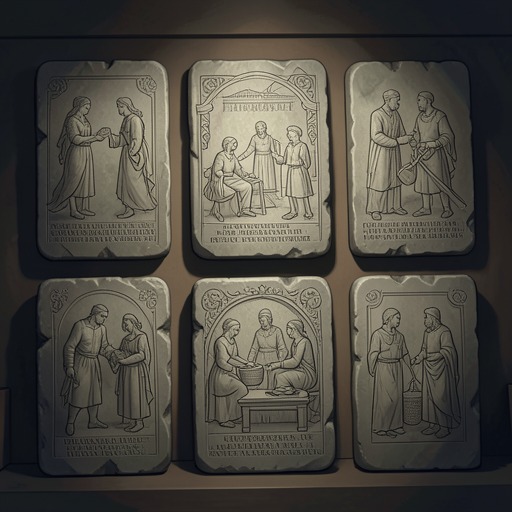
Private Property and Inheritance
The Second SexPrivate Property and Inheritance names the material and social order that, in Simone de Beauvoir’s history of women, turns masculine power into a durable system of family authority. Once land is treated as inheritable property, control over women’s sexuality, children, and descent becomes a means of securing the owner’s wealth and continuing his authority beyond his lifetime. In this account, women’s subordination is not explained by biology alone: it is reproduced through the institutions that determine who owns, inherits, and belongs.
From productive labor to possession
The change begins with a transformation in economic life. As agriculture becomes creative labor rather than an essentially magical operation, men claim to be generative forces in both cultivation and procreation. The land they own and the children they claim as heirs become parts of the same project: extending their lives through possessions passed on to descendants. The domestic cult of ancestors reinforces this arrangement, since the heir both cultivates paternal land and honors the father’s spirit. Property thus carries economic value and a claim to survival after death.
The effects extend beyond the household. In Beauvoir’s account, new technology and the use of enslaved labor diminish women’s former economic role within the tribe. Men’s expanding power is confirmed through ownership of land and labor, and the wife and children are brought under the authority that organizes the family’s work for the benefit of the fields. A relationship in which women’s fertility had once given them a measure of reciprocal importance gives way to a patriarchal order in which the man claims a woman and a posterity of his own. The shift is not simply that men acquire property; it is that the property system makes control over people part of the household’s productive and inheritable wealth.
Descent, heirs, and the exclusion of women
The decisive ideological change is the replacement of matrilineal descent with agnation, or descent through the male line. The mother is reduced to a caretaker of the child, while the father is declared the holder and transmitter of rights. Beauvoir presents this as an assertion of authority rather than a conclusion compelled by scientific knowledge: observations about procreation might have established the father’s participation, but patriarchal thought turns that participation into exclusive ownership of posterity. The resulting doctrine lets men claim the child, and thereby secure their place in the succession.
Inheritance gives this claim a practical force. If children belong to their father’s group, a woman’s own family cannot treat them as members who carry its line forward. Marriage therefore removes her from the group into which she was born and attaches her to her husband’s household. She is excluded from inheritance because her property might otherwise pass through her to that household; yet, deprived of property, she is herself treated as part of a man’s patrimony—first her father’s, then her husband’s. Property law does not merely withhold an asset: it denies women the independent standing associated with ownership and transmission.
The arrangement also reaches into the beginning of life. Beauvoir describes patriarchal societies in which fathers hold extensive power over children and girls may be exposed or killed more readily than boys. She contrasts this with the comparatively low valuation assigned to a female victim in societies using blood money. Such practices make the girl’s acceptance depend on her father’s decision and mark her entry into the family as less secure than a boy’s. In her account, the logic of property and descent therefore shapes not only a woman’s adult marriage but the value placed on her from birth.
Marriage, chastity, and the policing of descent
Once a woman is treated as property passed between households, marriage becomes an instrument of transfer and control. A father may choose her husband; after marriage, authority passes to the husband and his family. Polygamy is limited chiefly by economic considerations, while the husband may repudiate a wife with few protections for her. Women, by contrast, face strict demands of chastity. The asymmetry is tied to inheritance: a husband’s household must be able to identify the children who will receive its property.
Female virginity and fidelity consequently become matters of lineage, not simply personal morality. Beauvoir contrasts patriarchal demands with accounts of societies in which prenuptial chastity was not regularly required and adultery was not treated as severely. Under private property, a husband’s certainty about descent becomes paramount, and a wife’s infidelity is construed as a threat to the family’s inheritance. The husband’s claimed right to punish her, and the long survival of unequal legal treatment of adultery, express the same anxiety: property must pass to heirs recognized as belonging to the owner’s line.
This reasoning persists across legal systems and historical periods. Beauvoir notes that laws have repeatedly justified women’s restricted rights by appealing to the danger that a woman might bring an illegitimate child into the family. Even after the right of private vengeance was abolished under Augustus, she observes, the Napoleonic Code still offered a husband who avenged himself the prospect of the jury’s leniency. The legal details change, but the basic structure remains: women’s conduct is regulated more severely where it might unsettle male certainty about descent and property.
The naturalization of a historical order
Beauvoir’s analysis connects inheritance to a broader question: how does a social arrangement present itself as timeless nature? In her opening account of sexual hierarchy, she distinguishes women from groups whose subordination followed identifiable historical events. Women are as numerous as men, have always been present, and are dispersed within the households and economic ties that connect them to fathers and husbands. They therefore lack the separate organization and shared social space that could allow them to act collectively against their subordinators. This difference helps explain why women’s dependence can seem like an unchanging condition rather than a historical relation.
But the apparent naturalness of that relation is reinforced by institutions and ideas. Legislators, religious authorities, philosophers, and scholars have presented male supremacy as both divinely sanctioned and socially useful. The patriarchal family’s need to secure heirs gives a material interest to arguments about women’s alleged incapacity and proper place. Beauvoir’s account of the transition from maternal to paternal descent supplies one example: a claim created to consolidate men’s rights is represented as a truth about reproduction itself. The institution of inheritance and the ideology that defends it work together.
The contrast between property and biology is central to the argument. Women’s physiological capacity to bear children does not by itself dictate that fathers own those children, that women cannot inherit, or that a wife’s sexuality must be policed more strictly than her husband’s. Those arrangements arise within a social order organized around property and male descent. Beauvoir’s broader rejection of immutable feminine essence frames them as historical conditions that can be changed, not as necessary consequences of being female.
Historical argument and significance
Private property and inheritance provide the hinge between a story of economic change and a history of women’s legal and familial subordination. The narrative moves from land and household labor to descent, marriage, sexual regulation, and the transmission of wealth. Each stage adds a means of making masculine authority last: the owner controls the work of the household, claims the children as heirs, and uses law and custom to protect the succession.
The argument also clarifies why Beauvoir treats women’s history as part of a larger history of power rather than as a sequence of isolated changes in women’s status. In her conclusion, she stresses that women’s history has been written by men and that the decisions governing women’s lives have reflected men’s interests, projects, and fears. Property and inheritance exemplify this mechanism: a system devised to preserve wealth and lineage helps define women’s position, while its consequences are then offered as evidence that women naturally belong in subordinate roles.
The account is not simply a claim that ownership alone explains every form of women’s oppression. Beauvoir links economic organization to political authority, religious ideas, legal rules, and the unequal possibilities available to women. Nor does she present women as an autonomous class readily separated from men: women live dispersed among men and are divided by class and race as well as by their ties to particular households. Her analysis instead shows how inheritance makes the intimate family a site where larger power relations are reproduced, and how a material institution can acquire the appearance of an eternal social truth.