Roman Republic
The Second SexThe Roman Republic is a key historical case in Simone de Beauvoir’s analysis of how women’s lived power can diverge from their legal status. Roman matrons could manage households, influence family and civic life, and share in their husbands’ concerns; yet their authority remained bounded by male power. Later legal changes widened women’s rights, but without corresponding political and economic opportunities, emancipation could remain freedom without an effective field of action.
Household Authority and Civic Influence
In the Republic, the father stood at the head of the family, with authority over his wife and children. Yet women’s actual position was not captured by that legal hierarchy alone. The Roman matron occupied the atrium, the center of the home, rather than being confined to a separate women’s quarter. She supervised enslaved workers, oversaw children’s education, shared her husband’s work and concerns, and was regarded as a co-owner of his property. She attended meals, celebrations, and the theater, and men yielded the right of way to her in the street.
The book emphasizes the matron’s public and political influence through familiar Roman stories. The pleas of Coriolanus’s mother and wife are said to have moved him; a law associated with Licinius was attributed to his wife’s inspiration; and Cornelia is credited with shaping the character of the Gracchi. Cato’s observation that men governed women while women governed the men who governed everyone else captures the apparent paradox: formal authority belonged to men, while women could nevertheless exercise consequential influence within family and civic life.
Legal Change and Uneven Independence
As the Roman state consolidated its power, public justice increasingly displaced the authority of the family court. The father’s and husband’s control over a woman’s person was curtailed, while guardianship and manus—the power attached to a husband’s family—gradually lost force. Women could use fictitious marriages or cooperative guardians to escape guardianship, and under imperial legislation guardianship was eventually abolished. Dowry rules also gave women a material guarantee: a woman could demand the return of her dowry, and it did not simply revert to her husband or his male kin when a marriage ended. Mothers gained recognized claims to their children’s respect, and in specified circumstances could obtain custody.
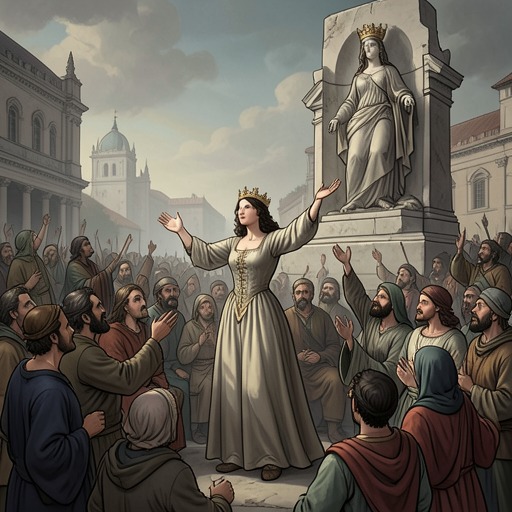
These changes did not amount to full equality. The Oppian Law, adopted during a military crisis to restrict luxury, was challenged after the danger passed. Matrons gathered in the public square and helped secure its repeal despite Cato’s opposition. The later Velleian Senate decree, by contrast, barred women from interceding for others and stripped away much of their legal capacity. The book presents the restriction as part of a recurring pattern: when women’s rights expanded, arguments about the supposed weakness of their sex could be used to justify renewed limits.
Freedom Without an Outlet
The Republic’s changing legal arrangements produced an unstable combination of rights and constraints. Women could inherit, make wills through the institution of the dowry, divorce and remarry, and in some respects hold rights concerning children comparable to those of fathers. But formal and economic independence did not automatically provide political capacity or a recognized sphere for women’s projects. In the book’s account, this gap made Roman women’s freedom negative: rights existed, but women lacked the means to turn them into sustained public action.
The consequences appeared in public disturbances and political interventions. Women protested, besieged courts, and took part in plots and civic conflict; the book also describes them carrying the statue of the Mother of the Gods along the Tiber. These actions register unrest, but they do not erase the structural absence of an enduring route into public life. For Simone de Beauvoir, the contrast between legal capacity and effective power is more revealing than either status alone.
Republic and Later Roman Society
The Roman matron of the Republic has, in Simone de Beauvoir’s comparison, a recognized place in the world but remains limited by the absence of full legal independence and economic autonomy. Later, as women acquired more formal freedom, they could still be left without socially sanctioned purposes or opportunities for action. The contrast exposes the inadequacy of treating legal emancipation as a complete measure of liberation: practical authority within the household, rights on paper, and the power to pursue projects are distinct conditions.
This historical example also supports the book’s wider insistence that women’s situation depends on concrete arrangements as well as abstract rights. The Republic’s matrons could influence families and, at times, public affairs, but their influence did not amount to collective sovereignty. Their history therefore illustrates how a society may grant women substantial responsibilities and practical importance while withholding the independent means to define the ends of their own activity.