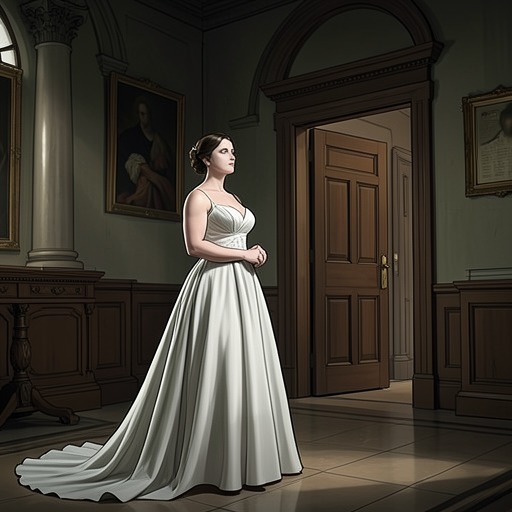
Sophia Tolstoy
The Second SexSophia Tolstoy appears in the discussion as a young woman whose marriage to Leo Tolstoy turns an admired courtship into a life marked by separation, loneliness, and uncertainty about her purpose. Her diary entries, spanning the first months of marriage and later years, give a detailed account of the distance between the life she had imagined and the one she inhabits. Simone de Beauvoir uses that record not simply as evidence of private unhappiness but to show how marriage, domestic routine, and dependence can narrow a woman’s sense of a future.
Identity and Marriage
On September 23, 1862, Sophia married Leo Tolstoy and left her family that evening. The departure was painful: she reserved her farewell to her mother until last, and her mother cried out as Sophia pulled away. In the carriage, Sophia wept and felt afraid. Her new husband was attentive to her immediate needs, but his care did not erase the shock of leaving the family with whom she had always lived or make the unfamiliar journey feel like a chosen future.
The couple reached Yasnaya Polyana the next day. Sophia’s diary records how difficult it was to address her husband familiarly; for a long time, she continued to use the formal form. She had imagined loving a man who was wholly new and untouched by a previous love, but the fact that he had loved before remained present to her during their intimacy. The difference between her ideal and his past became one element in an early marriage already unsettled by separation and uncertainty.
The First Months: Isolation and Loss of Purpose
Sophia’s diary repeatedly returns to the pain of being away from her family. In October 1862, she described feeling as if she were always asleep, frightened to be alone, and saddened by her husband’s distance. She feared that he did not love her and contrasted the warmth of her former home with the loneliness of the new one. She could not make herself happy or believe that she could make him happy; work, household tasks, and the prospect of a child did not supply the excitement she had lost.
The imbalance between their sources of purpose sharpened her distress. Leo Tolstoy had his work and the estate, while Sophia felt she had no inner resources or comparable undertaking. She wanted to do something real, but believed her aspirations had disappeared because marriage seemed to have given her everything she could expect and left nothing further to strive for. Her complaint was not simply that she had too little to do: she felt that the new life had deprived her of a meaningful direction.
In April 1863, she also recorded a mismatch in their expectations of love. She said that the physical side of love mattered greatly to her husband, while for her it was the opposite. The account places this difference alongside her earlier boredom and sadness, rather than treating marriage as an automatic resolution of desire or loneliness.
Attachment, Jealousy, and Contradiction
The narrative describes Sophia as recognizing almost immediately that she did not love her husband in a settled or uncomplicated way. She found intimacy distasteful, objected to his past and ideas, and experienced him as neglectful and harsh. Yet her unhappiness coexisted with intense attachment: she wanted him near her, felt tortured when he was away, and became jealous. In an 1863 diary entry, she called jealousy an illness and connected it to having given herself so completely that her happiness depended on him.
Her diary shows that dependence as a recurring conflict, not a single mood. In January 1863, she resented that Leo loved other people and activities when she wanted to be the sole object of his love; she also recognized that she needed to learn to love something beyond him, as he loved his work. Later that year she described following him jealously because she did not understand him. The desire for exclusive closeness sat beside her awareness that her life had become organized around his attention.
The record changes tone over time without resolving the contradiction. In 1868, Sophia read earlier diary pages with amusement and described the marriage as happy and harmonious, saying that she loved her husband increasingly and continued to love him with passionate, poetic, jealous intensity. By 1876, however, she again wrote of searching his diaries for references to love and of being tormented by jealousy and fear that he would leave her. The contrast shows how declarations of marital happiness could coexist with anxiety rather than conclusively replace it.
Domestic Routine and Constrained Autonomy
Six months after the wedding, Sophia contrasted her mundane life and anticipated death with her husband’s rich inner life, talent, and immortality. She described the prospect of sitting alone sewing or playing the piano while becoming convinced that, even if her husband did not love her, she was fixed in that life. Twelve years later, the daily pattern she recorded was still made of repeated domestic tasks: getting up after the cook and nurse arrived, darning, helping the children with grammar and piano, and darning again while other members of the household played games. The routine makes visible the gap between Leo Tolstoy’s work and the narrow, repetitive activity Sophia associated with her own days.
Simone de Beauvoir frames that gap as part of a broader account of marriage’s effects on women. A wife may initially try to admire her husband, believe herself indispensable to him and the children, and find shelter in home and affection. But when she discovers that her husband can manage without her and that her children will grow away from her, domestic life may no longer protect her from a sense of emptiness. Sophia’s diary gives that argument particular form: household work continues, but repetition does not create an independent project or a future she can claim as her own.
Protest and Significance
The account also presents Sophia’s dramatic refusals as responses to a situation in which she had little effective power over decisions affecting her life. Simone de Beauvoir describes her as having submitted to the married life, pregnancies, solitude, and conditions imposed by her husband, while receiving recriminations. When new decisions intensified their conflict, Sophia resorted to scenes of rejection, including false escapes, illnesses, and suicide attempts. The analysis does not treat those acts as a successful escape; it presents them as protests that exhausted her and troubled those around her but could not secure the autonomy she lacked.
Sophia’s significance in the book rests on this tension between intense feeling and restricted agency. Her diary preserves her own complaints about loneliness, lack of work, jealousy, and the loss of her former life, while the surrounding analysis places those complaints within the social structure of marriage. Her life is therefore not offered as a simple portrait of either a happy or unhappy wife. It demonstrates how love, dependence, domestic obligation, and protest can inhabit the same relationship—and how an individual woman’s distress can disclose the limits imposed on her capacity to act and define a life beyond her husband.