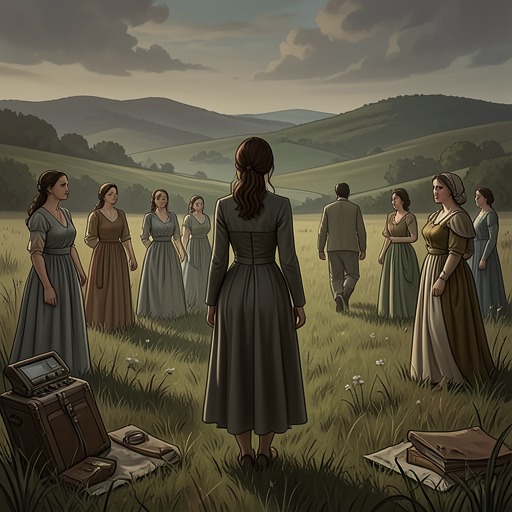
The Social Construction of Woman
The Second SexThe Social Construction of Woman names the process by which a human being who is capable of freedom and self-directed projects is formed into a socially subordinate feminine subject. The account rejects both biological inevitability and the idea that economic reform by itself can settle the question: the conditions that shape women are material, educational, moral, and cultural, and they reach from childhood into work, family life, and desire. Its decisive claim is that women’s situation can change, but only through a broad transformation that makes equality concrete and allows each person to pursue an open future.
Definition and central argument
Woman, in this account, is not defined by hormones or mysterious instincts. She becomes intelligible to herself through the way other people’s consciousnesses teach her to grasp her body and her relation to the world. Social formation begins early: the differences between girls and boys are not simply discovered at adolescence, but cultivated from infancy, then carried forward as part of a girl’s past. That history weighs on her without fixing her destiny for all time.
The argument draws on existentialist morality, in which a subject realizes freedom through projects that reach beyond the present toward other freedoms. Woman is, like every human being, an autonomous freedom; yet she discovers and chooses herself in a world where men require her to assume the position of the Other. Her own projects risk being treated as secondary to a sovereign male consciousness. Her drama therefore lies in the conflict between the claim to exist as an essential subject and the social situation that marks her as inessential.
This framework also distinguishes biological conditions from their social meanings. Reproductive capacity and physical differences matter in lived circumstances, but their significance varies with social organization. For example, the burdens of maternity become heavier when repeated pregnancies are imposed and women must raise children without support; they can be reduced when women control whether they have children and society assists with pregnancy and child care. The body is part of a situation, not a complete explanation of a life.
Labor, reproduction, and inherited inequality
The account traces the economic foundations of women’s subordination without treating them as the whole explanation. When agricultural work was organized around rudimentary tools and gardening, women’s work could remain economically important within the household. With more intensive cultivation, new tools, slavery, and private property, men acquired control over land and women, and descent shifted from the maternal clan to transmission from father to son. Domestic production consequently lost standing beside men’s recognized productive work. The resulting patriarchal family made women economically and socially dependent.
That history does not mean that private property or a particular tool alone caused women’s oppression. Men’s ambitions helped determine which capacities counted: technical change could have supported a different division of labor, but expansion and the assertion of mastery shaped its social results. Nor can the relation between the sexes simply be equated with class conflict. Women share a life and interests with men and may encounter their complicity; their situation is also shaped by reproductive life, which cannot be reduced to the status of a job. A just social arrangement must therefore address both production and reproduction rather than assume that abolishing the family, or treating gestation as ordinary labor, automatically frees women.
The practical consequences appear in the distribution of time and work. In the account’s French peasant example, a woman’s recognized place in the domestic economy and the authority she may sometimes exercise do not spare her an exhausting day: she tends animals and gardens, joins heavy field labor, prepares meals, manages the household, and cares for children. Pregnancy and child care are added to this workload, while leisure and social visits remain more available to men. This contrast shows how respect or responsibility within the household can coexist with harsh material dependence.
The possibility of paid work likewise does not by itself remove subordination. The discussion notes that modern machinery can reduce the importance of muscular differences, and that women’s employment expanded; it also emphasizes that women continue to bear most domestic and child-care labor. Where pregnancy is uncontrolled, abortion forbidden, and men regard household work as beneath them, women face a more difficult reconciliation of family and employment than their spouses. Economic opportunity matters, but unequal care work and institutional restrictions determine how fully it can be used.
Childhood, education, and the making of femininity
The girl’s formation is especially visible in the passage from childhood to puberty. As a child, she can experience herself in study, play, and relations with family and friends as active in the present, even when adults restrict her. At puberty, the future becomes bodily and immediate; the present can seem merely transitional, filled with occupations rather than ends of her own. Her youth is organized around waiting for a man, imagined as a liberator with the power to provide happiness and escape.
That expectation is not an isolated fantasy. Parents continue to prepare daughters for marriage rather than fostering their full personal development; girls can come to desire the same course because it appears advantageous. Less specialized training and less complete investment in a profession then reinforce women’s inferior position at work, which in turn strengthens the appeal of marriage as a route out of economic insecurity. The social expectation and the individual choice feed each other, forming a cycle rather than revealing an innate preference.
The proposed alternative begins with equal demands and opportunities from the earliest age. If girls received the same education, severity, freedoms, studies, games, and promised futures as boys—and encountered women and men treated as unambiguously equal—the meanings attached to the Oedipus and castration complexes would change. A mother who shared material and moral responsibility with a father could command equal prestige. A girl’s possible affection for her father would not have to become a feeling of weakness; she could also emulate him. If she could test her abilities in work and sport, the absence of a penis would not by itself establish inferiority, just as boys would not acquire a sense of superiority unless it were taught to them.
In these circumstances, girls would have less reason to seek compensation in narcissism and dreams and more reason to invest in what they do. Puberty would be easier to meet if it opened toward a free adult future rather than announcing a forced descent into femininity; coherent sexual education could help girls understand bodily change without treating it as a sentence on their lives. Coeducation would also weaken the idealized mystery of Man through everyday familiarity and open competition. The point is not that education could eliminate every difficulty of growing up, but that it need not add gratuitous obstacles to those experiences.
Repetition, dependence, and constrained choice
Domestic labor gives the social construction of femininity a daily form. Managing a home can allow a wife to make it her own: through choosing, arranging, supervising, and caring for household objects and needs, she can experience herself as active. Yet this activity does not necessarily carry her beyond the limits assigned to her. It can provide a local sense of authorship while leaving her without individual affirmation or a wider field of projects.
The repetitive structure of housework makes that limit plain. The housewife washes dishes, dusts, and mends what will soon be dirty, dusty, or torn again. Even a successful effort cannot be final; the task begins again the next day. The account compares this labor to the torment of Sisyphus because it perpetuates the present without producing a lasting conquest. A woman overwhelmed by poverty may struggle to make a home livable without being able to overcome the conditions that keep it poor. Housework is therefore not simply activity versus idleness: it is work whose social organization can deny the worker an open future.
Dependence also shapes choices beyond the home. Marriage retains social prestige, while men’s economic advantage and status encourage women to seek their approval. The chance of a fortunate marriage can appear as an appealing escape from a difficult and uncertain effort toward independence, but the promise divides women’s attention and sustains the conditions that make marriage seem necessary. Work may open a path away from subjection, yet women must still contend with the unequal rewards of labor and the expectation that they will please men.
The analysis of sexuality follows the same distinction between bodily experience and imposed meaning. Women may interpret sexual relations through an inherited tradition of servitude, so that a position understood as passive seems humiliating and contributes to sexual tension or frigidity. But those meanings are not fixed by anatomy: in a changed social reality, the same gestures could signify something different. The existence of couples in which sexual relations are balanced suggests an alternative based on exchange rather than victory and defeat. Both partners are embodied, vulnerable to desire, and capable of consent, activity, and voluntary giving; neither sex is condemned by its body to a permanent social role.
Collective change and an open future
A society that materially establishes equality would have to alter more than formal laws. The book sketches a world in which women are educated like men, work under the same conditions for the same wages, and are expected to support themselves; erotic freedom is accepted without turning sex into a paid service; and marriage rests on free commitment that either spouse can end. Motherhood is chosen, contraception and abortion are allowed, and mothers and children receive equal rights, with maternity leave supported by society. Shared responsibility for children would not require taking them from their parents, but would keep care from being abandoned to them alone.
Even this institutional program cannot instantly erase the past. Changing women’s economic situation is a primary condition of their development, but its promised moral, social, and cultural consequences have not yet been fully realized in the U.S.S.R., France, or the United States. Women consequently remain divided between past and present, sometimes pressed to appear as a man in order to work while still being judged by older definitions of femininity. They must shed an old identity and make new forms of life, a transformation that no individual teacher can accomplish alone. As the passage puts it through Stendhal’s image, “The forest must be planted all at once.”
The conclusion is collective rather than fatalistic. A girl raised with equal expectations, opportunities, and examples would not have to treat herself as an exception; everyday equality could change the meanings attached to her body, education, desires, and future. This does not promise to abolish the hardships of human life or guarantee that every person will flourish. It argues instead that society should stop multiplying obstacles and provide the means to go beyond them. Woman’s historical formation is powerful precisely because it is reproduced across institutions and relationships; because it is made, it can also be changed.