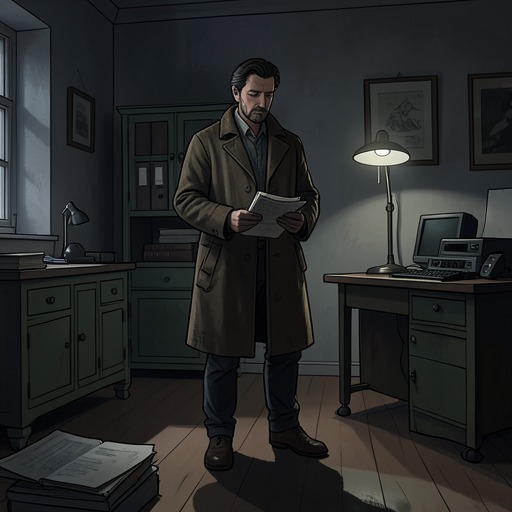
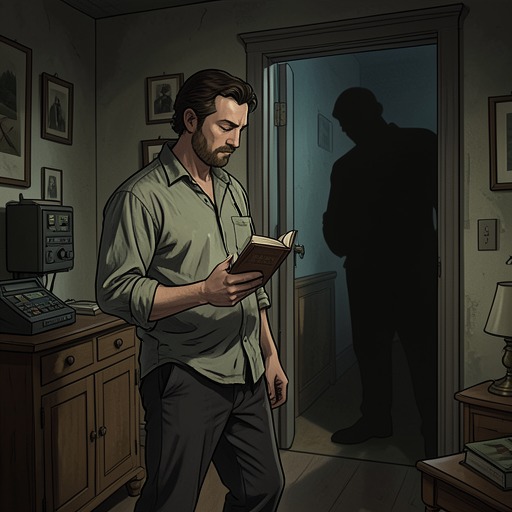
Anthony Cade
The Secret of ChimneysAnthony Cade is at once the story’s resourceful adventurer, an amateur participant in a murder investigation, and the concealed heir whose return changes the political stakes. Known at different points as Jimmy McGrath and finally disclosed as Prince Nicholas Obolovitch, he moves through the plot by taking on other people’s errands and identities; the revelation that he had merely spread a report of his own death gives his disguises a personal as well as political purpose.
Identity and Background
Anthony’s friendship with James(Jimmy)McGrath is the source of the commission that draws him into the story. Jimmy knows him as someone with an almost instinctive tendency to become involved in trouble, but also as a survivor who seems to have more than one life. Their reunion turns that familiarity into a practical arrangement: Jimmy is bound for Cape Town to pursue a gold-hunting scheme, while Anthony proposes to collect the thousand pounds offered for Jimmy. They settle on a quarter of the sum for Anthony, making the commission both a favor between friends and a paid undertaking.
The man who returns to London is visibly different from the boy who left it. Anthony remembers a youthful period when he was a Socialist, wore a flowing red tie, and spent time with earnest companions. He had left London at eighteen as a fair, slightly chubby boy; years later, he sees instead a lean man with a deep tan and a quizzical expression. After a stranger studies his face at the Blitz Hotel, Anthony examines his reflection and concludes that few old acquaintances would recognize him. The scene establishes how changed appearance helps protect a deeper secret: his former life is not simply distant but difficult for others to identify in the present.
When Virginia Revel asks his name, he gives it plainly: Anthony Cade. That answer is true as the identity he is then using, but not the whole truth. The name becomes the stable public label for a man whose earlier and later identities are revealed only gradually, so that candor and concealment coexist from his first personal introduction.
The Commission and the Changing Identities
Anthony’s commission begins with a clear division of labor. Jimmy will continue toward Cape Town and his search for gold; Anthony will collect the promised money. Their bargain makes Anthony’s arrival part of a practical errand, rather than an undertaking he initially describes as a political mission. The story’s accumulating dangers soon make that limited purpose impossible to maintain.
At Chimneys, Anthony enters the murder investigation as an outsider who knows how to read a room. Announced as a suspicious stranger from a village inn, he approaches Lord Caterham and privately sorts the other men into recognizable roles: a Scotland Yard investigator, a local dignitary, and a harried government-connected gentleman. He explains that rumors of a murder brought him there because he thought he might help. His instinctive assessment turns his outsider status into an advantage: he can see the conventions and pressures surrounding the investigation without being bound by them.
Anthony’s account of the preceding six weeks eventually reaches Virginia in a version he says needs no editing. It includes his own astonished recognition of “Mr Holmes,” linking his adventures to the detective story’s language of observation and deduction. Virginia, in turn, reveals that her cousin George Lomax had urged her to ingratiate herself with McGrath and obtain the memoirs. George had dressed the proposal in talk of English gentlewomen, but Virginia understood its purpose. The revelation clarifies that Anthony has been moving through a political scheme in which other people’s efforts to secure the memoirs intersect with his own commission.
Investigation and Cooperation
The murder inquiry gives Anthony a new objective beyond completing Jimmy’s errand. Superintendent Battle proposes that he work alongside the police, describing the value of combining an amateur’s intimacy with events and a professional’s experience. Anthony admits that he has long wanted to try solving a murder mystery. Their partnership therefore begins not as a formal appointment but as a mutual recognition of complementary strengths.
Anthony does not tell Battle everything at once. He later explains that he had withheld knowledge because he could not speak freely while doing so might harm Mrs Revel. Once the letters are definitively shown to have nothing to do with her, he judges that any suggestion of her complicity has become absurd and that the time has come to give Battle access to all the facts. He also acknowledges that he may have advised her badly, and that her explanation for paying a man to suppress the letters could be difficult for a jury to accept. His disclosure is a change in method: rather than continue to manage the inquiry alone, he chooses to help the professional investigator with the complete information available to him.
That decision also reflects Anthony’s growing respect for Battle. He says that Battle has impressed him through his ability to be present when a crucial moment arrives, and that withholding information would seriously hamper the investigation. Anthony’s earlier self-reliance thus gives way, at least in this case, to purposeful cooperation. The partnership allows his personal knowledge and Battle’s professional experience to work together without making Anthony’s own judgment disappear.
Royal Revelation and Political Stakes
The final disclosure recasts the identity at the center of the story. When Herman Isaacstein asks whether he can produce the prince needed for a loan, Anthony answers that Prince Michael is dead and that he himself had spread the report that he had been killed in the Congo. He clarifies that by saying he killed the prince, he means he created the report of his own death, not that he committed a murder. He then gives his full name: Nicholas Sergius Alexander Ferdinand Obolovitch. Because that name was too long for the kind of life he intended to lead, he emerged from the Congo as Anthony Cade.
The revelation brings the personal and political plots together. Anthony had promised Isaacstein a prince, and now presents himself as the person who can fulfill that promise; the exchange transforms a financial negotiation into a claim about succession and identity. His supposed death had removed him from public expectation, while his assumed name allowed him to live outside the identity attached to his birth. The truth does not merely add a title to Anthony’s biography: it changes what his presence means to those seeking a Herzoslovakian ruler.
Anthony’s private life also becomes part of the proposed royal future. When George Lomax reacts with surprise to the suggestion that Virginia Revel will be queen, Anthony confirms that she is to play that role. He describes her as the daughter of an English peer with an old lineage and notes that royal marriages into aristocratic families are fashionable; he also says that she knows something of Herzoslovakia. He tells Lord Caterham that he and Virginia married that morning. The marriage is thus both an intimate commitment and, in the political conversation, part of Anthony’s public presentation of a future kingship.
Narrative Role and Ending
Anthony’s many identities organize the book’s reversals. First he appears as Jimmy’s capable friend, then as a stranger drawn into a murder case, a would-be amateur detective, and a partner whose knowledge can assist Battle. Only at the end does the name Anthony Cade resolve into the royal identity behind it. Each stage changes the reader’s understanding of the previous one: the man who seemed to have reinvented himself through travel and appearance had also deliberately made himself presumed dead.
His characterization depends on the tension between improvisation and disclosure. He is quick to assess people and willing to take on uncertain tasks, yet his most consequential choice in the investigation is to stop withholding information once Virginia is no longer endangered by disclosure. At the political climax, he replaces the concealment of his identity with a direct declaration of who he is. The movement is not from disguise to a single unambiguous public role—he remains Anthony Cade in the account of his life—but from concealment as protection to identity as an openly asserted claim.
The ending joins the two forms of resolution that have followed him: personal attachment and public succession. Anthony’s marriage to Virginia is already accomplished before he announces it to the assembled political figures, while his royal identity is revealed in the same setting as the question of a loan and a possible ruler. The adventurer who began by collecting money for Jimmy therefore ends by offering himself as the missing prince, his private name and inherited name finally occupying the same story.