Bill Eversleigh
The Secret of ChimneysBill Eversleigh is a young Foreign Office aide whose good connections, agreeable manner, and devotion to Virginia Revel matter more than any aptitude for statecraft. George Lomax treats him as a dependable subordinate and errand-runner; the investigation at Chimneys, however, draws him into events that his official position and romantic attachments have made him only partly equipped to understand. His faithful service, jealous anxieties, and occasional courage give the political mystery a deliberately comic human counterpoint.
Identity and place in the Foreign Office
Bill is about twenty-five, large and ungainly in his movements, with a pleasantly ugly face, bright white teeth, and honest brown eyes. The description sets his open, likable appearance against his limited professional distinction. He is a good cricketer and a scratch golfer, has pleasant manners and an amiable disposition, but has obtained his Foreign Office position through good connections rather than brains.
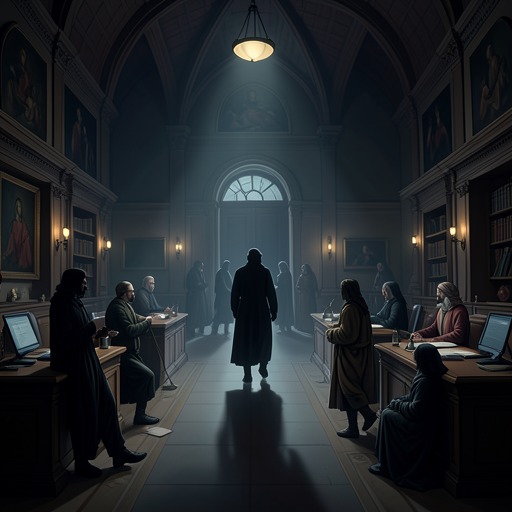
His work suits those limitations. He does no responsible or intellectually demanding business; instead, he remains at George’s elbow, interviews people George does not wish to see, runs errands, and makes himself useful. Bill performs these duties faithfully. When George is away, he stretches out in the largest chair and reads the sporting news, carrying on an office tradition rather than aspiring to authority. The account makes his status comic but not contemptible: he is not a strategist, yet his reliability is real.
Virginia Revel and unreturned devotion
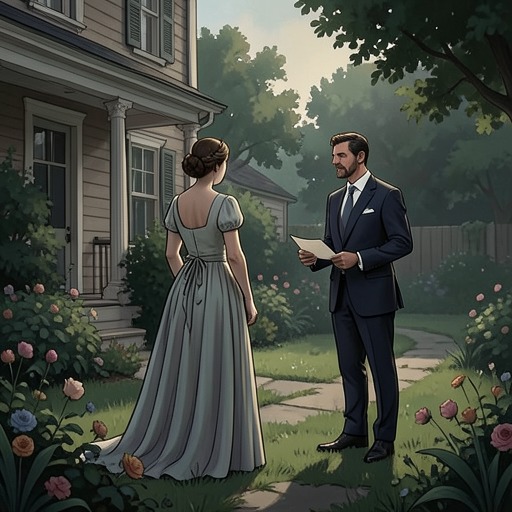
Bill’s closeness to Virginia is the most personal thread in his story. He visits her with a message from George, whom he irreverently calls “Codders,” and Virginia greets him with teasing familiarity. When Bill begins to press his feelings, she stops him: she will not have a declaration before lunch and jokingly asks him to think of her as a kindly, middle-aged maternal figure with his interests at heart. Bill persists in loving her, but the exchange makes clear that his attachment is not reciprocated as a romance.
That disparity colors his responses to Anthony Cade. Bill resents the “Colonial fellow” for monopolizing Virginia’s company and is relieved when Anthony leaves after the inquest. His jealousy is neither a serious obstacle to Virginia nor a well-grounded judgment of Anthony; it is an ordinary, self-interested feeling that becomes funny beside the international stakes around them. Bill’s romantic hopes also surface in his dream: he imagines rescuing Virginia from a burning building, only to become distracted by sandwiches, delayed by George’s telegrams, and thwarted on his way to a church wedding by missing clothes and an empty petrol tank. The dream turns his yearning into a miniature farce, complete with Virginia arriving on the arm of the Baron.
From errands to the council chamber
The practical inadequacy of Bill’s official work is clearest in the mistaken ship-arrival information that helps misdirect George’s preparations for James McGrath. George sends Bill to ask when the Granarth Castle is due; Bill’s indistinct pronunciation leads the clerk to understand another ship’s name, and George accepts the answer. The mistake reflects Bill’s carelessness neither as malice nor conspiracy: it grows from the gap between an errand-runner’s casual inquiry and the elaborate political plans built on its result.
At Chimneys, Bill’s habitual service becomes more burdensome. After the inquest, George’s fear of damaging publicity keeps Bill and Miss Oscar constantly occupied. Miss Oscar handles the useful and interesting work; Bill carries messages, decodes telegrams, and listens as George repeats himself. He ends the day exhausted and resentful that he has scarcely had a chance to speak with Virginia. This episode repeats the contrast at the heart of his character: Bill is an unfailing pair of hands, but the official machinery gives him little agency or recognition.
Yet Virginia’s appeal at night places him in a different role. She has heard a door and seen a light in the council chamber; after peering through the door, she decides she wants a strong man with her and wakes Bill. His importance here begins not with expertise but with the trust she places in his presence. When the group plans to conceal itself in the chamber because intruders may return, Bill supports the operation, although he tells Virginia that it is men’s work and tries to leave her out of it. His protectiveness carries both concern and the assumptions of his character: he wants to help, but also expects to decide who should take the risk.
During the confrontation, Bill’s sneeze gives away the concealed party. The sound is involuntary, checked as much as possible, but startling in the quiet room; the stranger turns, and Anthony immediately flashes his torch and tackles him. Bill then leans down to assist Anthony. The sequence makes Bill’s limitations and usefulness inseparable: he does not execute the capture, and his body betrays the ambush, but once the struggle begins he joins in rather than retreating.
Connections, revelations, and ending
Bill’s position gives him a route into the concealed affairs of the investigation. At a later gathering, he arrives with George and moves straight toward Bundle, asking anxiously whether Virginia has run away in the night or been kidnapped. His first concern is personal, and he suspects she might have gone with Anthony, whom he dislikes and has heard described as a possible master criminal. Bill’s assumptions reveal how little he knows of the larger design, even as his closeness to Virginia keeps him alert to changes in her movements.
Bundle tells him that Virginia left a note, and explains that Anthony has sent word he will return at nine that evening and has asked George to attend. Looking around at the assembled English and French detectives, Bill jokingly observes the gathering’s “strong foreign element” and notices the absence of an American representative. His comic inventory turns a room full of investigators and political actors into a social scene he can read through nationalities and familiar types. Bundle, meanwhile, senses that the gathering is close to the moment when “James, the footman” will be identified and everything explained; Bill is present as a witness to the approach of disclosure, not its source.
The explanation later given by Anthony connects Bill’s investigation to the mistaken-identity plot. Anthony says that he went to Dover and that Hiram Fish followed him, believing him to be King Victor; there they found a mysterious stranger imprisoned. The real man had been kidnapped while an impostor took his place. Bill is not credited with uncovering the deception, but his earlier work for George and his presence among the assembled company place him inside the official and social network through which the truth is finally made public.
At the close, Bill is not invited to the graveside ceremony. Instead, he appears at the telephone, pursuing a date with Dolly and insisting that he has never cared for anyone but her, while explaining that George has kept him working. His romantic attention has shifted from the unresponsive Virginia to another woman, but the form of his courtship remains recognizably Bill’s: earnest protest, anxious appeasement, and an attempt to secure supper and a show. As George concludes a speech on the lasting peace and prosperity of the British Empire, Bill’s private telephone conversation supplies a comic counter-scene to official rhetoric. He finishes where he has largely stood throughout: close to power’s bustle, excluded from its solemn ceremony, and preoccupied with affection and the next social engagement.