British Government
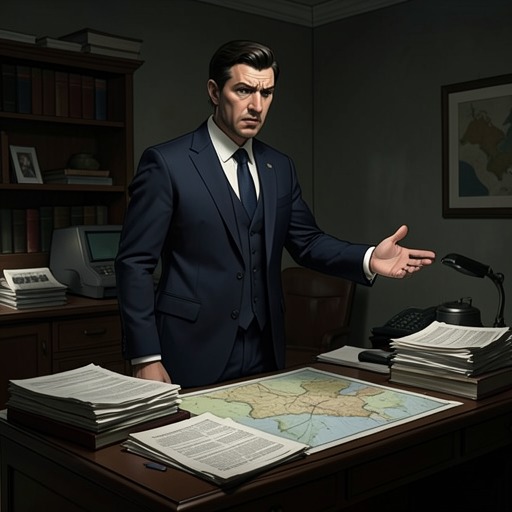
The Secret of ChimneysThe British Government is a political backer of restoring the monarchy in Herzoslovakia, supporting Prince Michael Obolovitch as a prospective ruler while British interests seek oil concessions. Its role links the country’s post-revolutionary succession crisis to a proposed financial bargain: a loan to put Prince Michael on the throne in return for concessions to Herman Isaacstein’s company. The memoirs of Count Stylptitch threaten to disrupt that arrangement, revealing how policy, finance, and the management of political scandal converge around the restoration plan.
Restoration and British Interests
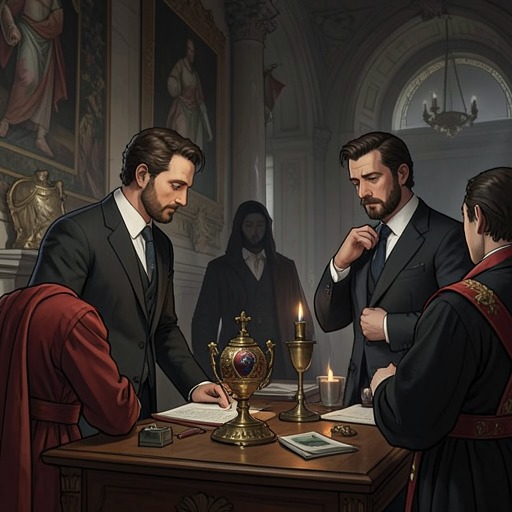
George Lomax presents the oil concessions as a matter of national importance, insisting that they should go to a British company. He says Prince Michael is due to arrive at Chimneys and that the arrangement can be completed there under the appearance of a shooting party. The private estate is thus to serve as the setting for a political and commercial negotiation concealed within a social event.
The Government’s support is also described as encouragement for Prince Michael’s claim. According to Lomax, people in Herzoslovakia wish to restore the monarchy and are prepared to offer him the crown. The plan combines that domestic prospect with British diplomatic backing and an investment arrangement: Isaacstein’s company would lend about a million pounds to help place Prince Michael on the throne, and the oil concessions would form the return. The evidence establishes these as connected aims, though it does not detail the Government’s internal deliberations or formal mechanisms of approval.
The Memoirs as a Political Threat
The proposed restoration takes place against the history of the revolution that overthrew the monarchy and established a republic. Anthony Cade recounts that public discontent followed the elevation of Queen Varaga, whose claimed royal ancestry was fabricated, and that an uprising killed the King and Queen before proclaiming a republic. In that setting, Count Stylptitch’s memoirs carry consequences beyond their appeal as scandalous reminiscences: their publication could unsettle the current effort to restore a royal government.
Lomax argues that publication at this particular moment might ruin the restoration project. The danger is therefore one of timing and political exposure: a manuscript due to be delivered to a London publisher by October 13 could become public while British support for Prince Michael and the concessions negotiations were in progress. The novel presents the Government’s position through Lomax’s urgent defense of discretion, without establishing the full contents of the memoirs or specifying exactly what they would reveal about British policy.
Policy, Succession, and Uncertainty
The Government’s preferred candidate is not the only possible claimant. After Prince Michael’s murder, Lomax reluctantly identifies Prince Nicholas as the probable next heir; Superintendent Battle confirms that Nicholas is Michael’s first cousin and says he is believed to have been in the United States, raising money on his expectations. This succession information makes the political project vulnerable to a sudden change in circumstances, even before the identity of the claimant is settled.
The final negotiations expose that vulnerability in financial terms. When Anthony Cade asks Herman Isaacstein whether he will offer Prince Nicholas the same loan on the same terms as Prince Michael, Isaacstein questions whether Nicholas can be produced, believing him to have been killed in the Congo. Cade explains that the death report was his own fabrication and reveals himself as Nicholas, under his full name, Nicholas Sergius Alexander Ferdinand Obolovitch. The episode shows how the restoration scheme depends not only on official support and capital but also on uncertain knowledge of the heir’s identity and survival. It does not establish a subsequent governmental response or confirm that the proposed restoration and concessions were carried out.