Dofu
The Secret of ChimneysDover is the setting of a decisive turn in Anthony Cade’s investigation: a suspicious address leads him to Hurstmere, where Mr Hiram Fish intercepts him, and the events there eventually help expose the pattern of impersonation surrounding King Victor. The town is more than a destination. Its isolated house and the abandoned headquarters discovered there give Anthony and Fish a place to test their suspicions and disrupt the conspirators’ plans.
Setting and approach
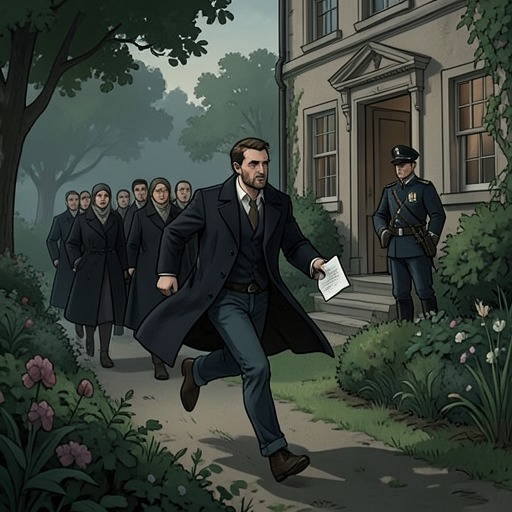
After reaching Victoria Station, Anthony misses the next train to Dover and waits for more than an hour. The journey itself passes without incident. On arrival, he first leaves the station, then turns back as if remembering something and asks for directions to Hurstmere, Langly Road. His slight smile gives way to a furrowed brow as he walks: the prospect of danger, rather than deterring him, seems to renew his energy.
Hurstmere stands at the end of the road, set back within untended grounds. Its rusted iron gate and partly obliterated name suggest a house that has been empty for years. Anthony considers the location lonely and suitable for his purpose. After checking that the road is deserted, he slips through the gate and proceeds quietly up the drive. The apparently neglected property provides the secluded setting for what he expects to find there.
Fish at Hurstmere
Anthony does not reach the house unchallenged. A sharp order stops him at the doorway, where Mr Hiram Fish is waiting with a large blue automatic. Fish explains that he caught the same train from Victoria. The encounter reveals that Anthony has been followed, while the weapon and the isolated setting immediately turn the inquiry into a confrontation.
The later account at Chimneys clarifies why the journey mattered. Fish had followed Anthony under the impression that Anthony was King Victor. At Dover the two men found a mysterious stranger imprisoned in the house; hearing the stranger’s story showed them that the same pattern had been repeated: the real person had been kidnapped and an impostor had taken his place. Dover thus supplies the crucial experience that lets Anthony and Fish connect the apparent deception at Hurstmere with the wider succession of false identities.
A clue that draws Anthony back
Dover also figures in the suspicions aired by the French detective at Chimneys. He says he found a scrap of paper bearing the address of a house in Dover, then saw Boris pick it up and take it to his master. The detective regarded Boris’s apparent connection with the Comrades of the Red Hand, and his attachment to Anthony, as grounds for suspicion. Anthony’s own arrival in Dover after leaving Chimneys seemed to support the detective’s theory that the gang’s headquarters had been exposed.
The detective’s deductions prove misleading. Anthony had gone to Dover, but his presence there did not establish that he was King Victor or that he was directing the Comrades. In retrospect, the address functions as an ambiguous clue: it points investigators toward the conspirators’ location while also helping produce a mistaken accusation against Anthony.
The abandoned headquarters and its consequences
The French detective reports that the house in Dover had been occupied by a group of foreigners until the previous afternoon, but had been abandoned by the time inquiries reached it. He interprets the sudden evacuation, following Anthony’s departure from Chimneys, as proof that Anthony had warned the gang. The subsequent explanation at the house offers a different account of the connection: Anthony and Fish established martial law there and prevented the Comrades from communicating with the false M. Lemoine. The impostor sent the group an order to leave, and word reached him that they had complied.
Dover therefore serves both as a hideout and as a temporary centre of counteraction. The Comrades’ departure leaves the false M. Lemoine without the communication he needs, while Anthony and Fish’s cooperation helps clarify the identity deception. The town’s role in the plot rests on this contrast: a deserted house that first appears to conceal the enemy becomes the place from which their links are interrupted. By the time the mystery is explained at Chimneys, Dover has supplied both the evidence of a kidnapped captive and the practical means to frustrate the conspiracy.