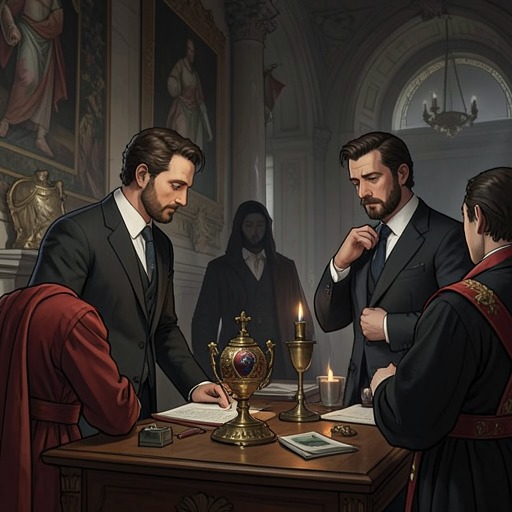
George Lomax
The Secret of ChimneysGeorge Lomax is a senior political figure whose effort to secure British interests in Herzoslovakia makes Chimneys the setting for negotiations, intrigue, and a succession crisis. A robust, imposing man with an immense sense of his own importance, he speaks in the language of national delicacy and public duty; the plot repeatedly exposes the gap between his confidence in managing events and his limited command of the people involved.
Identity and Political Purpose
Lomax is described as inclined to embonpoint, red-faced, and protuberant-eyed, with a powerful sense of his own importance. His physical presence and emphatic manner accompany a political style built on urgency: he presents the Herzoslovakian question as a matter on which the government cannot afford a mistake, and expects others to accept his framing.
His immediate objective is to secure oil concessions for a British company while supporting the restoration of the monarchy. He explains to Lord Caterham that one slip in the Herzoslovakian business would be disastrous and that the concessions must go to a British company. The arrival of Prince Michael Obolovitch is to provide the occasion for carrying the arrangement through at Chimneys, disguised as a shooting party. The country house is therefore not merely a social setting: Lomax treats it as a private venue in which sensitive political business can be conducted beyond public scrutiny.
Memoirs, Secrecy, and Virginia
Lomax fears that Count Stylptitch’s memoirs could ruin the political project if published at the wrong moment. His concern is not that readers will ignore them; he expects the memoirs to be read eagerly. The danger, as he sees it, is their publication during an attempt to restore the monarchy and offer the crown to Prince Michael, who has the support of the British government. His repeated insistence on delicacy makes political stability and control of damaging information inseparable.
He tries to enlist Virginia Revel in dealing with Anthony Cade, whom he understands to be James McGrath, and expects her to make herself agreeable to him and somehow obtain the memoirs. Virginia sees through the euphemisms: Lomax has wrapped his request in talk about English gentlewomen, but she recognizes that he wants her to extract the manuscript. She also challenges his claim that restoring the monarchy is essential to European peace, treating that rationale as empty while expressing her own preference for monarchy. Lomax had imagined her as a docile instrument who would accept hints without asking questions; her curiosity and independence make him recognize that his choice of intermediary may cause trouble.
The Financial Bargain and Its Risks
The arrangement at the heart of Lomax’s policy links political support to financial interest. Prince Michael was at Chimneys to meet Herman Isaacstein, and a loan was to be arranged on terms that had not yet been finalized. In return, if he came to the throne, Prince Michael pledged oil concessions to companies in which Isaacstein was interested. Lomax’s government was prepared to support Michael’s claim because of his pronounced British sympathies. The proposed restoration is thus presented not as an abstract constitutional preference but as a practical alliance joining a claimant, British policy, a financier, and future access to oil.
Lomax’s approval of Isaacstein is perfunctory, even as Superintendent Battle calls the financier a powerful personality. That brief exchange captures the political atmosphere around the deal: men with very different forms of influence are gathered in the same crisis, while Lomax continues to speak as if he can direct its course. His confidence is also shadowed by an earlier scandal. When Battle alludes to the Koh-i-Noor, Lomax reacts at once, urging discretion and asking that it be referred to only as “the K.” His alarm suggests how readily a political gathering can be unsettled by a concealed history, and how secrecy itself becomes part of his governing method.
Authority Challenged
Lomax’s manner becomes especially revealing when the mystery turns toward Anthony Cade. He objects that the case is “very fishy,” declares that nothing is known about Cade, and questions whether Battle has investigated him. Battle answers that inquiries sent to South Africa confirm Cade’s account: he had been in Bulawayo with McGrath and had previously worked for a tourist agent. Lomax’s suspicion reflects his habit of treating an unfamiliar person as a threat to be assessed, but the investigation does not support his insinuation.
When Cade is about to address the assembled party, Lomax protests that he has no standing and calls the situation irregular and difficult. Battle quietly speaks to him, and Lomax yields, albeit grudgingly, agreeing that everyone should listen. The episode reduces his long-winded authority to a voice that can be stopped by a brief private intervention. He remains influential enough to object, but not powerful enough to determine what the others hear.
Revelation and Political Recalibration
At the final gathering, Lomax is again bewildered when the Baron denies knowing a woman whom Lomax expects him to recognize. The Baron takes him aside and murmurs an explanation; Lomax’s face turns purple as he listens, and his response is a string of assurances that there is no need to complicate the situation and that discretion will be observed. The scene shows him adapting rapidly once new information reaches him, even if he cannot control the revelation itself.
Anthony then makes the political consequence explicit. He will not ask the British Foreign Office to support his claim without the most convincing documentary evidence, and proposes that he, the Baron, Isaacstein, and Lomax discuss the terms of the proposed loan. The Baron solemnly welcomes the prospect of seeing Anthony as King of Herzoslovakia. Lomax, whose plans had centered on Prince Michael and British-backed restoration, must now confront a different claimant and a negotiation reorganized around proof and finance. His role shifts from architect of the arrangement to one of the officials required to respond to a claim he did not anticipate.
The closing image returns Lomax to the public rhetoric with which he began: his peroration reaches its promised “lasting peace and prosperity of the British Empire.” The grand conclusion sits beside the week’s disorder and the private calculations that have shaped it. Lomax remains a practiced political speaker, but the events at Chimneys demonstrate that polished declarations cannot guarantee control over secret histories, competing claims, or the people he assumes will act as his instruments.