Giuseppe Manelli
The Secret of ChimneysGiuseppe Manelli is a skilled Italian waiter whose attempted theft, blackmail, and murder connect Anthony Cade’s entanglement with Virginia Revel to the political conspiracy unfolding at Chimneys. First glimpsed creeping toward a manuscript parcel, he later attacks Cade with a knife, blackmails Virginia with stolen letters, and is found shot near Staines; the subsequent reconstruction makes him a hired thief caught between the Comrades of the Red Hand and King Victor.
Identity and Introduction
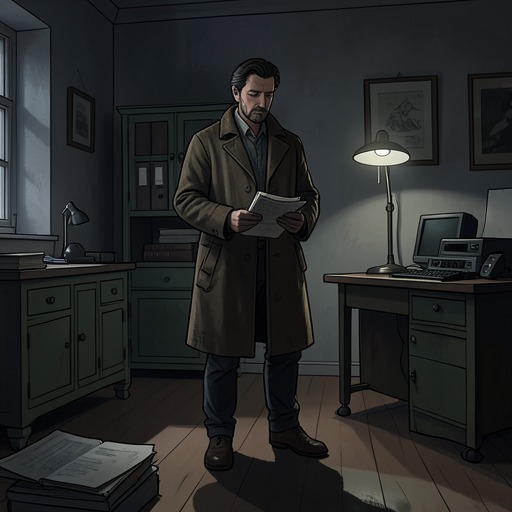
Manelli enters the story under the ordinary cover of hotel employment. When a waiter brings Cade a meal, Cade sees in a mirror that the man’s attention is fixed on a manuscript parcel. The waiter watches Cade’s back, circles the table softly, and fidgets with dry lips; Cade judges him Italian rather than French. When Cade turns abruptly, the man pretends to be occupied with the saltcellar. The scene establishes the contrast on which Manelli’s role depends: a familiar servant’s access conceals an alertness to valuable papers.
A hotel manager later supplies a work history. Manelli had joined the establishment about three months earlier, was considered skilled and experienced, and had been in England for roughly five years. He had worked at several hotels and restaurants. At two of those workplaces, serious robberies took place during his employment, though no suspicion had attached to him at the time. Cade recognizes the pattern as significant, but the information does not by itself establish that Manelli committed those earlier thefts.
The Attack on Cade
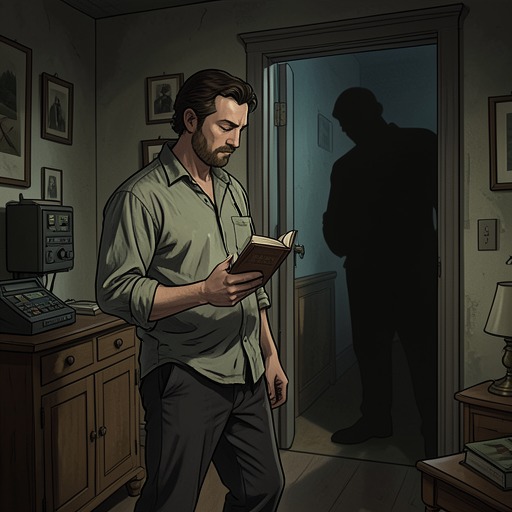
Manelli’s interest in the manuscript develops into a nighttime attack. About four hours after Cade has gone to bed, he wakes and sees a dark figure crouched by his suitcase. When Cade switches on the light, the intruder springs up: it is Manelli, holding a long, thin knife. Cade is unarmed, while Manelli appears practiced with his weapon.
The two struggle on the floor. Cade concentrates on restraining Manelli’s knife hand, slowly bending the arm back as Manelli grips his throat with his other hand. The knife drops with a sharp tinkle, but Manelli twists free. Cade moves toward the door to block his escape and realizes too late that the chair and water bottle are no longer where he had arranged them. The attempt exposes Manelli as more than a suspicious servant: he is prepared to use lethal force to get at the contents of Cade’s luggage.
Theft, Blackmail, and Death
Manelli also acquires Virginia’s letters and tries to profit from them by blackmail. When Cade and Virginia confront the situation after finding his body, Cade identifies the dead man as an Italian, probably a waiter by profession, who had pursued blackmail on the side. He cautiously suggests that the name may be Giuseppe. Virginia has recognized the body as Italian, but Cade’s identification gives the discovery a link to his earlier encounter with the waiter.
Cade’s examination of the body complicates the apparent solution: Manelli has been stripped of everything. His pockets are empty, and a hole in the lining shows that something was roughly torn away, leaving behind only a scrap of paper. The surviving fragment reads, “Chimneys 11.45 Thursday,” and appears to indicate an appointment. It does not identify who removed the missing material or explain the appointment, but it turns the body into a clue pointing back toward Chimneys.
The murder places Cade in peril as well as Manelli. Within twenty-four hours, Cade has become involved in two separate crimes: he has deliberately disposed of one body, frustrating justice, and then arrived at the scene of a second crime at the moment it was being committed. He decides to tell the truth with one alteration and one grave suppression. His selective account, and the evidence left behind by Manelli, make the waiter’s death part of the inquiry into the shooting at Chimneys rather than an isolated killing.
The Investigation and Manelli’s Network
The body is identified as Manelli’s after it has been found shot near Staines. Battle reports that Manelli worked as a waiter at the Blitz Hotel in London. The identification confirms that the dead man and the suspicious waiter Cade had encountered are the same person, joining Cade’s earlier attack to the later murder investigation.
Battle’s explanation remains a theory, but it supplies the clearest account of Manelli’s place in the conspiracy. He believes Manelli was a habitual thief recruited by either King Victor or the Comrades of the Red Hand to steal the memoirs. Manelli instead obtained Virginia’s letters. At first frustrated, he saw an opportunity to blackmail her, apparently without understanding the letters’ real significance. Battle suggests that the Comrades learned what he was doing, took it as a deliberate double-cross, and ordered his death; the group, he says, treats suspected traitors with conspicuous severity.
The evidence does not make the murder’s authorship equally clear. Battle finds the revolver engraved with Virginia’s name too elaborate for the Comrades, whose characteristic practice is to leave the Red Hand mark to terrorize others. He suspects King Victor may have intervened, perhaps in a deliberate attempt to implicate Virginia, but admits he cannot identify the motive. Manelli’s death therefore reveals the limits of the investigation as well as its connections: the account of his recruitment and execution is a reasoned reconstruction, while the precise division of responsibility remains uncertain.
Narrative Role and Aftermath
Manelli is a junction between distinct information networks. His hotel work gives him access to rooms and guests; his apparent interest in Cade’s manuscript draws him into the struggle over the memoirs; his possession of Virginia’s letters creates a private blackmail scheme; and his reported dealings with the Comrades or King Victor place him within a political plot. These roles do not make him a mastermind. Rather, his attempt to turn stolen information into private profit seems to put him at odds with the organization that may have hired him.
His story is shaped by reversals of appearance and knowledge. A competent waiter becomes a knife-wielding intruder; a would-be thief becomes a blackmailer; and a body stripped of its belongings leaves behind only a fragment that points toward another concealed affair. The letters’ significance is greater than Manelli appears to understand, while the empty pockets and torn lining suggest that someone else has removed evidence. His death thus does not close the case: it deepens it, leaving Cade and Battle to distinguish what Manelli did from what others may have done through or against him.