Herzoslovakian succession crisis
The Secret of ChimneysThe Herzoslovakian succession crisis is the struggle over who can claim the throne after Prince Michael’s death, and whether a royal restoration can proceed on the political and financial arrangements made for him. Its decisive reversal comes when Anthony Cade reveals that he is Prince Nicholas: the heir presumed dead is alive, and the apparent outsider at the centre of the investigation becomes the possible monarch around whom the negotiations can be reorganized.
Historical and Political Background
The crisis belongs to a country still shaped by the overthrow of its monarchy. King Nicholas IV married Queen Varaga, a woman whose supposed royal descent was fabricated; popular discontent and unrest culminated in an uprising that killed the king and queen and proclaimed a republic. Anthony recounts that the republic had remained in place, though political violence continued. This history makes the proposed restoration more than a routine change of ruler: the legitimacy of a returning dynasty is already a contested question.
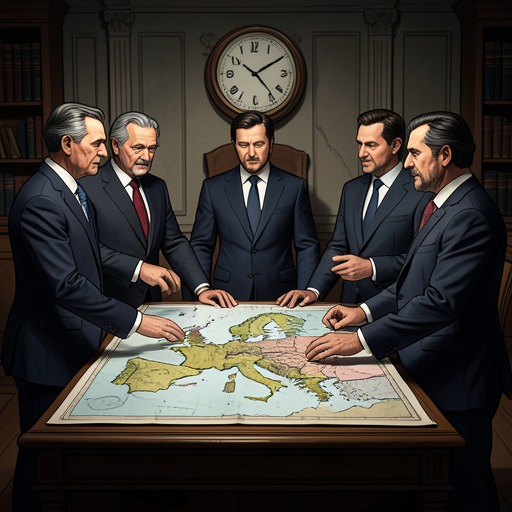
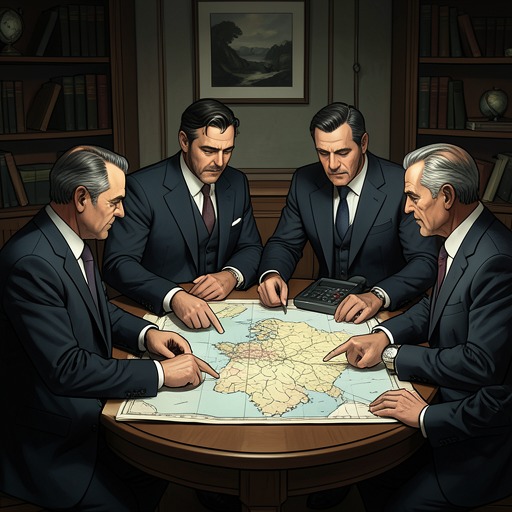
The memoirs of Count Stylptitch threaten to complicate the restoration. Count Stylptitch, a committed monarchist who had settled in Paris after King Nicholas’s assassination, entrusted his manuscript for delivery to London by October 13. George Lomax warns Lord Caterham that publication could ruin the restoration effort. The plan under discussion is to offer the crown to Prince Michael, who has the support of the British government, in exchange for concessions to Isaacstein and Company in return for a loan of roughly a million pounds. The manuscript’s possible disclosures therefore meet an alliance already dependent on secrecy, foreign backing, and a substantial financial bargain.
The Succession After Prince Michael
Prince Michael’s death removes the intended beneficiary of that bargain and makes the identity of his successor an immediate political question. When Battle asks who stands next in line, Lomax says that Prince Nicholas would probably be the heir. Battle identifies Nicholas as Prince Nicholas Obolovitch, Michael’s first cousin; he has been believed to be in the United States, where he had been raising money on the expectation of his eventual position.
The change in circumstances places Lomax and Isaacstein in a difficult position. Battle tells them that they, together with the Herzoslovakian Loyalist Party, are in serious trouble. The planned loan and political support had been discussed in connection with Michael, not a successor whose whereabouts and continued existence were uncertain. Nicholas’s presumed absence is thus both an obstacle to the succession and a fact that leaves the restoration’s participants negotiating without the very claimant now required to replace Michael.
Nicholas’s Return as Anthony Cade
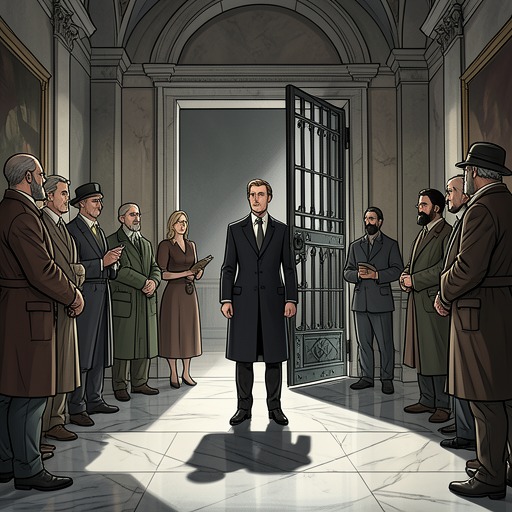
The final disclosure overturns that uncertainty. When Isaacstein asks whether the same loan can be offered to Michael’s cousin on the same terms, he doubts that Nicholas can be produced and refers to the report that he was killed in the Congo. Anthony answers that the report was true only in the sense that he had spread it: he had made the world believe Nicholas was dead. He identifies himself by his full royal name, Nicholas Sergius Alexander Ferdinand Obolovitch, and explains that he left the Congo as Anthony Cade because the royal name was too long for the life he meant to lead.
The revelation reconnects the succession plot to Anthony’s earlier commission. A manuscript sent secretly from Paris had been addressed to James McGrath, a Canadian in Africa; Anthony had received it after travelling widely. At the end of the affair, that apparently practical chain of errands and entrusted documents converges with the political question of the throne. Anthony is not simply a person who can be found and installed: the heir has been moving through the investigation under another identity, while the people debating his absence have been speaking in his presence.
Restoration, Proof, and Negotiation
Anthony does not ask the British Foreign Office to support his claim on assertion alone. He tells Lomax that he will provide convincing documentary evidence, then proposes that he, the Baron, and Isaacstein discuss the terms of the loan. The scene turns revelation into negotiation: ancestry establishes the possible claimant, but documentary proof and the terms of financing remain necessary to translate that identity into political action.
The Baron welcomes the prospect of seeing Anthony as king, making clear that the restoration has supporters beyond the financial and governmental participants. Anthony immediately adds that there is a condition: he is married. The disclosure introduces a personal fact into the same negotiations that have treated succession as a matter of inheritance, foreign policy, and capital. It also prevents the proposed settlement from being understood as a simple replacement of Michael by an otherwise unencumbered claimant.
Significance
The crisis is driven by the collision of three forms of political credibility: dynastic succession, documentary evidence, and practical support. Michael’s death disrupts a plan founded on his claim; the succession rule redirects attention to Nicholas; and the assumption that Nicholas is dead makes the next heir seem unavailable until Anthony reveals his identity. Meanwhile, the proposed restoration remains entangled with British backing, the Loyalist Party, Isaacstein’s loan, and Count Stylptitch’s potentially damaging memoirs.
The reversal also exposes how much of the political story has depended on appearances. Nicholas’s reported death concealed a deliberate change of identity, while the supposedly incidental Anthony Cade was the person whose royal claim could alter the negotiations. The resolution presented here is therefore not merely the discovery of an heir: it is the reappearance of a claimant able to demand proof, reopen the financial bargain, and make his own terms before any restoration can be settled.