Isaacstein's British Syndicate
The Secret of ChimneysIsaacstein's British Syndicate is the financial group represented by Herman Isaacstein in negotiations over a possible restoration of the monarchy in Herzoslovakia. Its central bargain links a substantial loan to oil concessions, making the syndicate an important private participant in a political project supported by the British Government. The death of Prince Michael and the question of who could succeed him expose how closely the arrangement depends on the kingdom’s contested dynastic future.
Identity and Representation
The syndicate is introduced through Isaacstein, whom George Lomax identifies as its representative. Lomax describes it as the all-British syndicate, while the negotiations also refer to the business as Isaacstein and Co. These labels present the group as an organized British financial interest rather than a personal arrangement made by Isaacstein alone; the evidence, however, does not specify its internal structure or name its other members.
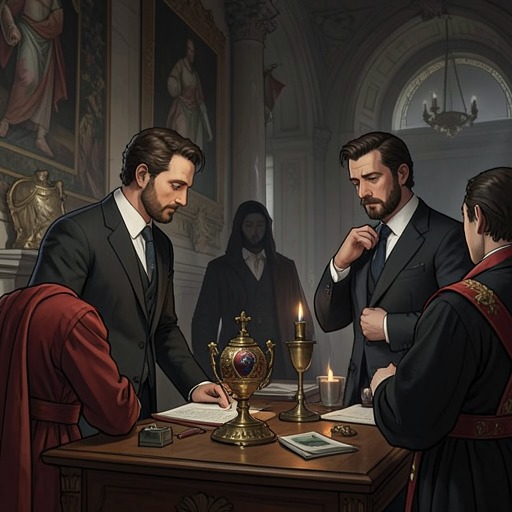
Isaacstein’s position gives him a place at the meeting between Prince Michael and British political representatives. When the proposed participants are listed, Isaacstein is included alongside the prince and his party, as well as Bill Eversleigh. His presence reflects the practical importance of private finance to the proposed restoration: dynastic claims and government support are not sufficient on their own if the candidate for the throne also needs a major loan.
The Loan-for-Concessions Proposal
The syndicate’s prospective return is access to oil concessions. Prince Michael was in Britain to meet Isaacstein for the express purpose of arranging a loan, but the precise terms had not yet been settled. The known outline was conditional: if Prince Michael came to the throne, he pledged to grant concessions to oil companies in which Isaacstein was interested.
The proposed loan was described as being of about a million, intended to help set Prince Michael on the throne. The sum is presented as a broad estimate, not as a finalized figure, and the concession terms were likewise still under discussion. The arrangement therefore joined an immediate financial commitment to a future political outcome: the syndicate would advance capital in anticipation of influence over oil resources if the royal restoration succeeded.
That exchange also places the syndicate within a wider contest for economic advantage. Battle observes that Prince Michael wanted money and Isaacstein wanted oil, while an American group of financiers had also made overtures to the prince. The British group was consequently not the only potential source of finance, and its access to the concessions was not described as already secured. The negotiations were a bid for a future benefit, dependent on both Prince Michael’s accession and agreement on terms.
Political Context and Exposure
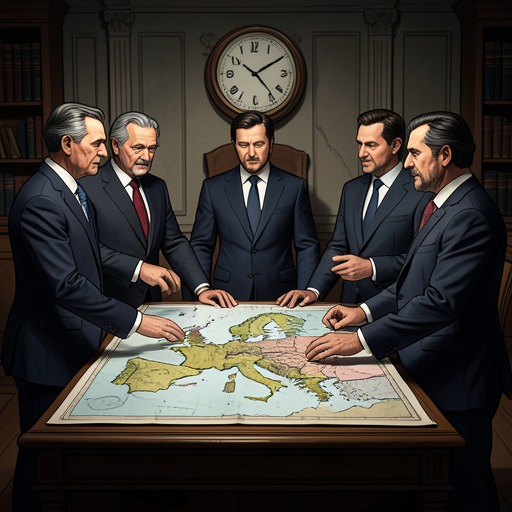
The financial negotiations formed part of a broader plan to restore the monarchy. George Lomax explains that supporters in Herzoslovakia wished to restore the crown and were prepared to offer it to Prince Michael, who had the support and encouragement of the British Government. The syndicate’s loan proposal was connected to this political backing, but the evidence distinguishes the interests involved: the government supported Prince Michael’s claim, while Isaacstein’s group sought commercial concessions in return for financing.
The publication of Count Stylptitch’s memoirs threatened to unsettle the restoration project. Lomax feared that revelations about the Obolovitch family’s rule could prompt public criticism, parliamentary questions, and resistance to replacing the republic with what opponents might portray as an obsolete tyranny serving capitalists. For the syndicate, this made political legitimacy more than a matter of ceremony. The loan-for-oil arrangement required a restoration capable of surviving controversy; a public dispute over the royal family and the motives behind restoring it could imperil the political conditions on which the expected concessions rested.
The syndicate is thus drawn into a succession crisis as well as a financial negotiation. When Battle asks who would be next in line after the loss of a king, Isaacstein acknowledges that the situation is a very large deal, and Lomax identifies Prince Nicholas as the probable heir. Later, after Prince Michael’s death, Battle confirms that Nicholas is his first cousin and the next heir. The succession question matters directly to the prospective investors because the original arrangement was made with Prince Michael, whose accession was supposed to unlock the promised concessions.
Prince Michael’s Death and the Unresolved Arrangement
Prince Michael’s murder changes the question from how to finance his accession to whether the same proposal could be transferred to his successor. The evidence does not establish that the syndicate completed the loan or received any concessions. Instead, the offer’s dependence on a particular claimant becomes explicit when Anthony asks Isaacstein whether he is prepared to offer the same loan on the same terms to Prince Michael’s cousin Nicholas.
Isaacstein initially questions whether Nicholas can be produced, believing he was killed in the Congo. Anthony then reveals that he is Nicholas: he had spread the report of his own death and had lived under the name Anthony Cade. This disclosure supplies a possible successor after Prince Michael’s death, but it does not itself establish the syndicate’s final decision, a completed loan, or the award of oil rights. The prospective financial arrangement remains a proposal whose political premise has changed.
Significance
The syndicate’s role makes the proposed restoration legible as a convergence of dynastic ambition, government policy, and commercial expectation. Its participation is neither identical to the British Government’s support nor independent of it: the government backs Prince Michael’s claim, while the syndicate is positioned to lend money in return for oil concessions. That distinction gives the negotiations their political tension, since a restoration can be presented both as a change in government and as an opportunity for private capital.
The shifting succession also reveals the fragility of a deal framed around future rewards. Prince Michael’s death removes the original prospective beneficiary and leaves the plan dependent on Nicholas, a claimant widely believed dead. The syndicate’s expected return is therefore unsettled at the very moment the political need for a successor becomes most urgent. In the evidence available, Isaacstein’s British Syndicate is defined less by a completed commercial outcome than by this exposed bargain: money is promised toward a throne, and access to oil depends on who can claim it and whether the restoration can endure.