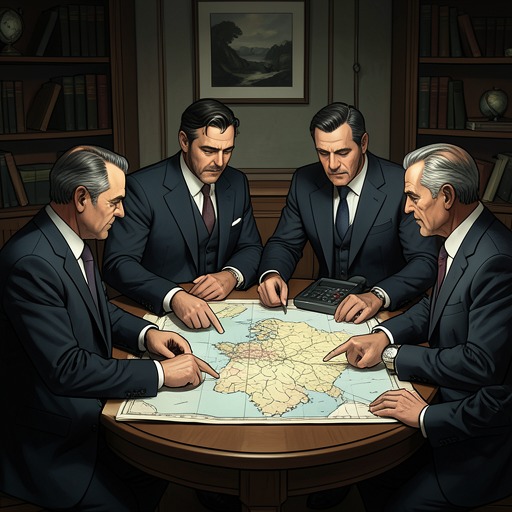
King Victor’s impersonation of Prince Nicholas in America
The Secret of ChimneysKing Victor’s impersonation of Prince Nicholas in the United States is a major fraud built on a convenient royal disappearance: King Victor revived the identity of a prince long presumed dead, used it to attract American investment in supposed oil concessions, and escaped with a tremendous haul before exposure drove him back to England. The scheme links the financial plot surrounding Herzoslovakia to the danger gathering at Chimneys, where King Victor may have been present during two crucial nights.
The Fugitive Behind the Impersonation
The account emerges during a conversation between Anthony Cade and the French detective M. Lemoine. Anthony asks whether King Victor is in England, noting that he had been released from prison a few months earlier and asking whether the French authorities had kept track of him. M. Lemoine admits that they tried, but King Victor immediately gave them the slip. The authorities expected him to head straight for England; instead, he went to the United States.
This unexpected destination changes the meaning of King Victor’s return to the English setting. His American venture was not a brief detour but an elaborate disguise conducted under a name that would command attention and trust. After his exposure, he had to leave the country hurriedly, and only then did he come to England, where M. Lemoine expects him eventually to appear at Chimneys—if he has not already arrived.
A Royal Identity Built on a Reported Death
King Victor chose to impersonate Prince Nicholas of Herzoslovakia, whose death in the Congo had been rumored years earlier. The rumor offered a practical opening: as M. Lemoine explains, a death in the Congo was difficult to prove. King Victor seized on that uncertainty and presented the absent prince as alive again, making a doubtful report of death the foundation of a new public identity.
The choice was effective precisely because the real Prince Nicholas was thought to be beyond verification. King Victor did not simply borrow a prestigious title; he supplied an apparent answer to an unresolved disappearance. The supposed resurrection gave the imposture a story that could support a claim to royal identity, while the distance and uncertainty surrounding the Congo made the original story difficult to disprove.
The American Confidence Scheme
Under the name of Prince Nicholas, King Victor persuaded American financiers to provide a tremendous sum of money on the strength of supposed oil concessions. His performance converted royal status into financial leverage: investors were not merely asked to back an uncertain commercial prospect, but were led to believe that the opportunity came through a Herzoslovakian prince. The account identifies the supposed concessions as the basis on which King Victor obtained his haul, though it supplies no further details about the investors or the arrangement.
The impersonation ended when King Victor was unmasked by a mere accident. The sudden exposure forced him to abandon the American operation and leave the country in haste. Thus the same uncertainty that enabled the fraud—whether Prince Nicholas had truly died—could not protect it indefinitely. A chance disclosure punctured the identity King Victor had constructed and sent him back into flight.
The Fraud's Consequences at Chimneys
M. Lemoine’s revelation astonishes both Anthony and Superintendent Battle. Anthony’s matchbox falls from his hand as he absorbs the news, and Battle is equally amazed. Their reactions register the scale of the reversal: a prince believed dead had been impersonated for profit by a fugitive who had slipped the French authorities and crossed into the American financial world under a royal name.
The information also sharpens the suspicion surrounding the recent events at Chimneys. M. Lemoine says he thinks King Victor was there on the night Prince Michael died and again the previous night. These are suspicions, not a confirmed account of King Victor’s actions at the house, but they make his American fraud immediately relevant to the unfolding investigation. The imposture explains why the French detective has come to England and turns King Victor’s supposed escape into a possible presence at the center of the current danger.
Identity as an Instrument of Power
The scheme depends on the gap between a name and the person entitled to use it. Prince Nicholas’s rumored death leaves an identity available for appropriation; King Victor turns that absence into both a political disguise and a means of extracting money. His false royal persona succeeds because it joins a plausible history to a profitable promise, then collapses when the disguise is accidentally exposed.
The episode also makes a sharp structural turn: a fugitive expected to travel to England first reappears in America as a supposedly resurrected prince. That detour enlarges the story beyond the immediate mystery at Chimneys, connecting royal succession, oil concessions, financial confidence, and mistaken identity. King Victor’s impersonation is therefore more than an isolated swindle; it is the disclosure that an apparent claimant can be manufactured from rumor, and that the consequences of such a performance follow him across borders.