Lady Eileen Brent
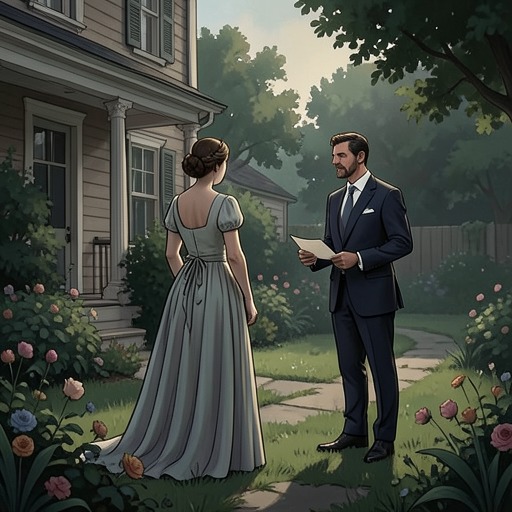
The Secret of ChimneysLady Eileen Brent, commonly called Bundle, is Lord Caterham’s eldest daughter, presented as tall, slim, dark, and determined. Her role is not confined to the household’s comic interruptions: she makes a practical contribution to the investigation at Chimneys, voices the central questions of motive and responsibility, and is included in the circle that must be told the truth about the case’s political stakes.
Identity and Introduction
Bundle is introduced as a young woman with an attractive, boyish face and a notably determined manner. She addresses her father directly, and her abrupt announcement that she has “got him” briefly makes the inspector think she has captured the murderer. The misunderstanding is quickly cleared up, but it establishes her brisk, purposeful presence in a house where the investigation has made its occupants wary.
George Lomax considers Bundle unsuitable for the diplomatic gathering he is arranging, dismissing her as a “red-hot Socialist” who would laugh at the idea. His judgment marks her out as politically irreverent rather than socially compliant; it also contrasts with his preference for Virginia Revel, whom he regards as possessing the poise and worldly experience the occasion requires. The distinction is Lomax’s, not a full account of Bundle’s politics, but it shows how others classify her before she has acted.
Practical Role in the Investigation
At the murder scene, the inspector notices footprints outside a window but no corresponding tracks on the parquet floor inside. Bundle supplies an ordinary explanation: a housemaid had polished only half the floor, entered in the dark, drawn the curtains, and started cleaning without seeing the body, which was concealed from her by a table. She explains that the maid discovered it only when she came close. The account resolves the apparent gap in the physical evidence through the sequence of the maid’s movements and the room’s layout.
The moment gives Bundle a specific investigative function. Rather than offering a dramatic theory, she notices how routine domestic work can account for a detail that otherwise appears suspicious. Her contribution helps the inspector make sense of the scene, while demonstrating that she observes the household closely enough to connect its everyday activity with the evidence.
Questions, Relationships, and Political Secrecy
After the murder, Bundle asks who killed the victim and why. Lord Caterham would rather leave both questions to the police and even says he hopes the blame will fall on Isaacstein. Bundle’s questions resist that easy withdrawal: she is interested not only in identifying the killer but also in understanding the motive. The exchange places her curiosity beside her father’s desire to avoid involvement.
Later, during a conversation about the concealed political business, Battle argues that Cade has a right to know because he has been drawn into the affair, and that Eversleigh may also be told because he is Lomax’s secretary. Virginia points out the familiar accusation that women are indiscreet. The passage frames the limits imposed on who may receive information; it does not establish that Bundle is present for this exchange, but it clarifies the broader pattern of secrecy around the household and its political visitors.
Connections to the Wider Plot
The investigation connects Chimneys to the memoirs of Count Stylptitch. The memoirs had been secretly sent to James McGrath, a Canadian then in Africa, who was due to arrive the following day. This is part of the wider context in which Bundle’s household becomes entangled, though the evidence does not show her managing the memoirs or taking part in their transfer.
The political consequences become explicit when Battle tells Lomax and Isaacstein that they, along with the Herzoslovakian Loyalist Party, are “in the soup.” That warning shows why the murder investigation cannot be separated from political interests. Bundle’s recorded contribution remains more limited and concrete: she helps explain evidence, asks questions about the crime, and belongs to the household through which the larger affair unfolds.
Narrative Function
Bundle’s scenes set practical observation and direct questioning against the secrecy and social maneuvering surrounding Chimneys. Her explanation of the footprints turns a potentially puzzling detail into a domestic sequence, while her question about who killed the victim and why gives the investigation its plainest formulation. The evidence supports a portrait of her as a determined, inquisitive presence in the household, but does not establish a larger role in solving the case or a subsequent change in her circumstances.