London
The Secret of ChimneysLondon is both Anthony Cade’s point of return and the city in which his separate assignments begin to converge. After fourteen years away, he arrives under the name Jimmy McGrath, moves between hotels, streets, and private addresses, and finds a capital that is at once familiar, altered, and implicated in the political and criminal business he has come to manage.
Return and First Bearings
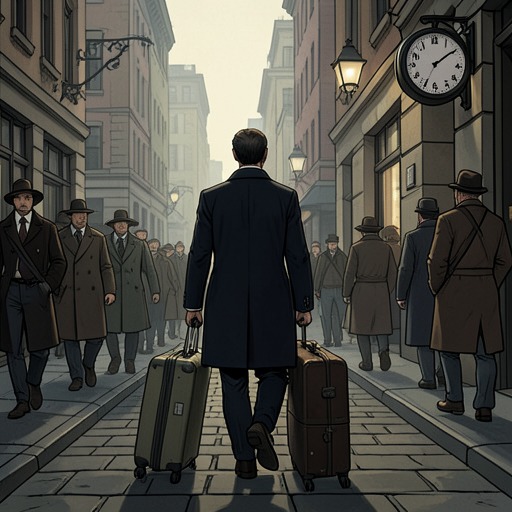
Anthony reaches London by boat train at Waterloo at two o’clock on a Wednesday afternoon, having arrived in Southampton the day before. George Lomax, misled by a misunderstood inquiry about the Granarth Castle, expects Jimmy McGrath to arrive on Thursday; Anthony’s early arrival gives him a temporary advantage over the plans made in his absence. He takes a taxi to the Blitz Hotel, books a room, and goes out for a walk along the Embankment.
The walk makes the return personal as well as logistical. Anthony remembers a restaurant near Blackfriars Bridge where he used to dine with other earnest young men. In those days he had been a Socialist and worn a red tie; now, after years away, the city seems changed. The memory establishes a contrast between his former political idealism and the experienced, resourceful man who has returned to carry out Jimmy McGrath’s commission.
London’s transport and commercial infrastructure also shape the action around Anthony. George’s mistaken information about the liner demonstrates how a small error in an office inquiry can distort official planning, while Anthony’s arrival at Waterloo and his immediate use of a taxi let him move independently of George’s expectations. The city is not merely a backdrop: its schedules, addresses, and institutions determine who meets whom and when.
The Search for Revel
The London telephone book initially offers Anthony no decisive answer to his second assignment. Looking up Revel, he finds six entries: a Harley Street surgeon, a saddler’s firm, a resident of Abbotbury Mansions in Hampstead, a Miss Mary Revel at Ealhag, the Hon. Mrs. Timothy Revel at 487 Pont Street, and Mrs. Willis Revel at 42 Cadogan Square. Eliminating the saddlers and Miss Mary Revel still leaves four possibilities, and Anthony cannot assume that the woman he seeks lives in London at all.
Rather than pursue each name at once, he decides to leave the matter to chance. Less than half an hour later, while turning through an illustrated paper, he finds an image of a tableau organized by the Duchess of Perth. The episode turns London’s abundant printed and social information into a form of clue: the telephone directory supplies a field of possibilities, while a newspaper illustration unexpectedly narrows Anthony’s search.
A later London address becomes the focus of his next move. After dealing with the memoir commission, Anthony decides to investigate 487 Pont Street in disguise. He packs his belongings, pays his hotel bill, and is about to leave by taxi when a boy brings him a letter. The planned departure is thus interrupted at the threshold of action, showing how his London itinerary repeatedly changes in response to new information.
The Hotel, the Letters, and the Murder
The Blitz Hotel is one of the central points in the London strand of the story. It is where Anthony lodges on arrival and where Giuseppe Manelli works as a waiter. Anthony later considers how to recover Virginia Revel’s stolen letters, reasoning that they may have little value to either the Red Hand or the Loyalist party and that Giuseppe might accept money for returning them. His attempt to understand the letters’ circulation is shaped by the hotel’s role as a meeting point between his private assignment and the wider political intrigue.
Anthony’s plans at the Blitz also connect the memoirs to the developing oil story. On the morning after considering how to retrieve the letters, he reads reports about new oil discoveries in Herzoslovakia and obtains an interview with the hotel manager through quiet persistence. London’s news and commercial contacts place the distant political crisis within the routine of the city, while the memoir manuscript deadline keeps Anthony’s immediate decisions under pressure.
The later identification of Giuseppe makes the London connection to the murder at Staines explicit. Before the identification, reports describe an unidentified foreigner found shot beside the road, with no weapon recovered. Battle subsequently tells Anthony that the dead man was Giuseppe Manelli, a waiter from the Blitz Hotel. The change from an anonymous newspaper report to a named hotel worker turns the murder into a direct consequence of the events Anthony has been navigating in London.
Battle further explains that King Victor’s associates took the letters from Giuseppe on the day of the Pont Street episode. Their theft was purposeful: they now possess the letters and know where to look for the prize, although they have not yet found it. London’s addresses therefore function as more than destinations. The city contains the trail of the stolen letters and the place where the conspirators believe the sought-after object can be recovered.
London’s Aftermath and Political Meaning
After the inquest into Giuseppe’s death, Anthony makes an unobtrusive departure. The official proceedings have been kept deliberately uninformative by Battle, the coroner, and the chief constable, while George Lomax is anxious to prevent damaging details from reaching the public. Bill Eversleigh spends the day carrying messages and decoding telegrams for George; Anthony’s departure is a relief to him, as he has had little chance to speak with Virginia.
The city also becomes the setting in which Anthony explains the identity he has concealed. Speaking with Battle, he says that he abandoned his own name and effectively killed himself because his English mother, English education, and greater interest in England made him feel out of place in Herzoslovakia. As a young man, he rejected kings and princes and believed in democratic ideals and human equality. His return to London recalls the earlier political self he describes, but his later account is more guarded: he still believes in democracy and human brotherhood, while doubting that people will behave decently through appeals to their better nature alone.
That reflection grows from an everyday London observation: on a Tube train, passengers refused to move along to make room for those entering. Anthony uses the incident to distinguish his enduring belief in equality from his diminished confidence in immediate human cooperation. London thus supplies not only the setting for his return but also the ordinary social example through which he explains how travel and experience altered his political outlook.
The city remains the destination for the memoirs even after Anthony has left it. He gives Jimmy a package and directs him to take a car to 17 Everdean Square, the private address of Mr Balderson, where delivery will earn a thousand pounds. Anthony reveals that the package is a dummy: he had checked with the publishers after a false call, placed the real manuscript in the manager’s safe, and never let it out of his possession. The London address, the publisher’s office, and the hotel safe form a chain of controlled transfers in which the apparent document and the genuine one travel by different routes.
At the close, London remains a place the characters can be summoned back to for delicate business. When George Lomax tells Lord Caterham that he wants a private conversation and that the King of Timbuctoo will soon arrive in London, Lord Caterham immediately asks Bundle to drive him to town and refuses to endure another demand connected with George. His reaction lends the capital a final, lightly comic association with political obligations: London is where official business gathers, but also where those drawn into it may choose to flee.