Mademoiselle Brun
The Secret of ChimneysMademoiselle Brun, apparently the French governess at Chimneys, is a false identity adopted by Queen Varaga, the Herzoslovakian queen thought to have died in the revolution. Her disguise gives her a place inside the household while she secretly searches for the historic diamond; after Prince Michael recognizes her, she kills him and helps obscure the crime. Her final exposure transforms the apparently ordinary governess into the hidden link between the royal past, the murder, and the diamond plot.
Identity and Introduction
Bundle identifies Mademoiselle Brun as the French governess responsible for keeping her younger sisters, Dulcie and Daisy, in order. Brun has been with the family for two months, having joined them while they were in Scotland. Bundle says she obtained the governess through an agency, pays her a hundred pounds a year, and knows her Christian name as Genevieve. The reference she offers is apparently reassuring: Brun is said to have lived for ten years with the Comtesse de Breteuil.
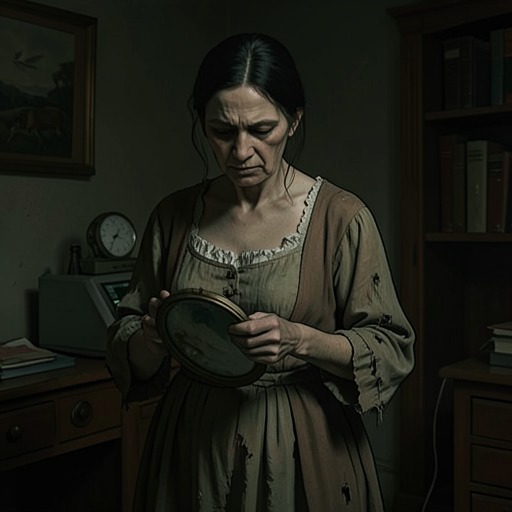
When Anthony visits the schoolroom, he sees a small, middle-aged woman with a sallow face, pepper-and-salt hair, and a slight moustache. The appearance does not fit his expectation of a notorious foreign adventuress, and he doubts his suspicions. He is pleasant to her, and the encounter seems to confirm the everyday role she performs in the house: she is delighted by the handsome visitor, while the children greet him eagerly and introduce him to their governess.
The Disguise and Its Unraveling
Anthony later explains that he had initially suspected Mademoiselle Brun because a light had been visible in her room on the night of the murder. He then made inquiries in Brittany and found that the Comtesse de Breteuil had genuinely employed a governess named Mademoiselle Brun and praised her. That confirmation misled him: he failed to consider that the real governess might have been kidnapped while travelling to her new post and replaced by an impostor. He shifted his attention to Mr Fish, and only reconsidered Brun after learning that Fish was a Pinkerton’s man pursuing King Victor.
A further clue lay in Virginia Revel’s recognition of the woman’s face. Anthony recalls that Virginia made the connection only after he mentioned the governess’s supposed employment by Madame de Breteuil; Virginia had said that this explained why the face seemed familiar. The distinction matters: the household’s credible account of Brun’s employment had shaped what Virginia thought she recognized, while the impostor’s resemblance to a known person pointed toward a concealed identity. Anthony concludes that keeping Virginia away from Chimneys had been important because she was the only member of the house party who had been to Herzoslovakia and was therefore the likeliest to recognize the woman.
Queen Varaga and the Diamond Plot
Anthony identifies the woman as a former actress and asks the Baron to look beyond her makeup. The Baron recognizes her as Queen Varaga, though he had believed her dead: after the revolution, her body had reportedly been recovered on the palace steps, mutilated and unrecognizable. Anthony suggests that this uncertainty allowed her to escape to America and spend years in hiding from the Comrades of the Red Hand, who had promoted the revolution and were hostile to her.
After King Victor’s release, Anthony says, Varaga and Victor planned to recover the diamond. Her position as a governess helped her avoid ordinary contact with royal guests, and she could excuse herself when necessary; she had done so with a migraine on the day the Baron visited. But while searching for the jewel, she unexpectedly encountered Prince Michael face to face. He recognized her, making exposure and disgrace imminent, and she shot him.
Varaga also placed the revolver in Herman Isaacstein’s suitcase to confuse the investigation and returned the letters. These acts connect her assumed household identity directly to the attempted framing and the effort to manage evidence after Prince Michael’s death. Anthony’s account also distinguishes her operation from the Comrades of the Red Hand’s earlier violence: their murder had been presented as punishment for supposed treachery, but its staging and the absence of the group’s identifying sign suggested to him that a more capable intelligence was directing events.
Exposure and Death
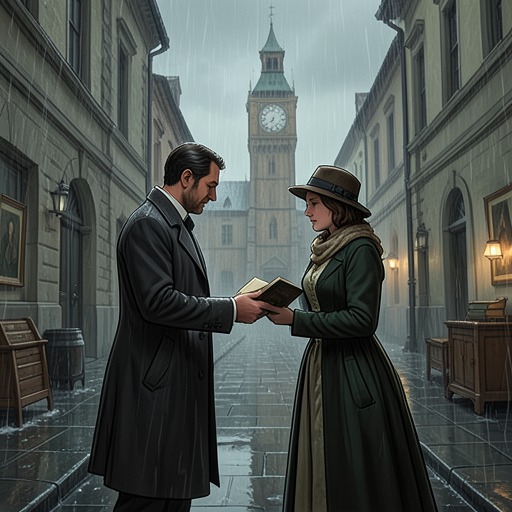
During the nighttime search of the council chamber, a small figure is found pulling books from the bookcase and replacing them, apparently absorbed in the search. A struggle follows after someone rushes into the room. In the confusion, a pistol goes off; when the lights are switched on, Boris is standing over Mademoiselle Brun, who has fallen with the pistol still in her hand. Boris says that she killed his master and had tried to shoot him; he attributes the shot during their struggle to Saint Michael’s intervention.
The revelation that the apparent governess is a woman, and then the Baron’s recognition of the supposedly dead queen, recasts her earlier presence in the house. Her disguise had depended not simply on changing her appearance but on a plausible employment history, a domestic role that kept her near the household without attracting the attention given to royal visitors, and the possibility that those who recognized her would be kept away. After her death, Superintendent Battle asks Anthony whether the woman was the late Queen Varaga. Anthony confirms it and hopes the matter will be hushed up as a family secret; Battle replies that George Lomax can be trusted to prevent the truth from spreading widely.
Narrative Role
Mademoiselle Brun’s character is built around the gap between a credible social identity and a concealed political past. The agency, salary, references, and routine work with the children make the imposture persuasive, while Anthony’s investigation shows how apparently verified details can still mislead when they establish the truth about the identity being borrowed rather than the person using it. Her disguise also turns domestic access into practical cover: as a governess she can remain in the house, search for the diamond, and stay outside the expected circle of royal contact.
Her eventual unmasking gathers several strands of the mystery into one person: the presumed-dead Queen Varaga, the hidden search for the diamond, Prince Michael’s murder, the planted revolver, and the returned letters. The final scene makes the disguise fail at the moment she is caught searching again. The pistol in her hand and Boris’s accusation confirm the violence behind the mild household role, while the decision to suppress the queen’s identity leaves the truth known to a small circle rather than publicly resolved.