Queen Varaga
The Secret of ChimneysQueen Varaga is the royal identity assumed by Angèle Mory, a Parisian actress whose path to the throne transformed a revolutionary plot into a personal bid for queenship. Her story joins political upheaval to impersonation: the woman who entered Herzoslovakia as an alleged Romanov descendant was later linked to King Victor, secret correspondence, and the movement of stolen royal jewels.
Identity and Rise
Before becoming Queen Varaga, Angèle Mory worked as an actress at the Folies Bergeres in Paris. French authorities suspected her of association with King Victor’s robberies, although they initially lacked proof. She was also approached by the Comrades of the Red Hand, who offered her a large sum to help entrap the young Nicholas IV during his Paris visit. Her assigned role was to attract the king and lure him to a place where the revolutionaries could act.
Mory accepted the offer, but pursued an ambition beyond the revolutionaries’ plan. She captivated Nicholas IV, who fell deeply in love with her and gave her jewels. Rather than remain a paid agent or become the king’s mistress, she set her sights on being queen. Her background made that ambition a political provocation: accounts describe her as a low-born Parisian performer, not an appropriate match even for a morganatic marriage.
She reached the throne through a fabricated pedigree. Presented in Herzoslovakia as Countess Varaga Popoleffsky, supposedly descended from the Romanovs, she married Nicholas IV in the cathedral at Ekarest. The ceremony was conducted by two reluctant archbishops. Nicholas secured the ministers’ acquiescence, and Mory was crowned Queen Varaga. The crown thus rested not on the ancestry publicly claimed for her, but on a story constructed to make her acceptable at court.
Queen and Revolution
The marriage did not secure public acceptance. Nicholas IV appears to have treated ministerial agreement as sufficient, but the populace wanted rulers of what it regarded as genuine aristocratic lineage. Discontent grew amid reports of repression, and the country eventually rose against the monarchy. Rebels stormed the palace, killed the king and queen, and proclaimed a republic. Herzoslovakia remained a republic thereafter, although political violence continued, including the assassination of presidents.
The Comrades of the Red Hand, initially her prospective employers, became her enemies when they believed she had betrayed their scheme by winning the king’s love and marrying him. They attempted to kill her twice. Their hostility and the public resentment surrounding her status formed part of the pressures preceding the revolution, although the evidence does not reduce the uprising to a single cause. In the aftermath, the bodies of Nicholas IV and Queen Varaga were recovered and identified with difficulty; the account presents their deaths as part of the revolution’s violent end to the royal regime.
Connection to King Victor
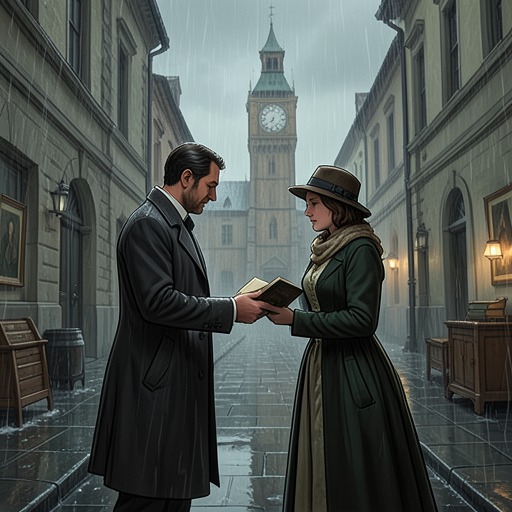
Queen Varaga’s apparent death did not erase her association with King Victor. According to M. Lemoine’s account, she continued to correspond with him from the Herzoslovakian court using a secret code. The letters were written in English and signed with the name of an English woman then at the embassy. That borrowed identity was Virginia Revel’s, whose name could make the correspondence look like the work of someone else if it came under scrutiny.
The letters were addressed to Captain O’Neill at his Paris rooms. Captain O’Neill was the name under which King Victor had operated in Paris, where he was suspected of a series of robberies. The correspondence therefore connected the queen’s court identity with the criminal world from which she had emerged. When the truth about the forged letters is disclosed, Virginia confirms that she had wondered about them; the letters had used her name without her involvement and risked making her appear to be their author.
Jewels and Criminal Methods
The connection between Queen Varaga and King Victor extended, in M. Lemoine’s account, to the handling of royal jewels. After the revolution, many crown jewels that had passed into the hands of the crowd made their way to Paris. Investigators found that in nine cases out of ten, the principal stones had been replaced with paste, including stones from the famously valuable Herzoslovakian collection. The substitution suggested that theft had continued alongside the queen’s royal life.
The account attributes the skill required to make substitutes convincing to King Victor, describing the jewel operation as pointing to him as its author. Queen Varaga is consequently presented not simply as a victim or symbol of political revolt, but as someone who retained ties to a former criminal associate while occupying the throne. Her assumed lineage, secret correspondence, and the jewels’ replacement stones all repeat the same pattern: appearances offer protection, while concealed identities and altered valuables expose the fragile boundary between court politics and theft.
Narrative Significance
Queen Varaga’s history is reconstructed through successive disclosures rather than through a direct account of her own experience. Anthony Cade first describes Nicholas IV’s marriage to a supposedly aristocratic woman of low birth and the uprising that ended the monarchy. Later, M. Lemoine supplies the Parisian history behind that marriage: Angèle Mory’s suspected criminal association, her recruitment by the Comrades of the Red Hand, and her decision to pursue the crown instead of carrying out their original plan. This later account changes the meaning of her rise from an unlikely royal match into a calculated transformation of identity.
The disclosures also give her story consequences in the present action. Virginia Revel discovers why her name appears on compromising letters, while the connection to King Victor helps explain how political history, forged identities, and jewel theft converge. Queen Varaga’s decisive significance lies in that convergence: her reign was brief, but the identities and schemes surrounding it remain active after the monarchy has fallen and she is believed dead.