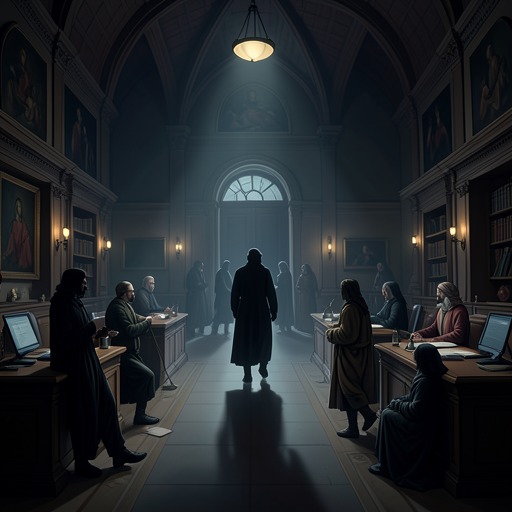
The nighttime search of Chimneys' council chamber
The Secret of ChimneysThe nighttime search of Chimneys' council chamber is a repeated intrusion staged around an armored figure and a section of panelling. What begins as an uncanny question—why would burglars take a man in armour to pieces?—becomes a test of who can enter the room unseen, who is watching, and how much the investigators themselves know. The episode ends not with a recovered object but with the capture of the bearded stranger and the revelation that he is M. Lemoine, a colleague of Superintendent Battle from the Sûreté in Paris.
The first search and the room's strange clues
Virginia Revel and Bill Eversleigh focus on the council chamber after the intruders’ apparent interest in the armor. Virginia insists Bill remove his boots so they can listen and watch more carefully, and wonders why anyone would disassemble an armored figure. Bill offers the practical possibility that it might be easier to carry in pieces, but the explanation does not satisfy her. The humor of the exchange does not dissolve the mystery: the armor is both a conspicuous object in the room and a possible cover for what the intruders are actually seeking.
The pair creep along the passage and wait outside the massive oak door. A brief light shines through the keyhole. Looking in, Bill can make out two people by the wall under the Holbein portrait, a flashlight beam, and activity around the figure in armor. Another shape crosses his limited view and returns; he cannot tell whether it is a man or a woman. The keyhole gives them fragments rather than a complete account, while the subdued chinking and a faint tapping suggest that the search involves both the armor and the panelling.
When the door yields, Bill and Virginia enter quietly. At the far end, a man stands on a chair with his back to them, tapping gently on the panelling beneath the picture. A floorboard betrays Bill. The intruder swings a powerful torch towards them, and Bill lunges as Virginia presses the light switch. The chandelier does not come on; the room remains dark, the torch falls and goes out, and the struggle becomes a confusion of panting and scuffling. Virginia holds at the doorway to block an escape, then calls loudly for help despite Bill’s instruction to go.
The struggle ends when someone crashes into a suit of armor, bringing it down with a deafening noise. Virginia glimpses a figure spring through the already-unlatched window and pursues him along the terrace. The open window matters beyond the escape itself: when the crime is discovered, the middle window is found unlatched, forcing Anthony Cade and the police to consider whether someone inside the house had opened it to make the killing look like an outside job—or whether Anthony’s account is false. The detail makes the architecture part of the evidence, not merely a route into or out of the room.
The second watch
After the first intrusion, Anthony argues that the search is likely to resume. A group of watchers agrees to take turns downstairs after the household has gone to bed. They carry powerful electric torches, and a revolver lies in the pocket of Anthony’s coat. Anthony expects the next attempt to come through the door; Virginia’s suspicion that someone had passed her in the darkness the night before points instead towards the window. She crouches behind an armored figure on the opposite wall, Bill takes position by the window, and Anthony hides behind an old oak dresser.
The watch stretches through the hours: one o’clock, half past, two, and half past again. Anthony grows stiff and cramped and begins to think that no one will come. Then a footstep sounds on the terrace, followed by scratching at the window. It opens, and a man steps across the sill. He stands still, listens, and sweeps the room with his torch. The watchers hold their breath; apparently satisfied that nothing has changed, the intruder goes to the same section of panelling he examined the previous night.
A small involuntary noise breaks the silence. Anthony tries pressing his upper lip, swallowing, throwing back his head, and pinching his nose, but cannot suppress a sneeze. Its being stifled does not make it harmless: in the quiet room it alerts the intruder. Anthony immediately flashes his torch and tackles him. This time Virginia reaches the switch successfully, and the room lights up with Anthony on top of the stranger and Bill ready to help.
Capture and identification
Anthony rolls the captured man over and recognizes the neat, dark-bearded stranger from the Cricketers. The arrival of Superintendent Battle in the open doorway changes the meaning of the capture. Battle is not a late, uninformed observer: he identifies the prisoner as M. Lemoine, a colleague they have been expecting, who works for the Sûreté in Paris. The apparent burglar is therefore part of the investigation rather than an unknown housebreaker, and the night’s violence gives way to an explanation of the investigators’ concealed cooperation.
The sequence draws its suspense from limited sight and delayed identification. At first, Virginia and Bill can glimpse only a torch, a figure at the panelling, and a shape crossing the dark; on the second night, even Anthony’s prepared watch is nearly undone by an ordinary sneeze. Yet the capture does not expose the object being sought behind the panelling. Instead, it reveals who the intruder is and establishes that Battle has allowed the search to proceed under observation. The mystery of the room’s target remains distinct from the question of the searchers’ identities.
Consequences for the investigation
The searches connect the chamber’s physical clues to the wider inquiry. The armor attracts attention and is knocked down during the first struggle; the panelling draws the intruders back; the window provides an unobserved approach; and a failed light switch briefly deprives Virginia and Bill of the advantage of visibility. On the second night, the watchers reverse the first encounter’s imbalance by preparing torches, positions, and a revolver, but success still depends on a chance bodily sound that exposes their concealment.
The episode also helps explain why Battle’s investigation proceeds through controlled patience rather than immediate disclosure. He later says that he likes to give a man plenty of rope, and asks Anthony why he has chosen this moment to share what he knows. Anthony explains that he had withheld information for Virginia’s sake, but that her innocence concerning the letters has now been established; he also concedes that his own earlier handling of events had made a mess of things. The captured searcher and Battle’s reveal thus belong to a larger process in which observation, withheld knowledge, and revised explanations gradually narrow the field of suspicion.
The council chamber’s two searches are consequently more than repeated burglaries. Their altered outcomes—first a dark struggle and escape, then a lit room and capture—make the room a compact theatre of uncertainty, where sight is obstructed, evidence can support competing accounts, and the people who appear to be pursuing the mystery may themselves be operating under cover. By identifying M. Lemoine without yet resolving the search’s ultimate object, the episode advances the investigation while preserving the distinction between a solved encounter and an unsolved secret.