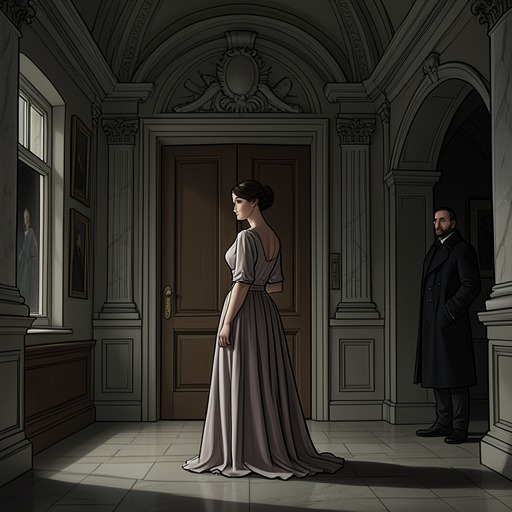
Virginia Revel—Tim Revel
The Secret of ChimneysVirginia Revel and Tim Revel were married, but Bundle’s account overturns the assumption that Virginia’s years of care reflected romantic love: she says Virginia married Tim because she had mistaken his emotional appeals for love, then devoted herself to him to compensate for a marriage she did not truly want.
Marriage and Its Origins
Virginia was eighteen when she married Tim, an Irishman whom Bundle describes as attractive and eloquent. According to Bundle, Tim repeatedly presented himself as being in picturesque despair, threatening to shoot himself or take to drink unless Virginia agreed to marry him. Virginia, young and persuaded by the intensity of the feeling she believed she had inspired, accepted.
Bundle presents this history as her own reconstruction: she was a child at the time, but says she heard accounts of the marriage and can piece them together from what she knows of Virginia. The explanation is therefore intimate testimony rather than a scene witnessed directly by the narrator.
Care Without Romantic Love
Bundle emphatically rejects the idea that Virginia loved Tim. She argues that Virginia worked tirelessly for him precisely because she did not love him and felt a need to make amends. Had she loved him, Bundle suggests, she would not have been so completely self-sacrificing. Her account separates outward devotion from inward attachment: Virginia could be an angel to Tim while still retaining what Bundle calls a devilish streak.
The marriage thus carries two meanings at once. Virginia’s labor and loyalty were real, but Bundle interprets them as duty and compensation rather than romantic fulfillment. Tim’s death, which Bundle says prevented him from having the fine career Virginia had helped him pursue, leaves that sustained care as the defining evidence of their shared life.
Freedom and Bundle’s Testimony
Bundle says Virginia enjoys her freedom and will be difficult to persuade to give it up. That claim makes the marriage’s end consequential beyond bereavement: in Bundle’s reading, Virginia’s independence is not a rejection of a beloved husband but a return to a life she had constrained herself to serve him.
Bundle offers this account to Anthony because he wants to understand Virginia, and she says he would never have heard it from Virginia herself. She calls her information an inside tip and insists that Virginia is admired even by women because she is not spiteful. Her final appeal to being a good sport frames the disclosure as friendly candor, while also underscoring that Virginia’s private history is being interpreted by someone close to her rather than narrated by Virginia herself.