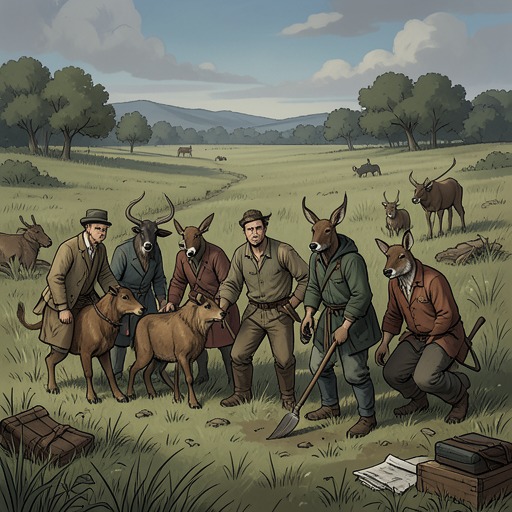
Individual choice
The Selfish GeneIndividual selection names an alternative to explaining altruism by benefits to a group or species: individuals with heritable traits that improve their own prospects tend to leave more descendants. The book treats this as a powerful corrective to group-selection stories, but develops it into a more precise gene-centered argument in which selection acts through inherited differences, while development and behavior remain complex, cooperative, and indirect.
The challenge to group selection
The contrast begins with apparent self-sacrifice. A bird that gives an alarm call may draw a predator’s attention to itself, and a parent’s distraction display may lure a fox away from chicks. These examples illustrate what altruism and selfishness mean at the level of individuals; the author explicitly warns that illustrative stories are not serious evidence for broad generalizations. The question is not whether an act looks self-sacrificing, but how such behavior could persist through evolution.
Group selection offers one answer: groups whose members sacrifice individual interests for the group’s welfare might be less likely to go extinct than groups of more self-interested members. The theory, associated in the book with Wynne-Edwards and popularized by Robert Ardrey in The Social Contract, imagines the individual as expendable when the group’s survival requires it. Individual selection instead asks what happens among individuals within such a group. Even if most members are altruistic, a selfish rebel could exploit their sacrifices, survive more successfully, and pass on selfish traits. Over generations, those traits could spread through the group. Migration and interbreeding provide another route by which selfish individuals might enter an initially altruistic group.
The argument does not deny that groups die out or that members’ behavior can affect a group’s fate. It distinguishes that slower process from the rapid competition among individuals: selfish individuals may prosper in the short term even while their group declines. Nor can future group extinction itself make evolution anticipate the long-term cost. Evolution is blind to the future. The book connects this distinction to the controversy over population regulation: Wynne-Edwards proposed that animals altruistically restrain reproduction for the good of the group, while individual selection asks whose reproductive success determines which inherited tendencies persist.
From individuals to genes
The book’s preferred language ultimately shifts from individual selection to gene selection. Individual bodies are vehicles containing thousands of genes, whose effects on development are interdependent: one gene can affect several bodily parts, and any one part can be influenced by many genes. Some genes regulate clusters of others. The finished organism is therefore not a simple sum of independently acting genetic instructions.
Sexual reproduction helps explain why genes, rather than whole individual bodies, can be treated as enduring units of selection. Recombination shuffles genetic material: during the formation of sperm or eggs, corresponding chromosome segments cross over, producing a mosaic of maternal and paternal material. The individual’s particular combination is temporary, whereas a gene can persist through many successive bodies. In the book’s definition, a gene is a portion of chromosomal material that can last through enough generations to serve as a unit of natural selection, with longevity understood through accurate copying.
This gene-centered framing does not mean genes independently construct organisms or directly dictate every action. A gene “for” a trait is shorthand for a heritable difference that, other things being equal, tends to influence that trait. Leg development, for example, is a cooperative process involving many genes and environmental conditions; a single gene may shift the outcome rather than create a leg by itself. The book compares this limited contribution to nitrate’s effect on wheat growth: nitrate can increase growth in suitable conditions, but cannot produce a plant without seed, soil, sunlight, water, and other necessities.
Behavior, inheritance, and evidence
The distinction between ultimate evolutionary effects and immediate behavioral control is central to the argument. Genes influence how survival machines and nervous systems develop, but moment-to-moment decisions are made by the nervous system. Brains can learn, simulate possibilities, and predict consequences; they may even act against genetic incentives, as when people choose not to have as many children as they could. Genes are described as primary policy-makers and brains as executives, but this is an analogy for indirect influence, not a claim that genes consciously plan.
To evolve, a behavior must be associated with inherited variation that fares differently from alternatives in the gene pool. The book notes that direct experimental evidence for genetic inheritance of altruistic behavior was lacking, and therefore turns to a complex behavior as a model. In honeybees, hygienic worker strains locate infected grubs, uncap their cells, remove the larvae, and discard them, helping suppress foul brood. Rothenbuhler’s crosses showed that first-generation hybrid hives did not display the complete behavior, although the relevant traits remained present recessively. After back-crossing, hives differed in whether they performed the whole sequence, only uncapped cells, or did neither. By removing caps himself, Rothenbuhler found that some apparently non-hygienic bees could then carry out the removal step. The result suggested separate inherited contributions to uncapping and removal, showing how a complicated behavior can be composed of distinct components rather than controlled by a single all-or-nothing instruction.
Scope and limits
The book applies the same selection logic to reproduction. Caring for a baby brother and caring for a baby son can have the same genetic relevance if the individuals are equally closely related, but bearing a child is not the same as caring for one: an individual can care for a brother only after someone else has brought him into the world. This distinction frames the dispute over whether animals reduce birth rates for the group’s benefit. For humans, the book notes that population growth depends on births and deaths at the world scale, and that the timing of births matters as well as the number: lengthening the interval between generations can slow annual growth.
The contrast also provides a test for adaptation claims. Large gatherings of starlings or midges might, in Wynne-Edwards’s account, function as population censuses linked automatically to reproductive restraint. The book presents that account as plausible in outline but argues that the cited examples can also be interpreted through more orthodox gene-centered explanations; it judges the evidence insufficient to establish the group-benefit interpretation. Likewise, clutch size cannot be evaluated by assuming that more eggs are always better. Producing more offspring carries costs in care, so the relevant question is which number best serves reproductive success under the conditions faced by a species.
The same reasoning extends beyond obvious bodily structures. Caddisflies build protective houses, and although the house lies outside the animal’s body, the book argues that selection could favor inherited differences that lead its builders to make more effective ones. There has been no direct genetic study of caddis houses in the evidence discussed, but if the house is an adaptation, hereditary variation in house-building must have provided material for selection. Individual selection thus opens onto the extended effects of genes without making the organism, the behavior, or the structure genetically simple: its central claim concerns which inherited differences persist, not a conscious purpose or a single cause for complex traits.