Survival machine
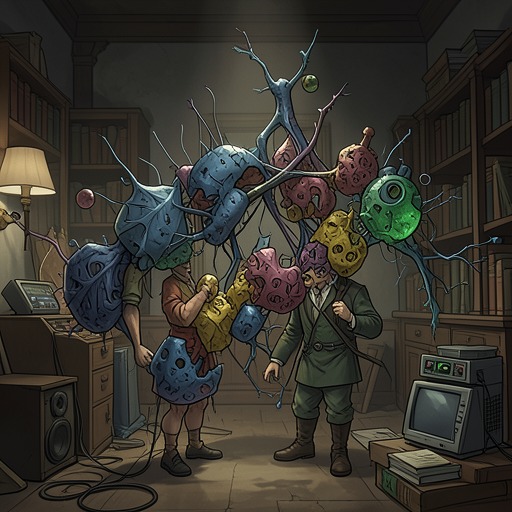
The Selfish GeneA survival machine is an organism built and governed through the effects of genes that have persisted by replication. The concept gives the book’s gene-centered account of evolution a concrete vehicle: genes are not conscious agents, but bodies shaped by their past success provide the means through which copies continue into future generations. The term encompasses more than animals or humans; it reaches across plants, bacteria, and viruses, and ultimately describes both individual bodies and the larger cooperative organizations some bodies form.
Origin and Definition
The account begins with replication and competition. In the imagined early environment, replicators used up scarce building blocks, and variants differed in their ability to persist, reproduce, or reduce the stability of rivals. Some may have taken apart rival molecules and used the released materials to make copies. Others may have protected themselves chemically or acquired protein walls. The emergence of such protective containers marks a decisive transition: replicators no longer merely persisted in their surroundings, but constructed vehicles that helped secure their continuation.
These vehicles became more elaborate as competition continued. The book presents their development as cumulative: as rivals acquired more effective means of survival, the protective structures and capacities of other replicators also changed. The image culminates billions of years later in replicators enclosed within vast colonies, remote from the outside world and affecting it indirectly. They have not disappeared; in the account, they are the genes carried within living bodies. The compressed formulation, “they created us, body and mind,” expresses the reversal at the heart of the concept: organisms are not the ultimate beneficiaries of evolution but vehicles whose construction and activity have been shaped by replicators.
The term applies across the living world. “We” in this account does not mean only people: plants, bacteria, and viruses are also survival machines. The book notes that even the number of species is unknown and gives an estimate of about three million living insect species, with individual insects numbering around a million million million. This expansive scope prevents the metaphor from being mistaken for a claim about human uniqueness.
How Genes Build and Use Bodies
A modern survival machine contains many thousands of genes, whose effects are entangled. Building a body is a cooperative process: a single gene may affect different parts, while any one bodily part is influenced by many genes and by their interactions. Some genes regulate clusters of others. The book compares this arrangement to plans whose pages cross-reference numerous parts of a building, while stressing that the metaphor has limits: inheritance and development are not a simple matter of one discrete instruction producing one isolated feature.
Sexual reproduction helps explain why genes, rather than complete bodies, are treated as the more persistent units. Recombination shuffles genetic material, so the combination found in one individual is temporary even when its constituent genes continue through many successive bodies. Crossing over can exchange matching chromosome segments, producing a mosaic rather than intact maternal and paternal sets in a sperm or egg. The book also cautions that a gene need not be a neatly bounded instruction: crossing over can split sequences within units that code for proteins. Its working definition concerns chromosomal material with enough copying fidelity and longevity to serve as a unit of natural selection.
Genes influence development indirectly and in company. There is no single gene that builds a leg by itself; a gene may, other things being equal, tend to make a leg longer than the effect of its alternative. The book compares this limited influence to nitrate’s contribution to wheat growth: nitrate can affect the result without being sufficient to produce a plant. Embryonic development depends on an interlocking network of genetic and environmental causes. Thus, calling a survival machine gene-shaped does not mean that a single gene dictates a whole body or behavior.
The genes’ cooperation produces bodies with an apparent individuality of their own. An animal moves as a coordinated unit, a result the book connects to selection favoring coordination over internal anarchy in competition for resources and in avoiding being eaten. Because the communal history of genes is now largely obscured by their integration, it is often more useful in ordinary discussion to treat the organism as an agent. That is a practical approximation, not a rejection of the gene-centered account: unless otherwise specified, the book uses selfish and altruistic to describe behavior by one animal body toward another.
Behavior, Strategy, and Gene-Level Explanation
Animals are especially prominent as survival machines because they evolved rapid, repeatable movement. Their muscles convert chemical energy into mechanical movement, with force acting through structures such as tendons and bones. The book’s interest, however, is not just the machinery of movement but the timing and pattern of behavior: bodies are active vehicles through which inherited effects meet the circumstances of life.
This behavioral account uses strategic language without attributing conscious calculation to animals. In discussing aggression, the book presents the possibility that a decision to fight, wait, escalate, or withdraw can be analyzed in terms of costs and benefits. John Maynard Smith’s evolutionarily stable strategy provides a model: a behavioral policy is stable when, once most of a population follows it, an alternative cannot do better. Such a strategy is not a plan consciously formulated by an animal. It describes the outcome of selection among bodies whose inherited effects produce different patterns of behavior.
The same distinction governs the phrase selfish gene. A gene is not one physical fragment acting independently, nor does it literally have intentions. It is a distributed set of copies of a particular stretch of DNA in many individuals. In the book’s shorthand, it “tries” to become more numerous in the gene pool by influencing bodies to survive and reproduce. More precisely, variants whose effects tend to increase their representation are the ones more likely to persist. A gene may also benefit copies of itself in other bodies; behavior that appears altruistic at the level of the individual can therefore be explained through gene-level effects without treating the body’s apparent purpose as the final evolutionary cause.
The account also emphasizes that gene-based estimates are historical rather than foresighted. Bodies are shaped by genes that survived under conditions resembling those their species encountered in the past. If conditions remain sufficiently similar, the resulting behavioral tendencies may be effective on average; if conditions change radically, the inherited responses may become mistaken and their genes may pay the cost. The survival machine is therefore not an infallible calculator but a product of earlier selection, carrying effects that can fit the present imperfectly.
Sterile Workers and Nested Organization
Social insects show how survival machines can be organized at more than one apparent level. A colony may share food, exchange information through chemical signals or bee dances, recognize intruders, and regulate the hive’s internal temperature. These coordinated functions make the community seem like a body with a communal stomach, communication system, and defenses.
The reproductive division clarifies the genetic interpretation of that apparent individuality. Most members of a social-insect colony are sterile workers, while a minority of reproductives carry the continuing reproductive line. The book compares workers to the liver, muscles, and nerve cells of an individual body: they contribute to the persistence of the larger organization without reproducing themselves. A worker’s self-sacrifice can thus serve copies of genes shared with relatives, even though it prevents that worker from producing offspring of its own. The analogy does not make a colony literally one organism; it shows how cooperation and reproductive specialization can be understood as arrangements through which genes persist.
This example also limits a simple picture of an organism as a self-contained unit. At one scale, the animal body is a coordinated whole; at another, its genes are the more persistent replicators; in social insects, workers and reproductives together produce a further level of organization. The survival-machine metaphor makes these nested arrangements visible without requiring mystical explanations of apparent selflessness.
The Metaphor’s Reach and Limits
The book repeatedly marks “survival machine” as explanatory language, not literal engineering or conscious design. Natural selection does not require genes to plan ahead; it retains effects that, over generations, have contributed to replication. Similarly, describing a strategy as if an animal followed instructions is a convenient way to express what its behavior resembles, not evidence that the animal consciously weighs alternatives. The metaphor is useful because it reverses the ordinary impression that genes exist to serve organisms: bodies are the temporary vehicles through which genes’ effects persist.
Its reach extends beyond the body that contains a gene. In the discussion of the extended phenotype, genes can influence behavior that manipulates the world or another organism, and selection may favor such effects insofar as they promote the relevant genes’ propagation. The central claim is that behavior tends to maximize the survival of genes “for” that behavior, whether or not those genes are in the body performing it. The survival machine remains the principal vehicle of gene effects, but it is not necessarily the boundary of their consequences.
The term also creates a bridge to the book’s later account of human culture. The book introduces “survival machine” partly because “animal” would exclude plants and, in some readers’ minds, humans. It argues that the evolutionary account should apply broadly unless a species has a particular reason to be excepted, then identifies culture as an important feature of human distinctiveness. Cultural transmission, like genetic transmission, can support an evolving system, though it works through imitation between brains rather than reproduction through bodies. A meme can even be physically realized in nervous systems and use a brain as a vehicle of transmission. This parallel extends the metaphor of replication while keeping genes and cultural replicators distinct.
The concept’s decisive contribution is therefore a change of explanatory scale. It acknowledges the organism as a coordinated, behaviorally effective body while treating it as temporary in relation to genes that can outlast the particular combination embodied in it. That distinction helps explain why individual behavior may look selfish or altruistic, why cooperation can arise among genes and bodies, and why the apparent unity of a living creature is compatible with a deeper history of replication.