The emergence of the first replicators
The Selfish GeneThe emergence of the first replicators is the hinge in The Selfish Gene’s account of life: it turns a world of chemical stability into one where copying, variation, and competition can cumulatively produce living organisms. The event is necessarily speculative, since nobody could have witnessed it, but its place in the argument is decisive. Once a molecule could generate copies, natural selection could begin to act on differences among those copies; much later, the replicators’ protective vehicles became the organisms in which genes still persist.
Before replication: chemistry and stability
The account begins with a distinction between the gradual formation of complex molecules and the later evolution of living systems. Molecules can fall into stable patterns through ordinary physical and chemical processes, without design or purpose. The stable shape of a complex modern molecule such as haemoglobin illustrates the principle, but it does not explain how an organism as complex as a human being could be assembled simply by shaking atoms together. In the book’s sequence, Darwinian evolution takes over where the slow chemical building-up leaves off.
The conditions preceding life are uncertain, and the author explicitly presents the origin account as a simplified, necessarily speculative reconstruction among rival theories. Plausible raw materials include water, carbon dioxide, methane, and ammonia. Laboratory simulations of a young Earth’s chemical conditions have combined simple substances with energy from sources such as ultraviolet light or electric sparks. In experiments lasting weeks, the flasks produced a weak brown soup containing more complex molecules, including amino acids, the building blocks of proteins. Later simulations also yielded purines and pyrimidines, which are building blocks of DNA.
Such results make the proposed early chemistry imaginable without proving the precise historical route. Organic substances could have collected in the seas, perhaps concentrated in drying scum along shores or in tiny suspended droplets. Further energy could have joined them into larger molecules. In a world without bacteria or other organisms to absorb and break them down, those molecules could drift through the thickening broth. The emergence of a replicator is placed within this chemically rich, unoccupied setting, not attributed to an act of foresight.
The copying molecule
At some point, by accident, a molecule appeared with an extraordinary property: it could make copies of itself. It need not have been the largest or most complex molecule in the soup. Its significance lay in replication. The event is described as exceedingly improbable on the scale of a human lifetime, but the relevant timescale is hundreds of millions of years; an occurrence that seems practically impossible over a short span becomes plausible across immense stretches of time.
The proposed mechanism begins with the replicator as a mould or template: a complex chain made from different kinds of building blocks. If each small building block has an affinity for its own kind, it can attach to a matching part of the replicator. The pieces that gather alongside the original are thereby arranged in a sequence that mimics it. They may then join into a stable chain. The resulting copy and its template can separate, leaving two replicators, each able to make more copies. The account also allows a more complex route: building blocks might instead attach according to reciprocal affinities, producing a complementary “negative” that can in turn reconstruct the original “positive.” The exact first copying mechanism is left open; what matters is that copying becomes possible.
The book compares replication to crystal formation, in which layers accumulate around a pattern, while emphasizing the new consequence once a copying molecule exists. Before its appearance, no particular kind of complex molecule was probably abundant: each depended on building blocks happening to assemble by chance in a stable arrangement. The replicator changed that balance. Its copies could spread rapidly through the seas, making the smaller building blocks scarce and leaving other large molecules to form less often. Replication therefore transformed chemical stability into a contest over resources.
Imperfect copying and competition
Copying is not perfect. Once replicators reproduce, errors can arise, and successive copying can make those differences cumulative. In the wider argument, variation matters because some mis-copies may produce greater stability or reduce the stability of rivals. Those variants are then more likely to be preserved and multiplied. The process does not require the molecules to recognize a struggle or pursue an intention: differential persistence is enough to generate the appearance of a contest.
The primeval soup could not support an unlimited number of replicators. Earth itself is finite, and the necessary building blocks were also limited. As replicators became numerous, they consumed the materials required to make further copies. Different varieties or strains competed for those scarce resources; less-favored varieties declined and many lines ultimately went extinct. The struggle for existence took place without awareness or feeling. In the account’s deliberately unsentimental logic, a copying error that happened to confer an advantage could be retained, while unsuccessful lines disappeared.
Some changes could make competition more direct. A replicator might acquire a way to break up rival molecules chemically, using the released building blocks for its own copies; such a development would both obtain food and remove competitors. Other replicators might protect themselves chemically or build a physical wall of protein. These are proposed possibilities in a speculative reconstruction, not witnessed episodes. Their explanatory role is to show how cumulative selection could favor both offensive and defensive adaptations without any plan directing the process.
From replicators to survival machines
Protection marks the transition from replicators that merely persist to replicators that construct vehicles for their continued existence. The first survival machines may have been no more than protective coats. As new rivals arose with more effective defenses and means of survival, these vehicles grew larger and more elaborate. In this account, complexity is cumulative: each generation’s variations are filtered by their effects on the replicators’ persistence and copying.
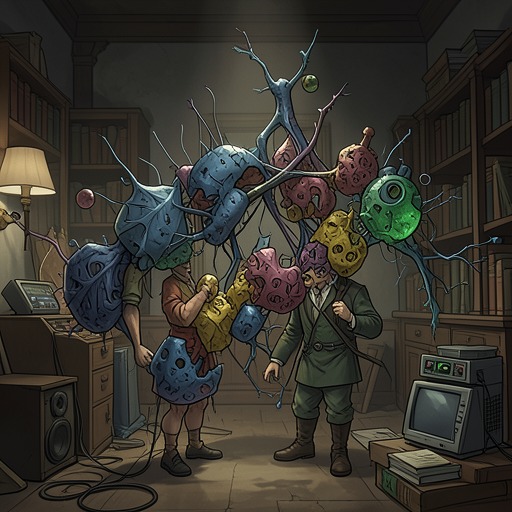
The story then leaps across roughly four billion years. The ancient replicators have not vanished, but neither do they float freely in the sea. They are described as living in huge colonies inside gigantic, lumbering robots, cut off from the outside world and connected to it by indirect routes. These are a vivid, mechanical image of organisms: the replicators are genes, and the bodies that contain them are their survival machines. The passage reverses the ordinary sense of agency. Organisms seem to be the central actors, yet the book’s gene-centered account treats them as vehicles built and maintained through the long-term success of replicators.
That framing does not mean that one gene single-handedly constructs an organism or directly commands each action. Modern survival machines contain many thousands of genes, whose effects interact in a cooperative and intricately interdependent process. A given gene can affect different parts of the body, while any one body part can be influenced by many genes; the effect of one gene depends on other genes and the environment. The replicator’s long-term evolutionary role and the organism’s development are therefore distinct levels of explanation.
The event’s explanatory reach
The first replicator is not presented as a consciously selfish actor. “Selfishness” and purpose are metaphors for the outcome of natural selection: replicators whose effects tend to increase their representation persist more successfully than alternatives. The book uses this shorthand to explain how selection can produce apparently purposeful arrangements without foresight. In the later analogy between genes and memes, the same caution is made explicit: purpose-language describes which replicators’ effects become common, not an intention inside them.
The emergence also establishes the book’s central distinction between replicators and the temporary bodies that carry them. Individual organisms reproduce, but the gene-centered argument focuses on gene survival across successive bodies and generations. Modern genes are not independent agents in development; they interact within complex systems. Still, their potentially long paths through generations make them useful units for explaining evolutionary persistence. The origin story thus moves from a chance copying molecule to organized bodies, then uses that contrast to recast animal behavior and biological form as effects shaped by selection on replicators.
The account’s ending is not the disappearance of the first replicators but their transformation into something less visible and more deeply embedded. After billions of years of increasingly elaborate vehicles, genes persist inside organisms that they helped create. The striking scale reversal is the point: the bodies that appear to contain and control life are, in the book’s account, also the survival machines through which ancient replicators continue their existence.