"Under Me" Stone Inscription
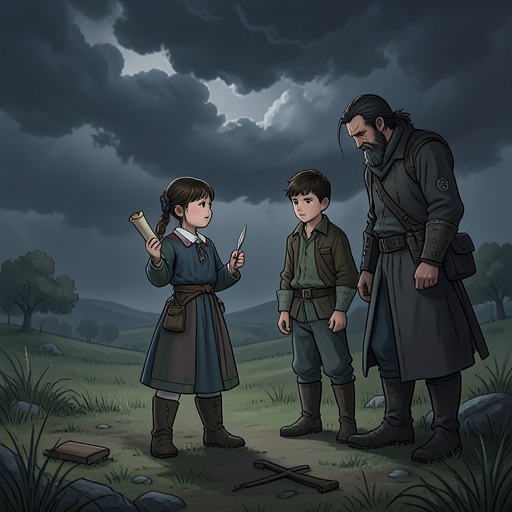
The Silver ChairThe “UNDER ME” inscription is the decisive written clue in the ruined giant city: it directs Jill Pole, Eustace Scrubb, and Puddleglum to seek Prince Rilian beneath the city, while its belated recognition exposes how the travelers have let distraction defeat the instructions they were given. The words appear in both Jill’s dream and the actual pavement, turning a brief vision into a physical sign they have already traversed without understanding.
Appearance and Setting
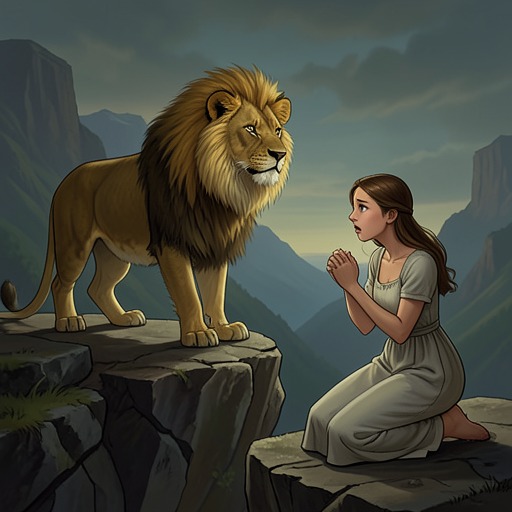
In Jill’s dream, the phrase is written in great letters across the world or sky, though she cannot tell which. The dream begins in the giants’ castle, where the fire is low and red and a wooden horse seems to move of its own accord before becoming a lion. The lion is Aslan, whom Jill recognizes from the mountain beyond the world’s end. He carries her to the window and makes her look out; the words “UNDER ME” appear in the bright moonlight. The dream fades, and Jill wakes late the next morning without remembering it.
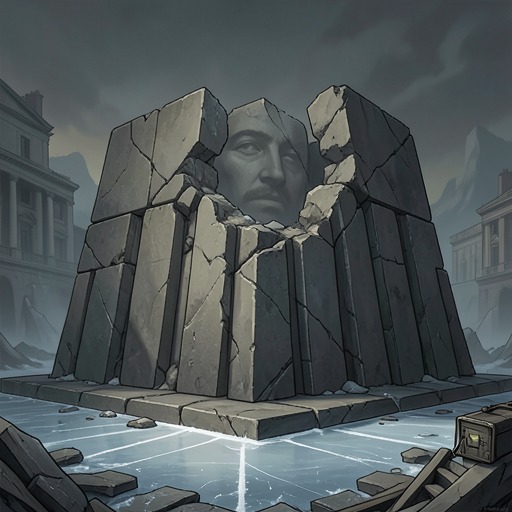
The inscription has a corresponding, material form at the ruins. After the rain washes almost all the snow away, Jill and her companions look down from the castle and see the hilltop they crossed the previous afternoon as a vast ruined city. Its flat surface is still largely paved; broken crosswise banks are the remains of walls, and what seemed to be factory chimneys are enormous broken pillars. The ledges on the northern and southern sides prove to be surviving steps of giant stairways. Across the centre of the pavement, in large, dark lettering, the same words run: “UNDER ME.”
Meaning and Route
The words supply the instruction the searchers need: Puddleglum understands them to mean that the Prince is to be sought under the city. Their plain wording becomes a geographical direction, linking the inscription’s position on the paving stones to the world below them. Yet it does not itself show the travelers an entrance or explain how to descend. Puddleglum reasons that if they had kept their attention on their task while still in the ruins, they might have been shown a little door, a cave, or a tunnel, or met someone who could help them. He also allows that Aslan himself might have appeared. By the time they work out the message, that opportunity has passed, and getting back to the city seems necessary but difficult.
Eustace reconstructs how the party had unknowingly followed the writing. Their sunken lane was the bottom stroke of the letter E in “ME”; they walked north along it, turned right up the upright stroke, turned right again along the middle stroke, and continued to the upper-left, or northeastern, corner before coming back. The apparent route through the landscape had in fact taken them through a letter in the inscription. The sign was not absent or hidden by the snow: they had entered its shape and walked its lines without reading them.
Failure to Recognize the Sign
The morning view produces an immediate recognition of failure. Eustace says that the second and third signs have been missed. Jill recalls her dream and blames herself, explaining that she had stopped repeating the signs each night; had she kept thinking about them, she believes she might have recognized the city even under the snow. Puddleglum admits that he had nearly recognized it as a ruined city, but did not act on that impression. Their responses distinguish a clue’s presence from the attention required to use it: the lettering was in front of them, and the dream had reinforced it, but neither fact had guided their choices in time.
Eustace identifies a further cause: since meeting the woman who travelled with the silent knight, the party had been keen to reach the giants’ castle and had nearly forgotten Prince Rilian. Puddleglum suspects that this diversion was exactly what the woman intended. The inscription therefore exposes not just a navigational error but the consequence of displaced purpose. Pursuing the apparent destination has made the searchers pass directly through the sign that points toward their actual objective.
When Jill wonders whether Aslan could have put the words on the stones during the night, she recounts the dream to the others. Eustace rejects the comforting possibility that the instruction appeared only after they had passed: he recognizes that they had walked along its letterforms. He also names the temptation to make the failure someone else’s responsibility, imagining that Jill and he both wished the writing had been added later, so that the missed direction would have been Aslan’s fault rather than their own. Their admission restores the distinction between an instruction being available and a traveler choosing to heed it. Jill still insists that she is responsible for spoiling the journey, but asks what the words mean; Puddleglum’s interpretation turns the recognition into a renewed, if uncertain, practical task.
Narrative and Thematic Function
The inscription binds dream, landscape, and quest into a single sign. Jill’s vision offers the words before she can consciously remember them, while the morning revelation places their monumental counterpart in the very terrain the travelers have crossed. The match makes the dream relevant without making it a sufficient guide: its meaning has to be recalled, interpreted, and connected to the physical city. Once the ruins are visible, Eustace’s tracing of the letter E reveals that the party’s own route has already enacted the message’s graphic form without producing understanding.
Its placement also gives the city’s ruins a double character. The broken walls, immense pillars, stairways, and pavement are remnants of a giant civilization, but the pavement is also a surface bearing directions that the travelers fail to read. The words do not merely decorate the setting; they make the landscape legible as a clue and turn its paths into parts of a written message. The failure to notice that message helps explain why reaching the castle has not brought the searchers closer to their goal.
“UNDER ME” is thus both instruction and test of attention. Its meaning is concise, but its consequences depend on remembering the earlier signs and resisting the diversion from the search for the Prince. The travelers can now state what they should have understood and where the Prince must be sought, yet they cannot simply reverse their mistake: the castle door is beyond their reach, and Puddleglum acknowledges that finding a way back down to the city is another matter. The inscription clarifies the direction of the quest precisely when the practical path has become harder to recover.