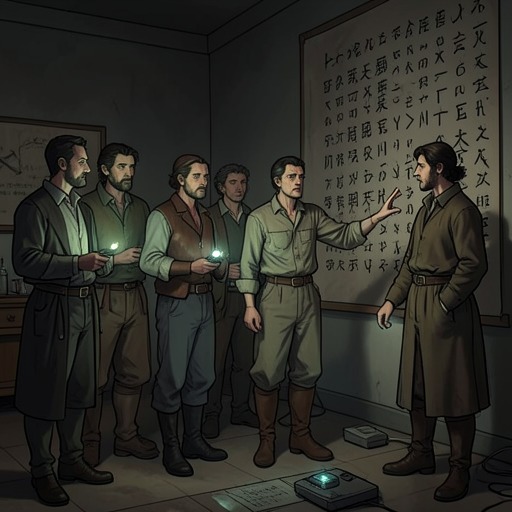
“There is no sun”
The Silver Chair“There is no sun” is the Lady of the Green Kirtle’s repeated claim that the world above ground does not exist. When the Prince, the Marsh-wiggle, and the children repeat it after her, the phrase records a moment of collective surrender to her enchantment; Jill’s recollection of Aslan immediately exposes that surrender as reversible.
The phrase and its repetition
The Witch first argues that the sun is only a dream copied from the lamp in the underground chamber: because her listeners cannot clearly describe the sun, she insists it is merely a children’s story. Jill briefly accepts this reasoning, feeling that it makes sense. The Witch then reduces the argument to a short, categorical assertion, repeating, “There is no sun.”
The claim shifts from argument to refrain. After the Witch says it again, more softly and deeply, the others remain silent; following a pause and an inner struggle, all four say together, “You are right. There is no sun.” The narrator notes the relief they feel in giving in. The phrase’s apparent simplicity thus conceals a change in their relation to their own knowledge: they voice the Witch’s denial as though it were their own conclusion.
A moment of submission—and resistance
The Witch’s assertion becomes even more absolute when she declares, “There never was a sun.” The Prince, the Marsh-wiggle, and the children repeat that stronger version. Their agreement shows the extent of her immediate influence, but the scene does not end with the denial firmly established.
For several minutes, Jill has sensed that she must remember something at all costs. The memory returns, though saying it feels difficult: she experiences the effort as if great weights lay upon her lips. She finally says, “There's Aslan.” The remembered name punctures the closed logic of the Witch’s claim. In the scene’s sequence, the refrain is therefore both the sign of the captives’ temporary capitulation and the point against which Jill’s recovered memory takes its stand.
Narrative significance
The exchange makes the conflict over reality audible. The Witch first invites her listeners to treat the sun as an inferior copy of the lamp, then turns that comparison into a denial, and finally draws them into repeating it together. Their shared words create an appearance of certainty, while Jill’s struggle to speak reveals that this certainty has been imposed rather than calmly reached.
The phrase’s force lies in its repetition and reversal: the captives echo the Witch, but Jill remembers Aslan before the denial can become the scene’s final word. Her recollection does not erase their moment of surrender; it shows that the remembered world can still be named against the enchantment. The episode turns a claim about the sun into a test of whether the characters can hold to what they remember when another voice insists that it never existed.