Eidin Wasteland
The Silver ChairEttinsmoor is the vast, lonely moor north of Narnia and beyond the River Shribble, forming a difficult stretch of the route in the search for Prince Rilian. Its rough uplands, wind-scoured approaches, and uncertain association with the Ruined City make the landscape more than a passage: it tests the travelers’ endurance and helps expose how hardship and the promise of comfort can draw them away from their purpose.
Setting and Boundaries
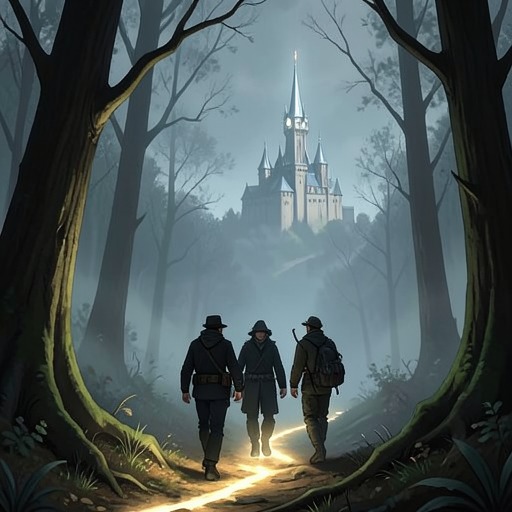
The northern edge of the marshland gives way to low, pale hills and occasional rocky cliffs, the beginning of Ettinsmoor. A river, the Shribble, separates the moor from the marsh; there are no bridges. From the marsh, the land looks like a remote, elevated barrier, and the travelers must find their own way across its natural boundary.
The moor is broad and sparsely marked. After scrambling up from the valley-land of Narnia, the travelers see it stretching northward as far as they can see. Rockier ground lies to one side, where Jill guesses the edge of the giants’ gorge may be. They avoid that side and set out across the upland instead. The open country offers no clear, easy route, but it is at first springy underfoot, with occasional streams and hollows.
The Ruined City and the Giants
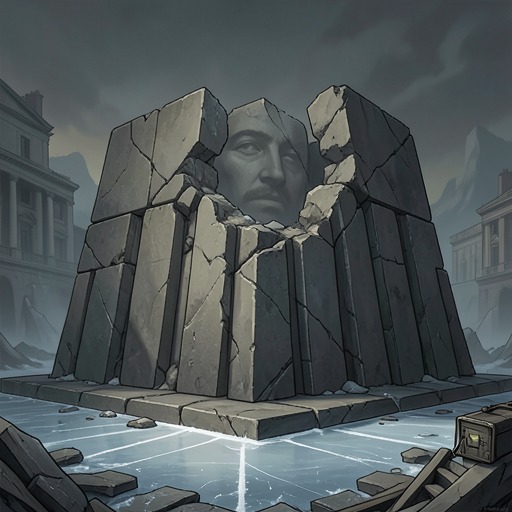
Ettinsmoor is associated with the Ruined City that the travelers hope to find by following Aslan’s signs. Puddleglum says the city, if it exists where people suppose, lies across the moor, but he has gone as far in that direction as most people without finding ruins. His uncertainty keeps the destination from becoming a dependable landmark: the party has a direction, but no confirmation that the sought-for place is there.
The upland is also connected with giants. Puddleglum identifies the people Jill asks about as giants, and Scrubb recalls that the King once told him he had defeated the giants in war and made them pay tribute. Near the approach to the moor, a gorge runs down from the upland. Puddleglum explains that giants mainly live along its sides, as though the gorge were their street. He recommends the steeper route straight ahead rather than following the stream into the gorge, and the travelers climb out of the valley and turn north.
Crossing and Exposure
At first the walk across the moor seems manageable. In pale winter sunlight, the ground is springy, and the sounds of peewits and an occasional hawk punctuate the growing loneliness. During a rest beside a stream, Jill begins to think she might enjoy adventures after all; Puddleglum replies that they have not had any yet. The exchange captures the moor’s ambiguous character: its open air and quiet can lift the travelers’ spirits, but the apparent calm offers no assurance that the journey will be easy.
After the travelers are diverted toward Harfang, the terrain grows harder. Their road passes through narrow, endless valleys where a cruel north wind blows into their faces. There is no usable firewood and no sheltered hollow like those they had found on the moor; stony ground hurts their feet by day and leaves them sore at night. These conditions intensify their longing for beds, baths, and hot meals, and they stop talking about Aslan and the lost prince. Jill also abandons her habit of repeating the signs each morning and evening. The difficult landscape thus works together with the promise of comfort: exhaustion makes the detour emotionally persuasive, even as it weakens the travelers’ attention to their quest.
From the Moor to the Ruined City
The route eventually passes through mountains and brings the travelers to a desolate rocky plain, with further snow-capped mountains beyond it and a low, flat-topped hill ahead. In the storm on that hill, the terrain becomes nearly impossible to read or cross. Four irregular ledges interrupt the ascent; on the exposed tableland, wind sweeps snow into their faces, smooth patches lie almost like ice, and banks two to five feet high divide the ground into squares and oblongs. Deep drifts collect on the north sides, wetting the travelers each time they climb over a bank.
Although this storm-crossed tableland comes after their passage through the uplands, it continues the northern journey’s pattern of terrain dictating movement and attention. Jill glimpses forms that resemble factory chimneys and a cliff unnaturally straight in outline, but her cold hands and her thoughts of Harfang occupy her instead. The travelers ultimately reach the underground route beneath the Ruined City. In the darkness of the underground sea, Puddleglum insists that they are back on the right lines: they were meant to go under the city, and now they are doing so. The geography that first seemed uncertain becomes, in retrospect, part of the instructed journey, while the crossing itself has shown how easily immediate discomfort can obscure its purpose.