Harfang’s custom of serving humans at the Autumn Feast
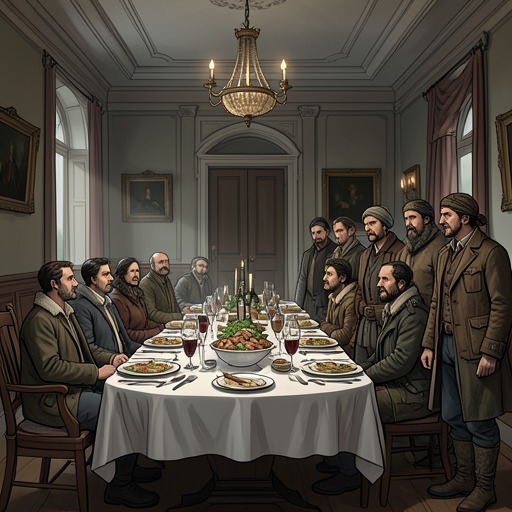
The Silver ChairHarfang’s custom of serving humans at the Autumn Feast is a culinary tradition that makes the travelers’ apparent welcome dangerous: a cookbook treats humans as a delicacy, and the giants pursue Jill Pole, Eustace Scrubb, and Puddleglum as food. The rule exposes the gulf between the giants’ polite domestic setting and the travelers’ status as potential prey.
The cookbook’s categories
At the castle, Jill finds a cookery book arranged alphabetically. Its entry for “MAN” describes humans as a delicacy and says they are traditionally served at the Autumn Feast, between the fish and the joint. The matter-of-fact recipe format makes the custom appear routine within giant society, even as its meaning horrifies the human-sized visitors.
The next entry, for “MARSH–WIGGLE,” likewise treats a speaking people as a possible foodstuff, though it notes objections based on the meat’s texture and flavour. Puddleglum points it out while Jill and Eustace read the entry about humans. Together, the entries show that the book’s classifications extend beyond humans: beings whom the travelers know as persons are listed according to their suitability for giant consumption.
Evidence of the practice
The travelers have already encountered the custom’s consequences before Jill reads the book. At a meal, they overhear giants discuss a stag they have killed, joking that it claimed it was too tough to eat. Eustace recognizes the victim as a Talking stag. For him, the killing is comparable to murder; for Jill, who is new to Narnia, it is a cruel killing; Puddleglum, born in Narnia, experiences it as the equivalent of eating a baby. Their different reactions emphasize that the stag was not merely an animal to them, but a speaking member of their world.
Puddleglum interprets the meal as a consequence of the travelers’ failure to heed Aslan’s signs, and the discovery ends their appetite. The episode also gives the cookbook’s entry a practical context: the giants’ food customs are not limited to a threat written on a page, but are reflected in what they hunt and eat.
Flight and significance
Once the travelers understand the danger, they leave the hall quietly. Later, as they escape from the castle, the giants discover them and give chase. Jill hears the King order the pursuit so that they will have “man–pies” for the next day. The threat confirms that the Autumn Feast custom is not an abstract tradition: the giants intend to make the fugitives into its next meal.
The custom reverses the expected roles of host and guest. The castle’s hospitality and its household book belong to a society that can regard intelligent beings as ingredients, while the travelers’ recognition of speech, thought, and community makes that treatment morally intolerable. The contrast is sharpened by Narnia’s broader social world, where the Prince is recognized by Beasts, Dryads, Dwarfs, and Fauns as their rightful king. Harfang’s food rule therefore marks a serious boundary between its giants and the community the travelers seek to rejoin.