Kyojin
The Silver ChairGiants are a people divided in the travelers’ experience between the reckless giants of Ettinsmoor and the apparently civilized giants of Harfang. Their immense size makes them a visible threat on the northern journey, but the deeper danger is the contrast between openly hazardous behavior and the polished welcome that leads the travelers toward the Autumn Feast.
Identity and Contrasting Communities
When Jill asks what sort of creatures they might encounter, Puddleglum identifies them as giants. The answer gives shape to an anxiety she already carries: she dislikes giants even in books and remembers having met one in a nightmare. Eustace, by contrast, recalls that Caspian X once told him of defeating giants in war and making them pay tribute. Giants therefore enter the journey both as a feared kind of creature and as a people whose past conflict with Narnia is already part of Eustace’s knowledge.
The travelers encounter the giants of Ettinsmoor first. Puddleglum later contrasts them with Harfang’s residents: the former are foolish, fierce, savage, and given to beastliness; the latter are presented by the Lady of the Green Kirtle as mild, civil, prudent, and courteous. This distinction matters to the travelers because the promise of safety and comfort makes the second group seem like a refuge from the first. Yet the story’s evidence will not let courtesy stand as proof of harmlessness.
The Giants of Ettinsmoor
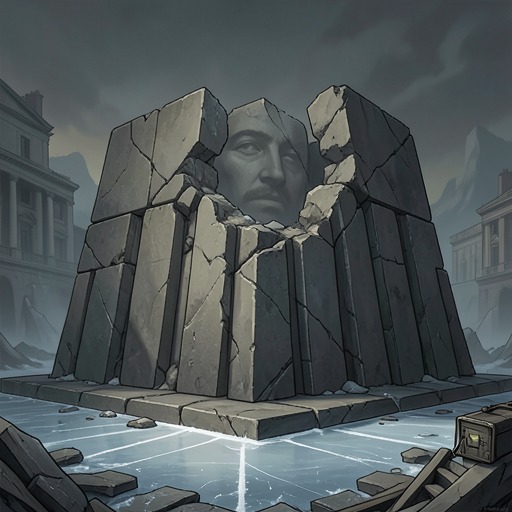
The first giants appear above a gorge. At first, Jill mistakes their shapes for unusual rock formations, imagining how heads, hair, beards, and ears might be read into the landscape. Then one moves, and the supposed rocks become real giants: forty or fifty figures in a row, leaning their elbows on the gorge’s edge as casually as people resting against a wall. The scene turns a landscape impression into immediate danger, while the number and scale of the figures make the travelers seem exposed and small.
Puddleglum tells Jill and Eustace to keep walking, avoid looking at the giants, and not run. The giants do not appear angry or interested, and there is no sign that they have noticed the travelers. Nevertheless, heavy stones begin to fall around them. Eustace wonders whether the giants are aiming at the group; Puddleglum explains that they are trying to hit a cairn and that their poor aim makes the travelers safer than if they were deliberate targets. The stones’ intended game is cock-shies, which Puddleglum describes as about the only game the giants are clever enough to understand.
The danger continues as the travelers pass a seemingly endless line of stone-throwers. After roughly twenty-five minutes, the giants quarrel, ending the game but bringing a new disturbance. Their long, meaningless words, jumping, and blows with stone hammers turn their stupidity into a source of further peril: they hurt themselves, repeat the same actions, and eventually sit down crying. Their behavior is presented as both comic and frightening. The humor does not remove the risk; it arises from the same heedlessness that makes their violence unpredictable.
The Invitation to Harfang
After meeting the Lady of the Green Kirtle, the travelers discuss their business cautiously. Puddleglum refuses to explain their errand to strangers, while the Lady offers information about the route to the giantish City Ruinous. She says the road leads instead to Harfang, where the gentle giants live, and suggests that the travelers might hear news of the ruined city there. More immediately, she advertises a place to winter, with baths, beds, bright fires, and four substantial meals each day.
The offer is tailored to travelers who have been walking through difficult country and longing for rest. Eustace responds enthusiastically to the prospect of sleeping in a bed again. The Lady’s description sets Harfang against the open dangers of Ettinsmoor: where the first giants threatened the travelers with falling stones, these hosts appear to promise comfort, order, and welcome. But the invitation is also a diversion from the journey’s purpose, and the travelers’ response shows how readily physical weariness can make a reassuring destination attractive.
Harfang’s Welcome and the Autumn Feast
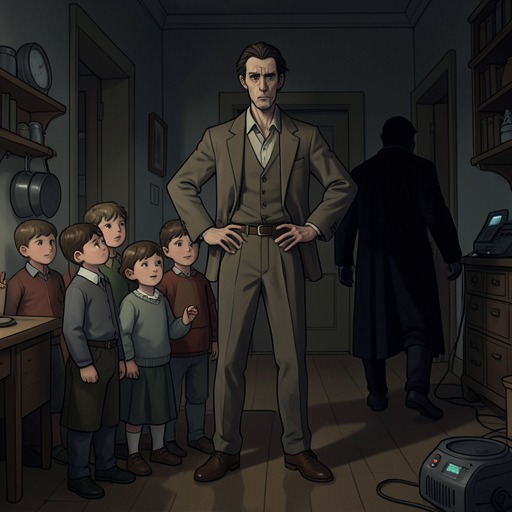
At the entrance to the giants’ home, a porter appears in the doorway. He is described as very tall but not as large as the travelers may have expected, with red hair, a leather jerkin covered in metal plates, bare knees, and puttees. He stoops to inspect Puddleglum and asks what kind of creature he is. Jill addresses him by invoking the Lady of the Green Kirtle’s greeting to the King of the Gentle Giants and explains that she has sent two Southern children and a Marsh-wiggle to the Autumn Feast. The travelers enter Harfang under the protection of the Lady’s introduction, presenting themselves as guests rather than as people in danger.
The meaning of that hospitality changes when Jill sees a cookery book. Its entry on humans describes them as a delicacy and says that they are traditionally served at the Autumn Feast between the fish and the joint. Jill cannot continue reading, but turns to see that the giantess beside her has awakened. She alerts Eustace and Puddleglum; they look at the book together, and Puddleglum points out the entry that describes Marsh-wiggles as unsuitable for giants’ consumption because of their stringy consistency and muddy flavour. Harfang’s civilized presentation is thereby exposed as a cover for treating its guests as food.
Narrative Significance
The giants’ two communities make the travelers’ judgments about danger more complicated than a simple opposition between a hostile people and a friendly one. The giants of Ettinsmoor are visibly dangerous, and Puddleglum’s practical advice helps the travelers pass them without drawing attention. At Harfang, the danger is harder to recognize because it arrives through an invitation, a promised bed, and the language of courteous hosting. The cooking book supplies the evidence that polite conduct alone cannot establish safety.
The episodes also connect scale with vulnerability. At the gorge, the giants’ casual stone-throwing endangers the travelers without requiring them to be the intended target. At Harfang, their enormous social power makes the feast’s customary treatment of humans a threat the guests only discover after accepting the welcome. The giants’ role in the journey thus extends beyond physical obstacles: their contrasting behavior tests whether the travelers can distinguish genuine safety from comfort that conceals peril.