Mountain of Aslan
The Silver ChairMountain of Aslan is the high, otherworldly place beyond the world containing Narnia where Jill and Eustace, accompanied by Aslan, encounter King Caspian’s body after his death. Its sudden summer brightness and the stream bearing Caspian’s body turn the children’s return home into a scene of mourning and revelation.
Setting and Arrival
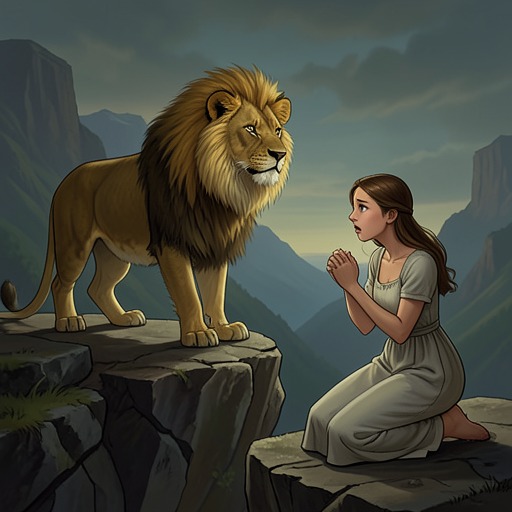
After Aslan tells Jill that she and Eustace have done the work for which he sent them into Narnia, Jill asks whether they may go home. Aslan answers that he has come to bring them Home, then blows. The ship, the dead King, the castle, the snow, and the winter sky drift away like wreaths of smoke; the children remain still rather than feeling themselves fly through the air. In their place is a landscape of midsummer sunshine, smooth turf, mighty trees, and a fresh stream.
The children find themselves once more on Mountain of Aslan, high above and beyond the world in which Narnia lies. The transition sets the mountain apart from the changing weather and mortal landscape they have just left: winter disappears, while the mountain’s clear summer light opens a different vantage on what has happened.
Caspian at the Stream
The funeral music for King Caspian continues as the children walk beside the stream, though its source cannot be located. Aslan leads them, and Jill cannot tell whether the Lion’s beauty or the despairing music is what fills her eyes with tears. Grief reaches them through both sight and sound before the body is shown.
When Aslan stops, the children look into the stream and see Caspian lying dead on its golden gravel, with water flowing over him like glass. His long white beard sways like water-weed. Jill, Eustace, and Aslan all weep. Eustace’s crying seems to Jill neither like a child’s tears nor like a boy’s embarrassed effort to hide them; she can only compare it to an adult’s grief. Yet the mountain complicates ordinary measures of age: people there do not seem to have particular ages.
The Mountain’s Significance
The scene holds loss and homecoming together. The funeral music persists even after the ship and the winter world vanish, so Caspian’s death is not erased by the children’s passage to the mountain. Instead, the stream makes the loss visible, and Aslan’s own tears place the Lion within the shared mourning rather than outside it.
The mountain also changes the scale of the children’s experience. Jill’s attempt to understand Eustace’s grief through familiar stages of childhood and adulthood fails in a place where age itself does not seem fixed. Their encounter with Caspian’s body is therefore both a concrete confrontation with death and a passage into a setting beyond the ordinary world, from which Aslan will lead them home.