Puddleglum
The Silver ChairPuddleglum is a Marsh-wiggle whose bleak expectations never prevent him from acting with courage. He joins Jill Pole and Eustace Scrubb in their search for Prince Rilian, then helps them resist the Green Witch and rescue the prince. His importance lies in the gap between his pessimistic predictions and his steadfast conduct: he expects hardship, but does not use that expectation as a reason to abandon his companions or the instructions Aslan gave Jill.
Identity and Introduction
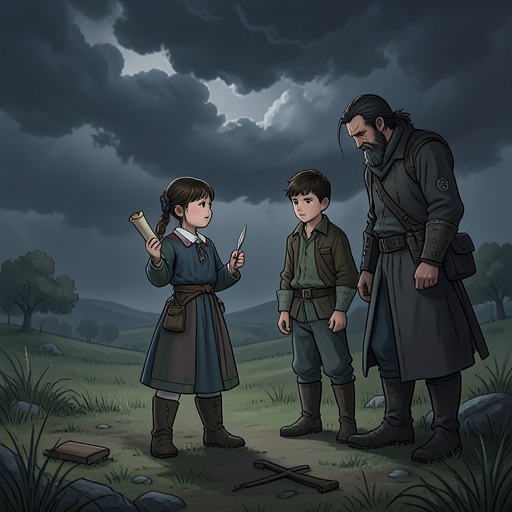
Puddleglum first appears after Glimfeather carries Jill and Eustace through the night to find him. Glimfeather calls him awake on the Lion’s business, and Puddleglum’s distant light approaches with questions about possible emergencies in Narnia. Even before he meets the children, his instinct is to imagine calamity; the scene also makes clear that his call to join them concerns more than an ordinary visit.
When Eustace asks his name, Puddleglum gives it plainly and adds that it does not matter if they forget, since he can always tell them again. The introduction is characteristic: he makes little of himself even as he becomes an indispensable member of the party. Jill and Eustace sit on either side of him and notice his very long limbs, webbed fingers and bare webbed feet, and loose, earth-coloured clothes. His body and clothing mark him as a Marsh-wiggle, while his plain-spoken manner establishes a personality that is recognizable without being limited to a single function.
Joining the Search
When Jill asks whether he can help find Rilian, Puddleglum does not promise success. He predicts a difficult northern journey, with winter approaching, enemies, mountains and rivers to cross, the risk of losing their way, little food, and sore feet. Yet his catalogue of obstacles does not end in refusal. He turns the possibility of failure into another dry forecast: even if they do not get far enough to help, they may get far enough not to return quickly.
The children notice that he says we rather than you, and ask whether he is coming with them. He confirms that he is. His decision is tied to his concern for Narnia’s future: he fears they may never see the King again after the King’s departure abroad, worries that Trumpkin is failing, predicts a poor harvest after a dry summer, and suspects that an enemy may attack. These predictions are not reported as events that have come to pass; they explain the anxious outlook with which he approaches the quest. Whatever he expects, he places himself beside the children rather than leaving them to face the journey alone.
Loyalty to Aslan’s Instructions
At the decisive moment in the underground chamber, Puddleglum faces a choice with no assurance of a happy outcome. The captive knight is bound to the silver chair, and Jill and Eustace consider whether to release him. Puddleglum recalls the limit of what Aslan told Jill: Aslan specified what she must do, not what would happen afterward. The knight might prove their destruction, he admits, but uncertainty does not excuse them from following the sign.
That distinction defines his loyalty. Puddleglum does not claim to know the future or turn faith into a guarantee of safety. He accepts that freeing the captive may bring danger and still insists that the instruction be carried out. As Jill agrees to proceed, the group faces the possibility of death together; Puddleglum and Eustace draw their swords and approach the prisoner. His courage is therefore not confidence that events will go well, but willingness to act when the outcome is unknown.
Once released, the knight destroys the silver chair. He recognizes Puddleglum as a real Narnian Marsh-wiggle, and Puddleglum answers the Green Witch’s subsequent denial of Narnia with the authority of lived experience: he has lived there all his life. His simple testimony counters the Witch’s effort to make the place seem unreal, and it confirms how important the connection between remembered experience and present belief will become.
Resistance to the Green Witch
The Witch tries to persuade the four travelers that the world above is only a childish invention, insisting there is no Narnia, Overworld, sky, sun, or Aslan. Under the spell, the others begin to lose their strength and conviction. Puddleglum, too, struggles against the pressure, but he draws on specific memories rather than abstract argument: he remembers the sky full of stars, the sun rising from the sea, disappearing behind the mountains, and shining overhead at midday. He concedes that the Witch might have blotted out the world; what he will not concede is that he never experienced it. His recollection restores the others’ confidence enough for Rilian to recognize that they have been forgetting what they know.
When the Witch renews her attempt to dismiss their beliefs as make-believe, Puddleglum acts before answering. He crosses to the fire and stamps on it with his bare foot, knowingly accepting pain to interrupt the spell. His action weakens the fire and its sweet smell, clears the others’ minds, and exposes a sharp change in the Witch’s manner when she threatens him. The pain itself brings Puddleglum’s own thoughts into focus. The scene makes physical cost part of his resistance, but its decisive result is a recovery of clear judgment: he can now answer the Witch without pretending to certainty about every disputed point.
His reply begins in his habitual register of caution. He allows that the Witch’s claims might be right, then argues that even if Narnia and its familiar world were imagined, they would seem more important than her underground kingdom. He refuses to accept the Witch’s account of what is real as the only measure of what deserves allegiance. He is prepared to stand on Aslan’s side even if Aslan is not there to lead him, and to live as like a Narnian as he can even if Narnia does not exist. The thought is not a retreat from belief so much as a declaration that the values embodied by Aslan and Narnia remain worth choosing under the Witch’s most hostile assumptions.
Puddleglum ends by proposing that the company leave the Witch’s court and seek Overland, though he expects their lives may be short. Jill and Eustace acclaim him, and Rilian turns to warn them of the Witch. Puddleglum’s stand has broken the enchantment’s hold and shifted the scene from a contest over what the companions can remember to immediate physical danger.
Combat, Rescue, and Return
When the Witch transforms into a serpent and coils around Rilian, Puddleglum joins the prince and Eustace in the fight. Eustace’s blow fails to pierce the serpent’s scales; Puddleglum and Rilian strike at its neck. Their blows weaken its hold, and repeated attacks by the three companions finally kill it. Puddleglum is thus not only the party’s voice of resistance: he takes part in the action that frees Rilian from the creature that has kept him captive. Rilian then identifies the serpent as the same one he pursued after it killed his mother, revealing that his long enslavement had been at the hands of her killer.
After the travelers escape the underground realm, Puddleglum emerges into the moonlight from a great opening dug in a hillside by Narnian helpers. The crowd recognizes him as an old Puddleglum from the Eastern Marshes and mentions that search parties have been looking for him and that Trumpkin has posted notices. The reunion is halted when the rescuers see Rilian. Their recognition of the prince turns the rescue into a public restoration: attention moves from the missing Marsh-wiggle to the returning heir, while Puddleglum stands among those who have brought him back.
At the close of the adventure, Jill visits Puddleglum’s bed to say goodbye and apologizes for calling him a wet blanket. Eustace calls him the best friend in the world, and Jill hopes they will meet again. The exchange offers a final contrast to Puddleglum’s own repeated expectation of trouble. His companions remember him not simply for gloom or grim forecasts, but as a friend whose loyalty, judgment, and willingness to act helped carry them through the quest.