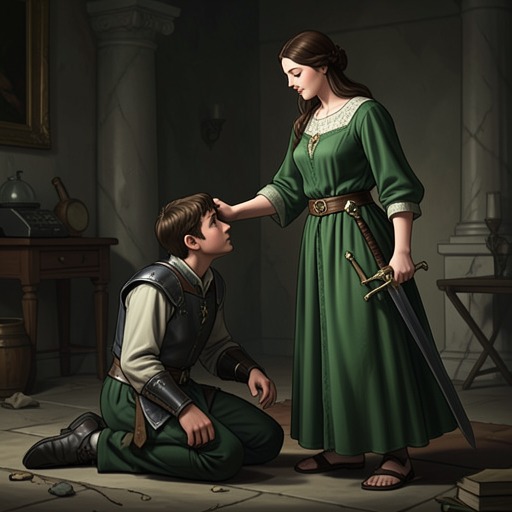
Rilian’s Enchanted Captivity
The Silver ChairRilian’s Enchanted Captivity is a magical imprisonment in the Underland that separates Rilian from his identity and homeland while making his nightly release depend on the very people who have been warned not to free him. Its decisive reversal comes when Jill Pole, Eustace Scrubb, and Puddleglum recognize Aslan’s sign in Rilian’s plea, cut his bonds, and see him destroy the silver chair that has held him. The episode turns a rescue into a test of memory and trust: the captives must distinguish the Queen of Underland’s account of Rilian from the truth his own divided experience can no longer reliably tell him.
Identity and Conditions of the Captivity
Rilian cannot recall who he was before living at the Queen of Underland’s court, or how he came to the Dark World. He accepts the Queen’s explanation that she rescued him from an evil enchantment and brought him there through generosity, yet he also says that he remains bound by a spell from which only she can free him. His account is therefore shaped by a contradiction he cannot resolve: he trusts the person who claims to be his protector while describing a continuing captivity that only she controls.
The enchantment has a nightly cycle. Rilian says that at a particular hour his mind changes first, making him furious and dangerous even toward his closest companions; after that, he is said to become a great serpent. He has no memory of these episodes when they end. He wakes again in his proper human form and sound mind, though tired, and learns what occurred from other people, including the Queen. The spell thus divides what happens to him from what he can know about himself: the apparently composed man at court cannot directly testify to the transformation that defines his imprisonment.
The Queen’s Account and the Planned Invasion
The Queen presents Rilian’s captivity as a temporary condition on the way to kingship. She has told him that the enchantment will end once she makes him king of a land in the Overworld and places its crown on his head. He believes that the destination has already been chosen and that the Queen’s Earthmen are digging toward it, beneath the grass where the people above live. He expects the tunnel to break through soon, allowing him to ride out with the Queen and a thousand Earthmen, attack the inhabitants, kill their leaders, and take the crown within a day.
This promised release is inseparable from a plan of conquest. Rilian understands the Queen’s scheme as his route back to health and rule, not as an attack on another people; the Queen’s framing gives him a future while concealing its cost to those who live above. Puddleglum, by contrast, identifies the Queen as a witch and an enemy, and warns that danger, deception, magic, and treason surround the travelers. The discrepancy makes Rilian’s account evidence both of the spell’s reach and of the political purpose for which the Queen is using him.
The Chair and the Nightly Crisis
When the travelers return to the room after dinner, the main door has been shut and Rilian is bound to a silver chair. Restraints hold his ankles, knees, elbows, wrists, and waist; sweat and anguish mark the approach of the nightly fit. Although he is still able to speak, he warns the visitors that the spell will make him beg or threaten them to release him. They must not yield, he says, because while he remains tied they are safe, whereas freedom would bring first his fury and then the serpent form.
As the fit begins, Rilian strains against his bonds and speaks of being buried under the earth and held in a tangled enchantment. In this state he remembers the Overworld through images absent from his account of court life: wind, sky, and a little pool reflecting green trees and blue sky. The images convey his longing to return, but they do not immediately settle the travelers’ dilemma. He then says that he is sane every night and asks them to cut him loose, believing that freedom from the chair would let his recovered self endure.
Rilian’s appeal grows more difficult to resist because it alternates threats with assurances of friendship. He warns that he could be their mortal enemy if they leave him bound, and then invokes the bright skies of Overland and Aslan himself as he charges them to free him. The travelers remember their promise not to release him, but they also recognize the appeal to Aslan as the sign they were instructed to follow. Their uncertainty centers on whether the Queen has manipulated Rilian into speaking the required name or whether this is the genuine sign. They have already failed to obey three signs and fear missing the fourth as well.
Release and the Return of Rilian’s Identity
Jill decides that they must act. Puddleglum and Eustace draw their swords and methodically cut the cords while invoking Aslan. As soon as he is free, Rilian crosses the room, takes up the sword that had been removed from him and placed on the table, and strikes the silver chair. Its destruction is immediate: the chair breaks into twisted fragments, accompanied by a flash and a sound like small thunder. Rilian condemns it as an instrument of sorcery, intended to prevent the Queen from using it on another victim.
With the chair broken, the wrongness in Rilian’s face is gone, and he recognizes Puddleglum as a real Narnian Marsh-wiggle. He asks whether he had forgotten Narnia under the spell, then identifies himself as Rilian, Prince of Narnia, and names Caspian as his father. The disclosure establishes the truth the Queen’s story had obscured: the captive is not an unknown man whom she rescued, but the missing prince of the Overworld. Puddleglum and the children kneel and explain that they came to seek him; the spell’s end restores not only Rilian’s self-recognition but also the relationship and purpose that connect him to his rescuers.
Narrative Significance
The captivity is built around competing accounts of reality. In the Queen’s version, Rilian is a dependent guest awaiting a cure and a crown; in his own nighttime recollections, he is a prisoner longing for the sky, though the spell leaves him uncertain about his past. The chair makes that concealed condition visible: the man who warns his visitors not to release him is physically bound to the object that sustains his captivity. Its destruction is therefore both a practical act of rescue and the material end of the Queen’s control over his nightly transformation.
The rescue also tests whether the travelers will act on the signs they were given when doing so seems dangerous and emotionally painful. Rilian’s appeal invokes Aslan at the moment when his behavior appears most alarming, so obedience cannot be reduced to trusting appearances or accepting the Queen’s explanation. By freeing him, the travelers recover the person whose identity and loyalty the enchantment had obscured, and halt a plan that would have used him to lead an invasion into the Overworld. The sequence binds personal liberation to the wider danger: ending Rilian’s captivity also removes the Queen’s intended instrument of conquest.