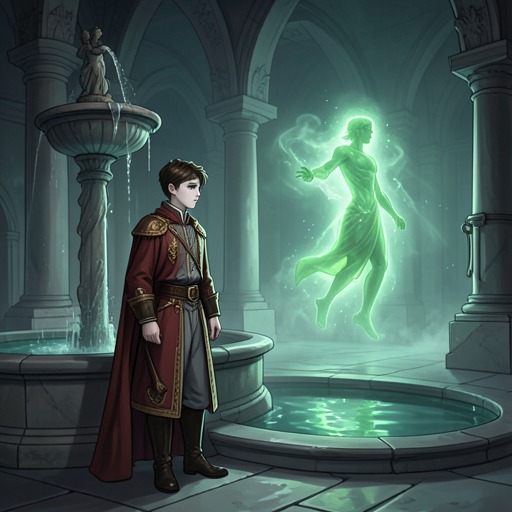
The Death of the Queen of Narnia
The Silver ChairThe death of the Queen of Narnia is the sudden loss that turns a family outing into a national bereavement and sets Prince Rilian on a path of grief, vengeance, and unexplained change. A green serpent attacks her in a woodland glade; Rilian pursues it but cannot reach it, and she dies before she can deliver the message she seems to be trying to give him. Her death is followed by mourning across Narnia and by Rilian’s repeated rides in the north.
The May Outing and the Attack
About ten years before the owl’s account, Rilian was a very young knight. On a May morning in northern Narnia, he rode with his mother, the Queen, and a large company of squires and ladies. They wore garlands of fresh leaves and carried horns, but had brought no hounds: this was a May outing, not a hunt. The group stopped at a glade where a fountain flowed from the earth, and dismounted to eat and drink.
When the Queen grew sleepy, the others spread cloaks for her on the grassy bank. Rilian and the rest of the party moved away so that their conversation would not wake her. A great serpent then came from the thick wood and attacked her. The party hurried to her, with Rilian arriving first; he saw the creature moving away and pursued it with his sword drawn. It was large, shining, and green, but it slipped into dense bushes beyond his reach.
Her Death and the Unspoken Message
Rilian returned to his mother and found the others gathered around her. He immediately understood that no medicine could save her. While she remained alive, she appeared to be trying to tell him something, but could not speak clearly; whatever the message was, she died without conveying it. Her death came less than ten minutes after the company first heard her cry.
The failed pursuit and the interrupted message give the scene two unresolved threads: the serpent escapes, and the Queen’s intended words remain unknown. The account establishes the attack and her death, but does not disclose what she meant to tell Rilian or connect the serpent to any further cause.
Mourning and Rilian’s Response
The Queen’s body was carried back to Cair Paravel, where Rilian, King Caspian, and all Narnia mourned her. She is remembered as a great, wise, gracious, and happy lady, the bride King Caspian had brought home from the eastern end of the world. People said that the blood of the stars flowed in her veins. Her loss is therefore presented not only as a private bereavement for her husband and son but as a public sorrow.
Rilian took his mother’s death especially hard. He thereafter rode continually along Narnia’s northern marches, seeking the venomous serpent so that he could kill it and avenge her. Although his journeys attracted little comment at first, he returned looking tired and distraught. About a month after the Queen’s death, observers began to notice a change in him: his eyes suggested that he had seen visions, yet although he spent the day riding, his horse showed no signs of hard exertion.
Drinian’s Question and the Event’s Place in the Story
Lord Drinian, Rilian’s chief older friend and a former captain of Caspian’s, eventually challenged the prince to stop pursuing the serpent. He argued that vengeance against a mindless creature could not be true vengeance and that Rilian was exhausting himself in vain. Rilian replied that he had almost forgotten the serpent over the previous seven days. When Drinian asked why he continued riding in the northern woods, Rilian said that he had seen there the most beautiful thing ever made. Drinian asked to accompany him the next day, and Rilian agreed.
That exchange marks a turn in the aftermath: Rilian’s northern rides, initially explained as a search for revenge, have acquired another purpose that he describes only in terms of a beautiful sight. The Queen’s death thus supplies the immediate cause of his grief and pursuit while also forming the narrative background to the change Drinian detects. Her own final message remains unrevealed in this account.