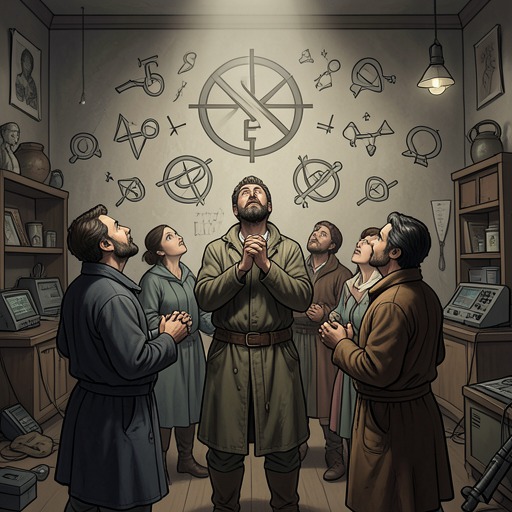
Christians
The Social ContractChristians are presented in The Social Contract as a collective figure in Jean-Jacques Rousseau’s inquiry into the conditions of legitimate political life. The central tension is not between private goodness and private vice, but between spiritual devotion and the worldly attachments on which civic solidarity, resistance to oppression, and a state’s survival depend. Rousseau’s account moves from universal brotherhood to political vulnerability: the qualities that make true Christians morally admirable, he argues, can also leave their community unable to protect itself.
Identity and Religious Setting
Rousseau distinguishes three forms of religion in their relation to society. The religion of man is the inward faith of the Gospel: it has no temples, altars, or rites, and consists in worship of the supreme God and the moral obligations common to humanity. A religion of the citizen, by contrast, belongs to a particular country, establishes its gods and public rites, and ties religious duty to the laws and identity of that political community. A third, priestly religion places people under separate religious and civil authorities, giving them competing obligations and allegiances.
The Christians at the heart of Rousseau’s argument are specifically adherents of Gospel Christianity, which he separates from the institutional Christianity of his own day. He describes them as recognizing one another as children of one God and therefore as brothers; the bond joining them is not dissolved even by death. Their fellowship reaches beyond the boundaries of a single state. That universality is ethically powerful, but it does not automatically make them a cohesive political body.
This distinction reflects the book’s broader method. Rousseau is not primarily describing the actual institutions of particular states; he is asking what principles could make political society legitimate. He rejects the idea that a fact, such as conquest or established power, can by itself produce a right to rule. In that framework, Christians matter as a test case: their faith may unite people morally, but the question is whether it can also provide the specifically civic attachment a state requires.
Goodness and Political Detachment
Rousseau grants the imagined community of true Christians an exceptional moral character. Its people would obey the laws, its rulers would be just and temperate, its magistrates upright, and its soldiers unafraid of death. Vanity and luxury would have no place. On these terms, the society looks close to perfect: its members do their duties without the ordinary temptations of private ambition.
Yet the same spiritual orientation that supports this virtue also weakens political attachment. Christianity, as Rousseau defines it here, concerns heavenly things; the Christian’s true country is not of this world. A believer may fulfill civic duties while remaining indifferent to whether the state prospers or suffers. Success can seem a source of pride to distrust, while political adversity can be accepted as providential. Public outcomes consequently lack the emotional and collective force that would make citizens defend their country as their own.
Rousseau’s paradox is that a society’s perfection may deprive it of the bond that holds it together. Because the true Christian looks beyond earthly fortunes, the community may be peaceful without being politically robust. Its members’ goodness does not necessarily become a shared determination to preserve their institutions; moral innocence, by itself, cannot replace civic solidarity.
Vulnerability to Political Power
The argument sharpens when Rousseau considers a community containing even one ambitious hypocrite. Christian charity, he contends, makes it difficult for believers to judge their neighbors harshly. A self-seeker can exploit that reluctance, acquire a share of public authority, and turn office into power. Once established, the usurper can be treated as someone whose authority must be respected, and then obeyed, as though the political situation were itself providential.
The resulting difficulty is not simply that bad people exist. It is that the virtues of the community can disable its response to their actions. Expelling an usurper would disturb public tranquillity, require force, and risk bloodshed; those measures sit uneasily with Christian meekness. Resignation may then appear preferable to the struggle for civic freedom. Rousseau’s imagined Christians are not unaware that domination exists, but their spiritual priorities make earthly political status seem secondary to salvation.
This is the political cost Rousseau attaches to a religion that does not bind citizens specifically to their state. It adds no civic force to laws by attaching them to a shared public cult, and it can draw believers’ hearts away from earthly affairs altogether. The contrast is with citizen religion, which makes the country and its laws objects of devotion. Rousseau acknowledges that such a religion can unite civic worship and loyalty, while warning that it may also rest on error and become exclusive, intolerant, and dangerous to other peoples.
War and the Limits of Christian Republics
The distinction between duty and political passion becomes clearest in war. Rousseau imagines Christian citizens marching into battle and performing their duty without seeking flight, yet lacking a strong desire for victory. They may be more prepared to die than to conquer. Against an enemy animated by pride, courage, and love of country, that stoicism could prove disastrous: disciplined willingness to accept an outcome is not the same as a collective determination to prevail.
He contrasts this imagined army with peoples such as Sparta and Rome, whose ardent attachment to glory and country could give them an advantage over Christians indifferent to earthly success. The example shows why Rousseau regards civic feeling as more than a private emotion. A state’s survival may depend on citizens who care about its fortunes and can act together to defend them; a purely spiritual orientation can leave them dutiful but politically uncommitted.
Rousseau therefore concludes that the terms Christian republic are incompatible under the account he has developed. He associates Christianity with dependence and argues that it can benefit tyranny, because believers may accept subjection rather than disrupt their peace or jeopardize their spiritual ends. This is a structural claim about political allegiance, not a story of an individual Christian’s conversion or changing character. Christians function as the decisive collective example in Rousseau’s argument: universal moral brotherhood may transcend national divisions, but, without a worldly bond to the state, it cannot by itself secure civic freedom or political endurance.