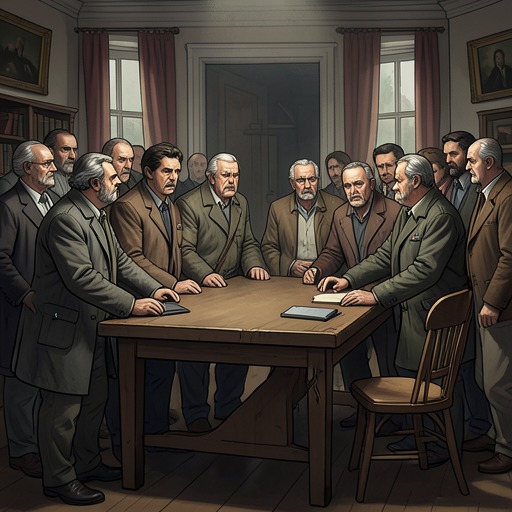
Oligarchy
The Social ContractOligarchy names the corrupted endpoint of aristocratic government in Rousseau’s account: when the State is dissolved, aristocracy degenerates into rule by a few. The term is not simply a label for a small governing body. It marks a political breakdown in which government’s particular will overcomes the general will, severing the compact that makes legitimate collective rule possible.
Definition and Place in the Typology
Rousseau places oligarchy in a sequence of political degeneration. Government naturally contracts from democracy to aristocracy and then from aristocracy to royalty; this movement from many rulers to fewer is not, by itself, the dissolution of the State. Dissolution occurs when government usurps sovereignty or its members seize powers that should be exercised collectively. Once the State is dissolved, the general name for governmental abuse is anarchy: democracy has become ochlocracy, aristocracy oligarchy, and royalty tyranny.
The distinction is consequential. Oligarchy is not merely aristocratic government at a smaller scale, nor is it interchangeable with tyranny. It belongs to the condition in which a form of government has become an abuse after the political bond breaks. Rousseau’s terminology therefore separates the ordinary classification of regimes from the failure of legitimate authority.
Scale, Strength, and Political Form
The possibility of a fitting government depends partly on the size of the State. Rousseau argues that every body politic has a maximum strength beyond which growth weakens rather than enlarges it: extending the social bond relaxes it, and a small State is generally stronger in proportion than a great one. Yet smallness alone does not define a sound regime. The State must also be able to maintain itself, and its government must suit its circumstances.
He accordingly proposes a general relation between the number of supreme magistrates and the number of citizens: democracy tends to suit small States, aristocracy those of middle size, and monarchy great ones. The rule admits innumerable exceptions, but it explains why aristocracy can be an appropriate form under some conditions without being a guarantee against oligarchy. A form’s suitability and its later corruption are different questions.
Territory and population also need to stand in a workable relation. The land should sustain its inhabitants, and the number of inhabitants should correspond to what the land can maintain. Too much territory is difficult to guard and inadequately cultivated, potentially drawing the State into defensive wars; too little leaves it dependent on neighbours and exposed to wars of offence. These conditions help frame the strength and vulnerability of political forms, but they do not replace the central test of whether government remains subordinate to sovereignty.
Usurpation and Dissolution
Rousseau describes a continuing conflict between the government’s particular will and the general will. As government exerts itself against sovereignty, the constitution changes. Because no other corporate will can balance the prince’s will, that pressure tends ultimately toward the prince’s suppression of the Sovereign and the breaking of the social treaty. The danger is inherent in the political body, not an accident external to it.
One route to dissolution begins when the prince stops administering the State according to law and usurps sovereign power. The government then becomes a separate body within the former State, composed of its own members, while the rest of the people are reduced to subjects under its mastery. The social compact is broken, and private citizens recover their natural liberty, though they may be compelled to obey without being bound by the compact.
A second route arises when government members individually seize authority that should be exercised by the body as a whole. Rousseau regards this as a grave violation that produces still greater disorder: there are, in effect, as many princes as magistrates, and the State, divided along with its government, either perishes or changes form. Oligarchy thus belongs to a general diagnosis of institutional seizure, not to a single constitutional arrangement.
The Compact, Law, and Popular Authority
The social compact is meant to unite people’s forces for their common protection while allowing each associate to remain free. Its terms are tacit but binding; if the compact is violated, each person regains original rights and natural liberty while losing the conventional liberty surrendered in forming the community. The contract’s equal, total alienation of each associate to the whole is intended to prevent any one person from imposing uniquely burdensome conditions on others.
That arrangement depends on the general will having effective force. If an individual refuses to obey it, Rousseau says, the whole body may compel obedience; this is his account of being forced to be free. The point is not that every government command expresses the general will, but that civil obligations require a political association capable of securing common terms rather than leaving each person dependent on private power. When government usurps sovereignty, that basis of obligation is broken.
Sovereignty cannot be represented, because it lies in the general will, which cannot be delegated as though it were an agent’s private choice. Deputies can act only as stewards and cannot make definitive laws on the people’s behalf. A law that the people has not ratified in person is, in Rousseau’s formulation, no law. This standard clarifies why oligarchy signifies more than limited participation: it describes a political order in which a few have displaced the sovereign authority of the people.
Property and the Material Basis of the State
The political compact also establishes the civil conditions in which property can be recognized. Rousseau distinguishes possession acquired through force or first occupancy from property grounded in a positive title. Under the social contract, people exchange natural liberty and an unlimited claim to whatever they can seize for civil liberty and recognized ownership; civil liberty is limited by the general will rather than by an individual’s strength alone.
Property is both protected and burdened by the State. Rousseau calls it one of the most sacred rights of citizenship because it supports personal preservation and serves as a foundation and guarantee of civil society. Yet maintaining the State and government requires public contributions, and laws governing inheritance, wills, and contracts necessarily constrain how individuals dispose of their goods. The need to reconcile these claims makes legitimate public authority especially important: a government that no longer answers to the common sovereign risks turning public obligations into the private exactions of rulers.
Rousseau’s account therefore connects oligarchy to a larger measure of political legitimacy. A government’s form may fit the scale of its State, and the State may possess land and population adequate to its needs; neither condition secures its survival if the governing few take the sovereign power for themselves. Oligarchy names the resulting degeneration of aristocracy, where the structure of rule remains recognizable but its relation to the people’s authority has been undone.