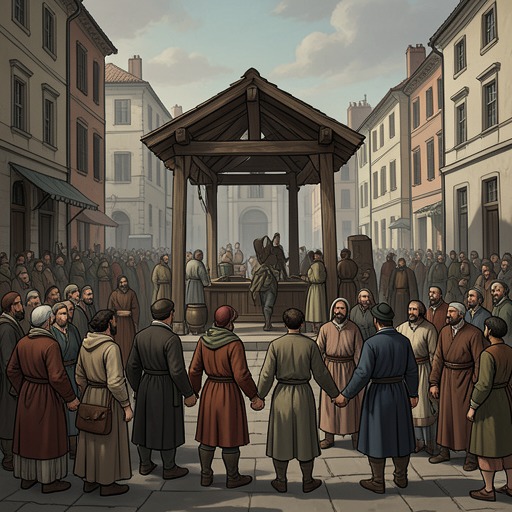
Popular sovereignty and political representation
The Social ContractPopular sovereignty and political representation is the relation between a people’s authority to make law and the deputies or officials who may act on its behalf. In Jean-Jacques Rousseau’s account, the people can delegate administrative work, but it cannot transfer or be represented in the exercise of sovereignty: a law requires popular ratification. This distinction makes participation a condition of political freedom and a safeguard against rulers turning public authority into private power.
The compact and the ground of sovereignty
The argument begins with a problem of collective self-preservation. Individuals cannot create new force, Rousseau reasons; they can only combine existing forces and direct them toward a common purpose. Yet each person’s strength and liberty are also indispensable to personal preservation. The social compact must therefore join people in a common force capable of defending each person and their goods, while allowing each, through the association, to obey himself and remain free. This is the foundational problem that the Social Contract sets out to solve.
The compact does not make sovereignty the possession of a ruler or an assembly of deputies. It establishes a political body whose common interest is expressed as the general will. Rousseau’s distinction between natural and civil liberty clarifies what is at stake: civil liberty is bounded by the general will, unlike natural liberty, which is limited by an individual’s strength. The compact thus changes the terms of freedom rather than simply exchanging freedom for obedience. Its claim to legitimacy depends on public authority remaining common, instead of becoming a power that one person or faction exercises over the rest.
That common authority also requires compliance with its laws. An individual’s private will may conflict with the general will he has as a citizen; he may seek the benefits of citizenship while treating his obligations as an unfair contribution to a political body he regards as merely abstract. If such conduct becomes secure, Rousseau warns, the body politic is undone. The compact therefore tacitly empowers the whole body to compel an individual who refuses to obey the general will. Rousseau calls this being “forced to be free”: coercion is presented not as a ruler’s personal command, but as enforcement of the civic condition that protects each citizen from personal dependence.
Deputies, citizens, and the retreat from public service
Representation arises in Rousseau’s account from a weakening of direct civic participation. When public service ceases to be citizens’ chief concern and they prefer to contribute money rather than serve in person, they pay troops instead of marching to war and appoint deputies instead of attending councils. He links this retreat to commerce, the arts, the pursuit of profit, and a taste for ease: citizens surrender part of their income to free time for further private gain. The danger is political as well as moral. A people that avoids public duties may end by having soldiers capable of enslaving the country and representatives capable of selling it.
The same withdrawal helps explain why representation takes hold in large states. Rousseau identifies lukewarm patriotism, active private interest, the vastness of states, conquest, and abuses of government as conditions that suggest appointing deputies to national assemblies. In the resulting arrangement, he says, the interests of two orders come first and second, while the public interest occupies only third place. Representation is therefore not a neutral solution to administrative scale: it can reorder political priorities, placing particular interests ahead of the common good.
The condition of assemblies provides a measure of that change. In a well-ordered city, citizens hurry to public meetings because common affairs matter to them. Under bad government, they do not bother to attend: they expect the general will to be ignored, while private cares absorb their attention. Rousseau traces a vicious circle in which good laws help produce better ones, while bad laws breed worse laws and further disengagement. When a citizen’s attitude to public affairs becomes indifference, the state, in his formulation, may be considered lost.
What representatives can and cannot do
Rousseau’s central constitutional claim is that sovereignty cannot be represented for the same reason that it cannot be alienated: it resides essentially in the general will. A will cannot be represented as an intermediate version of itself; it is either the same will or another. Deputies are therefore not representatives in the sovereign sense, but stewards, and they cannot perform definitive acts on the people’s behalf. Any law that the people has not ratified in person is null and void, not a law at all.
The contrast with England makes the practical consequence pointed. The people there, Rousseau says, believes itself free, but enjoys freedom only while electing members of Parliament. After the election, it is subject to a system in which its deputies do not possess the people’s sovereign will. The brief interval of electoral choice cannot substitute for continuing popular authority over legislation.
Rousseau calls the idea of representation modern and traces it to feudal government, which he condemns as an iniquitous system that degrades humanity. He contrasts it with ancient republics and monarchies, where the people had no representatives in the modern sense. Even in Rome, he argues, the tribunes’ protected status did not mean that they could assume the people’s functions: they did not claim authority to pass a plebiscite on their own. The practical difficulties of popular assembly were real; in the time of the Gracchi, some Roman citizens had to vote from rooftops because of the crowds. But inconvenience does not, for Rousseau, turn a deputy into the sovereign.
His distinction between legislative and executive power defines a narrower, legitimate role for delegation. Law is the declaration of the general will, so the people cannot be represented in exercising legislative power. The executive, by contrast, applies force to give the law effect; in that work, representation is both possible and necessary. Rousseau argues that the Roman tribunes, who possessed no executive power, could not rightfully represent the Roman people through their entrusted functions. When they did so, they usurped powers belonging to the Senate. Delegated administration can carry out the law, but it cannot claim the people’s authority to make it.
Scale, civic conditions, and the limits of assembly
Rousseau recognizes that direct popular sovereignty is difficult to preserve in a large political community. State size matters because a body politic has a maximum strength it loses by growing beyond the limits of good government. As the social bond extends, he argues, it relaxes; a small state is generally stronger in proportion than a great one. Long distances make administration burdensome, and successive levels of authority—from cities and districts through provinces to larger governments and a supreme administration—add expenses borne by the people. Those costs can drain the resources needed for emergencies.
Territory and population also need to remain in a fitting relation. The land should sustain its inhabitants, and the inhabitants should be numerous enough to make proper use of the land. Too much territory is difficult to guard and may be inadequately cultivated, with surplus production prompting defensive wars; too little can make a state dependent on neighbors and lead to wars of offense. Rousseau argues that no fixed ratio can apply everywhere, since fertility, products, climate, population growth, and inhabitants’ habits differ. The broader point is that the conditions of civic government cannot be assessed by size alone.
The scale problem appears again in Rousseau’s account of political forms. Generally, he says, democracy suits small states, aristocracy those of middle size, and monarchy great ones, although circumstances can supply innumerable exceptions. Yet he does not treat a small state as an easy answer: it may seem liable to conquest. He postpones the resolution, proposing that the external strength of a great people might be combined with the convenient government and good order of a small state. The tension remains central to representation: the larger the polity, the harder it is for citizens to assemble, but replacing their sovereign voice with deputies threatens the very freedom the compact is meant to secure.
Representation, property, and unequal public protection
The insistence on popular authority also shapes Rousseau’s account of public finance. Property is a fundamental right of citizenship and, he argues, a foundation of civil society: it helps secure citizens’ commitments and makes duties harder to evade. At the same time, maintaining the state requires contributions from members. If the people governed itself without intermediaries, citizens could assess themselves according to public needs and individual means, while watching how the funds were used. In practice, even a small state is too populous for every member to administer it directly; public money must pass through officials who have private interests as well as public responsibilities.
Rousseau sees a resulting crisis of confidence. The people may notice the cupidity and extravagant spending of rulers more readily than genuine public needs, resenting the loss of necessities to fund others’ superfluities. Once that resentment becomes sufficiently bitter, even an upright administration may struggle to restore trust. Voluntary contributions then fail, while forced contributions are illegitimate. This is why Rousseau treats taxation not as an ordinary prerogative of officials but as a question of sovereign consent.
The compact’s protection of property must coexist with an obligation to contribute to public needs. For an assessment to be lawful, Rousseau says, the need must be clearly recognized by those who contribute, and the tax must depend on the general will expressed by a majority vote, not on officials’ arbitrary choice. The standard does not require each individual to consent separately or pay only what he personally prefers; it requires a common decision and a proportional rating. The people’s authority over taxation thus follows the same logic as its authority over law: administrative necessity does not authorize government to make the sovereign decision in its place.
Proportionality, however, involves more than counting possessions. Other things being equal, a person with ten times another’s property should pay ten times as much. But Rousseau also distinguishes necessities from superfluities: those who possess only ordinary necessities should pay nothing, while the wealthy may fairly be taxed on what exceeds them. He rejects the claim that social rank turns luxury into necessity, observing that a dignitary has no greater bodily needs than a herdsman and that relinquishing costly display for the state’s urgent needs could increase public respect.
The third measure is the advantage each person receives from society. Rousseau contrasts the immense protection society affords the rich with the precarious security of the poor. The wealthy have access to lucrative offices, privileges, exemptions, and public authority; misconduct by an eminent person may be quietly forgiven. By contrast, when a rich person is robbed or insulted, police and public assistance move quickly, and even innocent people may suffer suspicion. The poor person struggles to obtain justice, is more readily burdened with public work, and cannot count on help after an accident. This disparity reveals why formal participation and consent matter: public authority may claim to act for everyone while its protection and burdens fall unequally.
Popular sovereignty and political representation therefore meet at a demanding boundary. Citizens may entrust officials with executing laws and administering public resources, but they cannot make those officials sovereign by withdrawing from public life. If the government itself usurps sovereignty and ceases to administer the state according to law, Rousseau says, the social compact is broken; private citizens recover their natural liberty and are forced, but no longer bound, to obey. Representation is not merely a matter of choosing who governs. It tests whether the general will remains the people’s own, whether public duties are still shared, and whether the state’s power protects its members rather than placing them under the unchecked will of others.