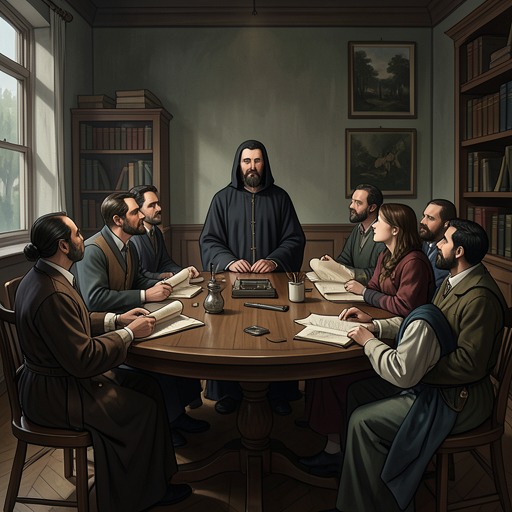
Roman Curia Congress
The Social ContractThe Roman Curiate Assembly was the earliest of Rome’s three principal popular assemblies, founded by Romulus and organized around curiae. In its original form it helped balance the authority of the people against the power and wealth of the patricians, while preserving the founder’s supremacy over both. Its later decline shows how an assembly’s political character depended not simply on its name or procedure, but on who could participate and whose interests its structure served.
Foundation and civic function
In the constitutional account presented in the book, assemblies lawfully convened at Rome were called comitia, and took three forms: the Roman Curiate Assembly, the Roman Centuriate Assembly, and the Roman Tribal Assembly. The Curiate Assembly was founded by Romulus; the Centuriate Assembly by Servius; the Tribal Assembly by the tribunes. No law was sanctioned and no magistrate elected except through the comitia. Because citizens were enrolled in a curia, century, or tribe, none was formally excluded from voting, and the Roman people counted as sovereign both in law and in practice.
That claim of popular sovereignty rested on procedure as well as membership. For an assembly’s decisions to have the force of law, it had to be called by a duly authorized body or magistrate, convene on a day permitted by law, and receive favourable auguries. The rules about days kept assemblies from taking place on festivals and market days, when country people visiting Rome for business might not have time to remain in the public square. The religious requirement, meanwhile, gave the senate a means of restraining the people and the tribunes, although the tribunes found ways around it.
Romulus’s design and the curiate vote
Romulus’s arrangement aimed to check the senate by means of the people and the people by means of the senate, while leaving him in a position of ascendancy over both. Through the curiae, the people gained the strength of numbers to counterbalance the patricians’ power and wealth. Yet the design retained a monarchical advantage: patricians could influence the majority through their clients. The author presents this relationship of patron and client as a particularly skilful political arrangement, one that enabled a patrician order otherwise at odds with republican principles to endure.
The assembly’s history also outlasted the monarchy. Since the curiae continued under the kings until the time of Servius, and the later Tarquin’s reign was not considered legitimate, royal laws came to be known generally as leges curiatae. The curiate form thus remained connected to the authority of the early kings even after the political conditions that had given it prominence had changed.
Decline under the Republic
Under the Republic, the Roman Curiate Assembly was confined to the four urban tribes and included only Rome’s populace. That restricted composition suited neither the senate, which led the patricians, nor the tribunes, who, despite being plebeians, stood at the head of the more prosperous citizens. The assembly accordingly lost standing. Its degradation went so far that thirty lictors would gather and perform what the assembly itself was supposed to do.
The book contrasts the political effects of the three assemblies. The Tribal Assembly was most favourable to popular government, while the Centuriate Assembly favoured aristocracy. The Curiate Assembly, in which Rome’s urban populace held the majority, was judged suited only to tyranny and harmful designs; even seditious actors avoided it because its use exposed their purposes too plainly. The assembly’s loss of authority therefore reflects more than institutional obsolescence: a form that had once balanced civic groups came to be regarded as politically dangerous when its limited electorate and diminished standing no longer supported a credible expression of the whole people.
Place in Roman popular sovereignty
The Roman Curiate Assembly belongs to a wider argument about the difference between political fact and political right. The book distinguishes the study of established institutions and their history from the search for principles that could make political association legitimate. Existing arrangements, including an assembly’s past authority, cannot by themselves establish a right to rule. In that framework, the Curiate Assembly matters both as an institution through which citizens once voted and as a case showing that formal participation does not guarantee that a body represents the political community on equal terms.
Its trajectory is defined by a sharp contrast: founded to mediate between the people and patrician power, it retained links to royal law, then narrowed under the Republic to an urban constituency and fell into disuse. The account makes its political significance depend on the changing relation among membership, voting authority, and the claims made in the people’s name. Its decline sits alongside the continued sovereignty attributed to the Roman comitia as a whole, while the fullest majesty of the people is assigned to the Centuriate Assembly because that body alone included all.