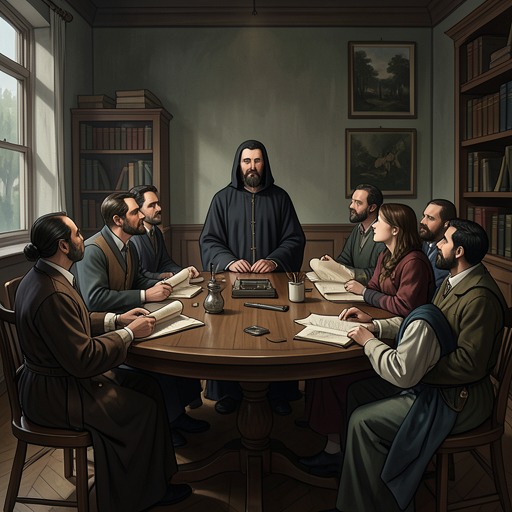
Roman tribal assembly
The Social ContractThe Comitia Tributa, or Tribal Assembly, was one of the three forms of Roman comitia, distinguished by the manner in which the people were assembled and their votes organized. Convened by the tribunes, it elected them and passed plebiscites. In Rousseau’s account it was the assembly most favorable to popular government, but its exclusion of the senate and patricians exposed a tension between popular power and the full inclusion of citizens.
Place in the Roman Assemblies
Roman assemblies were called comitia when lawfully summoned and were held in Rome’s public square or on the Campus Martius. The three forms were the Comitia Curiata, founded by Romulus; the Comitia Centuriata, founded by Servius; and the Comitia Tributa, established by the people’s tribunes. No law received sanction and no magistrate was elected outside the comitia. Since every citizen was enrolled in a curia, century, or tribe, the assembly system gave citizens the right to vote and made the Roman people sovereign in law and in practice.
A comitia’s authority depended on three conditions: it had to be convoked by a properly authorized body or magistrate, meet on a day permitted by law, and receive favorable auguries. The restriction on festival and market days allowed country people who came to Rome on business to take part without losing their entire day in the public square. The requirement of favorable auguries, by contrast, gave the senate a means to check the people and restrain tribunes; the tribunes nevertheless found ways around that obstacle.
Powers and Exclusion
The Comitia Tributa was properly the council of the Roman people. Only the tribunes could convene it, and it was there that the tribunes were elected and their plebiscites passed. The senate had no standing in the assembly and no right even to attend. Senators were therefore bound to obey laws on which they could not vote—a position Rousseau calls less free than that of the poorest citizens.
That exclusion raised a problem of legitimacy. If patricians had attended as citizens rather than exercising collective rank, Rousseau argues, they would have had little influence in a vote decided by counting heads: the poorest proletarian would count as much as the princeps senatus. He regards the exclusion as a badly conceived injustice, sufficient by itself to invalidate the decrees of an assembly from which some of its members were barred. The assembly’s popular character thus did not, by itself, settle whether its decisions could claim authority over all citizens.
Institutional Character and Political Significance
Rousseau treats the Roman assemblies not as interchangeable procedures but as institutions whose effects depended on how each distributed participation and votes. The Comitia Tributa favored popular government; the Comitia Centuriata favored aristocracy. The Comitia Curiata, in which Rome’s urban populace formed the majority, could serve tyranny and harmful designs, and fell into disrepute. Rousseau places the people’s full majesty in the Centuriata because it alone included all, while noting that the Curiata excluded rural tribes and the Tributa excluded the senate and patricians.
The contrast makes the Tributa important both as an instrument of popular rule and as an example of its limits. It gave the people a formal political forum for electing tribunes and approving plebiscites, yet its restricted membership compromised the universal standing Rousseau associates with legitimate public decisions. Its place in his account therefore turns on more than whether a vote is popular: the organization of participation determines which political interest an assembly advances, and exclusion bears directly on the validity of its acts.