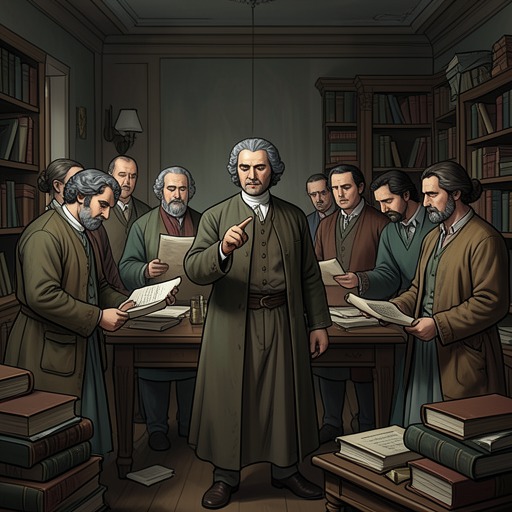
Socrates
The Social ContractSocrates is presented as the most searching critic of the learned world and as a philosopher whose acknowledged ignorance constitutes his wisdom. Jean-Jacques Rousseau uses him first to challenge the prestige of poetry, art, and scholarship, then to distinguish individual philosophical virtue from the patriotism that binds citizens to their country. Socrates remains an exemplar, but not the civic guide Rousseau ultimately prefers: his teaching reaches a few, while Cato’s service is directed toward the happiness of an entire people.
The Critique of Poets and Artists
In Rousseau’s account of Athens, Socrates stands among the few wise men who resisted the general current and preserved their integrity in the company of the Muses. He is introduced not merely as an opponent of artistic culture but as its most unhappy and penetrating judge: someone who tested the claims of poets and artists against what they actually knew. His questioning makes the celebrated authority of cultural achievement look less like wisdom than like confidence mistaken for knowledge.
Socrates regards poets as people whose talents deceive both themselves and their audiences. They present themselves as wise and are accepted as wise, although their poetic ability does not establish understanding. The point is not that they lack talent; it is that their talent lends undeserved authority to claims about wisdom. Their public standing rests on a confusion between the power to make poetry and the knowledge of what is true.
He applies the same test to artists, while acknowledging that he himself knows little about their crafts. The most skilful artists, he finds, excel others in their particular work and then infer that they are wiser than everyone else. Their error lies in carrying a real, limited competence beyond its proper domain. Socrates says that this arrogance spoils their skill in his eyes: measured against the oracle’s challenge, he would rather remain as he is than possess their knowledge while sharing their overconfidence.
His account draws a sharp distinction between ignorance and the belief that one knows. Sophists, poets, orators, artists, and Socrates himself do not know the nature of the true, the good, or the beautiful; unlike the others, however, he does not mistake ignorance for knowledge. The oracle’s judgment of his wisdom therefore resolves into a narrow but decisive advantage: he is convinced that he is ignorant of what he does not know. Intellectual humility, rather than command of the arts or accumulation of learning, is the standard by which the passage measures wisdom.
An Example Against Scholarly Vanity
Rousseau places Socrates within a contrast between Athens and Sparta. Athens becomes the seat of politeness and taste, renowned for orators, philosophers, marble, painting, and artistic models that later ages will admire. Sparta, by contrast, expels artists, the arts, and the learned, leaving behind no comparable store of material monuments but the memory of heroic actions. Socrates supplies an internal critique of the Athenian achievement: even in a city celebrated for its intellectual and artistic accomplishments, its most unhappy wise man doubts that these forms of distinction amount to knowledge.
Rousseau extends Socrates’ example beyond the ancient city. He imagines that, if alive in the modern age, Socrates would not be persuaded by contemporary scholars and artists to revise his judgment. He would refuse to swell the flood of books and would teach not by adding another body of learning but by leaving an example and the memory of his virtues. The contrast is between instruction through accumulated works and instruction through a life that embodies intellectual restraint.
That contrast also shapes Rousseau’s account of Rome. Socrates had begun at Athens, and the elder Cato continued at Rome, warning against Greek influences said to corrupt civic virtue and courage. Yet culture prevailed: Rome filled with philosophers and orators, military discipline was neglected, agriculture fell into contempt, and citizens formed sects and forgot their country. The old civic names of liberty, disinterestedness, and obedience to law gave way to the names of Epicurus, Zeno, and Arcesilaus. Socrates thus belongs to a warning about the distance between studying virtue and sustaining it in public life; the Romans, Rousseau says, were undone when they began to study what they had previously practised.
Socrates and Cato: Two Forms of Virtue
Rousseau’s clearest assessment of Socrates comes through comparison with Cato. Socrates is the greater philosopher, but Cato is more completely a citizen. Athens was already ruined in Socrates’ time, and Socrates had no country beyond the world at large. Cato, by contrast, kept his country’s cause at heart, lived for it, and could not bear to outlive it. The contrast is not a denial of Socrates’ courage or integrity; it locates his virtue in a different relation to political community.
Socrates instructed a few individuals, opposed the Sophists, and died for truth. Cato defended his country, its liberty, and its laws against the conquerors of the world, and left the earth when there was no longer a country for him to serve. The difference in scale and object matters to Rousseau’s argument: one life offers instruction to particular pupils, while the other is committed to the shared political conditions on which a people’s life depends.
The comparison is carefully balanced. A worthy pupil of Socrates would be the most virtuous person of his time; a worthy follower of Cato would be one of the greatest. The former’s virtue would be his own happiness, while the latter would seek happiness in the happiness of all. Rousseau does not discard philosophical teaching: people may be taught by Socrates. But they should be led by Cato, because no people has ever been made into a nation of philosophers, whereas it is possible to make a people happy. Individual excellence and civic achievement are both valued, but they do not perform the same work.
Narrative and Political Significance
Socrates functions in the argument as both witness and measure. His examination of poets and artists exposes a recurring mistake: a limited capacity is treated as proof of comprehensive wisdom. His refusal to claim knowledge he lacks offers a model of integrity against the vanity Rousseau associates with the learned. Yet Rousseau also places a boundary around what this model can accomplish. Opposition to the Sophists and death for truth make Socrates exemplary as a philosopher; they do not, by themselves, make him the figure best suited to unite a people around its common good.
That boundary connects the comparison to Rousseau’s account of patriotism. Citizens are not made virtuous simply by being told to be good; they must be taught, and example is only one means of instruction. Patriotism gives particular force to their attachment by directing concern toward fellow citizens joined by common interests and shared life. Socrates, whose country was the world at large, represents a virtue that can be admired and learned from, but the contrast with Cato shows why Rousseau gives priority to civic attachment when asking how a people can become happy.
The argument also clarifies the political conditions required for such attachment. A country cannot reasonably demand love from people who receive nothing from it beyond what it offers to strangers, or whose lives, liberties, and property remain at the mercy of those in power without relief through law. Rousseau insists that the security of each citizen is bound to the public union: if an individual who could have been rescued is allowed to perish, is wrongfully imprisoned, or receives an obviously unjust sentence, the fundamental compact is broken. Against that standard, Socrates’ philosophical example illuminates the importance of virtue, while the comparison with Cato directs attention to the laws and public protections that make civic virtue and patriotism possible.