Switzerland
The Social ContractSwitzerland appears in the political account as more than a geographical example: its free cities, especially Geneva, help frame the possibility of active popular consent, and its recovery after the expulsion of tyrants illustrates the rare renewal of civic life. Yet the argument does not treat Swiss experience as a formula transferable to every state. Switzerland’s significance lies in the conjunction of self-government, limited political scale, and a historically particular capacity for renewal.
A contemporary model of self-government
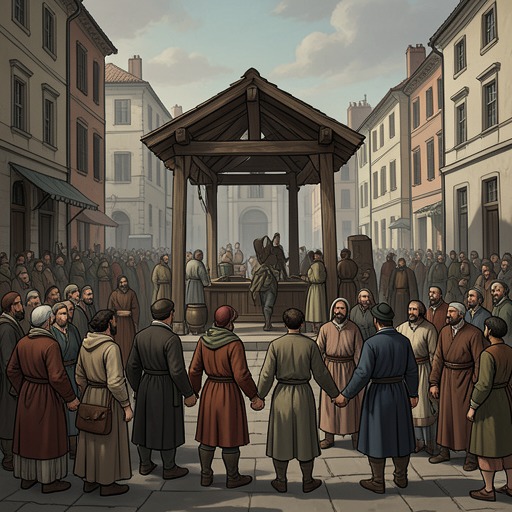
Jean-Jacques Rousseau admired the Swiss free cities, naming Berne and, above all, Geneva, his native place. In contrast to the representative governments he observed elsewhere in Europe, these cities supplied a living reference point for political communities in which citizens could participate directly. Rousseau’s alternative to tacit consent was an active agreement, periodically renewed: popular consent had to possess constitutional means of expression if it was to be more than a name.
The scale of this model also marked its limit. Seeing no nation-state in contemporary Europe where representative government worked democratically, Rousseau could not conceive how active agreement might operate across a large nation. He therefore held that self-government was possible only for a city, and wished to replace Europe’s nation-states with federative leagues of independent city-states. Switzerland’s free cities helped make that proposal imaginable, but they did not resolve the problem of extending it to larger political units.
Renewal after the expulsion of tyrants
Switzerland also figures in Rousseau’s account of political rebirth. At rare moments, he argues, violence and revolution can make a state seem to be born anew: the horror of the past displaces forgetfulness, and a people emerges with something like the vigour of youth. He places Switzerland, after the expulsion of its tyrants, alongside Sparta in the time of Lycurgus, Holland after its tyrants were expelled, and Rome after the Tarquins.
The example is deliberately exceptional rather than a promise that revolution can repair any polity. Such recoveries arise from a state’s particular constitution and cannot happen twice to the same people. A people may regain freedom while it remains uncivilized, but once its civic impulse has lost its vigour, disturbances can destroy it without restoring it. Switzerland thus represents a possible recovery whose conditions are rare, not a general method of political renewal.
Scale, political strength, and institutional fit
The wider argument about state size helps explain the attraction of Swiss cities. Rousseau maintains that every body politic has a maximum strength it cannot exceed without losing power: as the social tie extends, it relaxes, and, in general, a small state is stronger in proportion than a great one. Long distances make administration more difficult and costly, multiplying layers of authority—from city and district to province and higher administration—while draining resources from the people and leaving less for emergencies.
Size alone, however, does not determine a state’s proper form. Rousseau associates democratic government generally with small states, aristocratic government with states of middle size, and monarchy with great ones, while acknowledging innumerable exceptions. The relationship between territory and population must also suit the land’s fertility, products, climate, and inhabitants. Switzerland’s political relevance therefore rests not on a claim that one institutional design fits every country, but on the broader insistence that political arrangements must answer to the scale and conditions of the community.
The political bond and its vulnerability
The Swiss example belongs to a theory in which political association is meant to protect each person and their goods through the common force, while allowing each associate to remain free. The social compact joins individuals into a collective body; it does not make legitimate government a mere substitute for citizens’ participation. Rousseau’s account of active consent and self-government gives this bond a practical dimension, one that he associated with the Swiss free cities.
That bond is vulnerable because individual interests can diverge from the common interest. When government’s particular will presses continually against the general will, the constitution changes and the government tends toward suppressing the sovereign people. If the ruler usurps sovereign power, the state is dissolved and a new body, consisting only of government members, becomes master over the rest; the social compact is broken, and private citizens recover their natural liberty. Against this danger, the Swiss cases carry a double significance: civic participation helps make political freedom possible, while the recovery after expulsion of tyrants shows how exceptional and constitution-dependent its renewal can be.
From city institutions to popular sovereignty
Rousseau’s historical discussion of Rome illustrates another dimension of the problem of organizing popular power. The new republic was first divided into three tribes, associated with Albans, Sabines, and foreigners; each tribe was divided into ten curiae, and each curia into decuries. The growing number of foreign residents made the original division unequal, and Servius replaced its racial basis with four tribes organized by the city’s quarters. This Roman example is distinct from the Swiss cases, but reinforces the emphasis on institutional structure: political arrangements must reckon with changes in the people they organize.
For Rousseau, popular sovereignty cannot be represented: deputies may act only as stewards, and a law not ratified by the people in person is null. The contrast between this principle and large-scale representative government clarifies why Switzerland’s free cities matter to his argument. They exemplify the civic scale he considered necessary for self-government, while the account of Rome demonstrates that even a republic’s internal divisions require careful adjustment if political participation is to remain effective.