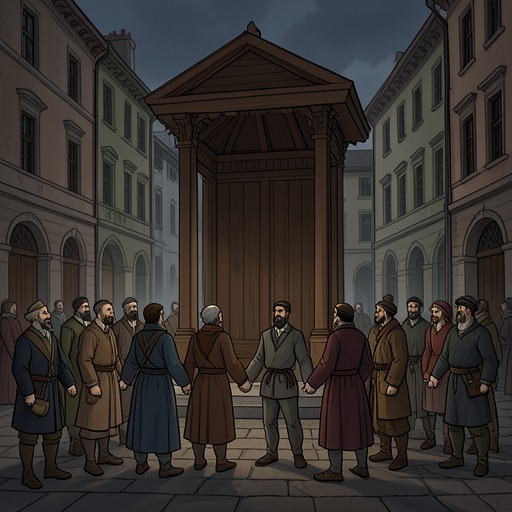
Will of all
The Social ContractThe Will of All names the sum of individual wills, including the particular interests that citizens bring to public decisions. Rousseau distinguishes this aggregate from the General Will, which takes the common interest as its object. The distinction matters because a vote can register what individuals want without expressing what is advantageous for the State as a whole.
Definition and distinction
The Will of All is not simply another name for the General Will. The former adds together particular wills; the latter concerns the common interest. Rousseau’s account allows that citizens can vote for private advantage rather than public benefit. Such a vote does not, by itself, corrupt the General Will: it is a particular response to a different question, and its force is negligible when judged from the standpoint of the common interest.
The distinction depends on what a deliberation asks citizens to decide. If they answer whether a proposal benefits the State, their judgments address the common question. If they instead ask which person or party will benefit, they have substituted a private question for the public one. The purpose of orderly deliberation, on this account, is not to manufacture the General Will but to ensure that the common question is put and answered as such.
How aggregation can work
Rousseau describes a possible relation between particular wills and the General Will through cancellation. Opposing private interests can offset one another; once these pluses and minuses are removed, the remaining differences may indicate the common interest. In this qualified sense, the Will of All can provide the material from which a decision reflecting the General Will emerges, without being identical to it.
That result depends on conditions Rousseau treats as essential. Citizens must have adequate information and deliberate without communicating with one another. Under those conditions, he argues, the aggregate of small differences would yield a good decision. The argument is therefore conditional, not a claim that whatever a majority decides must be right.
Factions and distortion
Partial associations disrupt the cancellation on which this account depends. Within a faction, the association’s will can appear general to its members while remaining particular in relation to the State. Political divisions then reduce the number of independent judgments: instead of as many votes as citizens, the effective result reflects the smaller number of associations. With fewer differences to offset one another, the outcome becomes less general.
The distortion becomes decisive when one association grows large enough to prevail over all the others. The decision then no longer results from a sum of small differences; it expresses a single prevailing difference and is purely particular. Rousseau accordingly proposes preventing partial societies where possible. If they exist, he argues, they should be numerous and kept from becoming unequal, rather than allowing one bloc to dominate deliberation.
Majority decisions and political limits
The Will of All helps explain why a majority vote cannot be treated as infallible. Rousseau’s defense of majority decision depends on ideal conditions, including the absence of unequal factions; it does not establish that an actual majority always expresses the common interest. Citizens may be deceived about what benefits them, and organized interests can make the prevailing opinion particular rather than general.
The same distinction clarifies the limits of political representation. Sovereignty lies in the General Will and, because will cannot be represented, deputies can act only as stewards, not as representatives empowered to make definitive laws. A law requires personal ratification by the people; without it, Rousseau holds, the measure is null. Thus neither the Will of All as an aggregate nor an assembly of delegates automatically substitutes for the people’s sovereign judgment: public decisions must remain directed toward the common interest and subject to popular authorization.