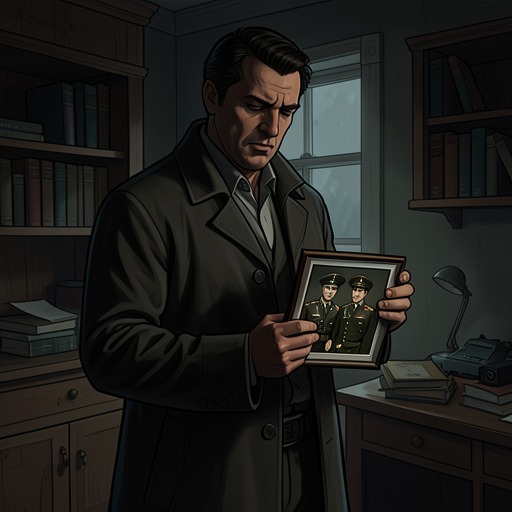
Ab Lofthus’s suicide note
The SonAb Lofthus’s suicide note is the document used to disguise his killing as suicide and protect his family from the consequences. Its significance lies not only in what Ab signed, but in the long delay before others could say plainly that he had not killed himself: the letter passed through the hands of his son and the police, while its truth was obscured and only later disclosed to Sonny.
The Note and Ab’s Death
Ab signed the note before he was shot, according to Sonny’s account to Martha. He said his father did so to save his mother and him. The document therefore presents a deliberate sacrifice: Ab accepted the appearance of responsibility for his own death as a way to shield the people he loved.
Sonny’s account connects the letter to the moment he found his father dead. After returning from a wrestling tournament in Lillehammer, he went to Ab’s study to tell him he had won his weight class. He initially thought his father had fallen asleep at his desk, then saw the gun. He remembered finding an old-fashioned black pistol in Ab’s desk as a child, but had not known then what his father’s hidden writing and secrets would mean. When Sonny discovered the letter after Ab’s death, he first considered destroying it and pretending it had never existed; instead, he gave it to the police.
A Document the Police Would Rather Suppress
Sonny believed the officers who received the note wanted to shred it too. That response makes the document more than a private message: it becomes evidence that threatens the official account of Ab’s death. The note’s existence does not immediately secure the truth. Its passage into police hands is followed by an apparent effort to make the evidence disappear, leaving Ab’s sacrifice concealed behind the suicide story.
The discrepancy eventually surfaces in two separate disclosures. Johannes Halden, speaking to Sonny in the darkness of the prison, admits that he had been Ab’s confidential informant and then tells him that Ab did not shoot himself. His confession supplies the direct correction to the false account that the note had helped establish. Later, Sonny tells Martha that Ab signed the note before he was shot, explaining its protective purpose. Together, the disclosures distinguish the document’s staged appearance from the circumstances of Ab’s death.
The Family’s Cost
The note’s protective purpose did not spare Sonny from the aftermath. He found his father’s body and the letter, then gave it to the police; afterward, he tried to care for his mother as she deteriorated, leaving wrestling and other activities behind. As a teenager he began using drugs, and later paid for them by confessing to crimes committed by others, including taking the fall for two murders in exchange for drugs in prison. The note’s intended protection and the devastation that followed stand in sharp contrast: Ab’s act was meant to save his family, but it did not prevent the collapse that shaped Sonny’s life.
Sonny’s later letter to Martha places Ab’s hidden records in a further context. After finding his father’s diary, Sonny wonders whether Ab meant his family to discover it or had hidden it deliberately. The diary recounts the financial pressure that preceded Ab’s decision to act, including a mortgage the family could no longer afford after interest rates rose. The suicide note and diary thus serve different but connected purposes: one is the public-facing account that conceals the killing, while the other preserves fragments of the pressure and choices behind it.
Confession, Evidence, and Belated Truth
The note belongs to a wider pattern in which the story’s truth emerges through testimony and records that arrive late or are compromised. Sonny’s father left a written account that the police might have destroyed; Johannes eventually speaks aloud despite fearing the consequences; and Sonny himself discloses the note’s purpose to Martha. The written document cannot speak for itself. Its meaning depends on those willing to preserve, interpret, and finally contradict the account it helped create.
That dependence gives the note its central tension. As a means of protecting Ab’s family, it converts a killing into an apparent suicide; as a surviving piece of evidence, it also makes the false account vulnerable to correction. Its eventual meaning is therefore double: it records Ab’s attempt to take the blame for those he loved, and its suppression reveals how institutions can obstruct the truth that the sacrifice was meant to contain.