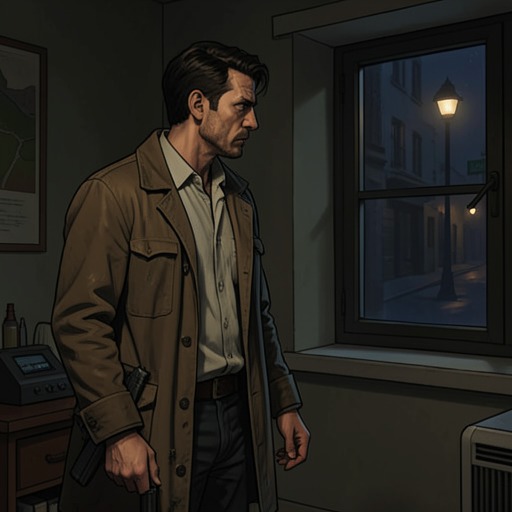
Gustav Rover
The SonGustav Rover is a former weapons maker and criminal associate of Hugo Nestor whose confession helps expose the violence behind Nestor’s organization and supplies investigators with a link between Sonny Lofthus, Per Vollan, and the circumstances of Sonny’s escape. A skilled craftsman who once made weapons difficult to recognize, Rover is also a man who could not carry out Nestor’s order to kill a young woman. His story turns on the distance between technical competence and moral resolve: he built weapons for others, but at a decisive moment could not pull the trigger himself.
Identity and Criminal Background
Rover appears in the story as an inmate recently released from Staten Maximum Security Prison, where he had sought Sonny’s blessing before leaving. His account gives Sonny a particular presence in Rover’s mind: the other prisoners call Sonny a killer, the son of a corrupt police officer, and a man with healing hands, while Rover approaches him as someone who might absolve him. Rover does not claim religious conviction; he hopes that confession and Sonny’s blessing will help him leave prison feeling cleansed and able to change.
Before prison, Rover supplied guns to a biker gang and modified weapons in his motorcycle workshop. His craftsmanship made him valuable and eventually brought him to Nestor’s attention. While serving an earlier sentence, Rover became dependent on Nestor, who arranged that Rover’s work would serve Nestor rather than rival groups. Nestor paid him far more than he could expect to earn repairing motorcycles, but the arrangement demanded loyalty and service beyond the work itself.
Rover’s skills extended to designing weapons disguised as ordinary objects. Eight years before his prison confession, he made two gold-plated objects shaped like pistols for a client who wanted a gun that would not have to be hidden. One of them later reached Staten in the form of a lighter: it could produce a flame, and prison officers who searched Rover allowed him to keep it after offering to sell him smuggled cigarettes. The episode reveals both Rover’s ingenuity and the failures of prison security, while the object itself embodies the concealment on which his trade depended.
Nestor’s Order and Rover’s Refusal
Rover tells Sonny that Nestor had given a Belarusian young woman the nickname Minsk. After she had been attacked by one of Nestor’s dogs, Nestor ordered Rover to shoot her, presenting the killing as a test of loyalty and a warning intended for the other girls. Rover had modified an old Ruger MK II pistol and expected to obey. At the crucial moment, however, he found that he could not pull the trigger, even though he understood that she was likely to die.
His refusal did not amount to rescue. Rover stood by as the others put the woman in a blanket, carried her to a car, and drove her to the woods at Østmarksetra. They rolled her down a slope toward Ulsrudsvannet, where she was found the following day. Rover explains that Nestor wanted the body discovered and publicized so that the other girls would see what could happen to them. The distinction between failing to kill her himself and doing nothing to prevent her death becomes the moral centre of Rover’s confession: he resisted one act, but remained within the group that carried out Nestor’s purpose.
The memory had continued to trouble Rover. He describes repeatedly revisiting the night in Tøyen Park and says that speaking about it aloud made the event feel fully real to him. He had not slept properly and was haunted by nightmares, which drove him to tell Nestor he wanted out. Rover said he was finished filing down Uzis and Glocks and wanted to return to repairing motorbikes and living quietly. Nestor appeared to accept his departure but made clear that Rover must not talk. Rover believed the matter settled, turned down later jobs despite having weapons available, and nevertheless feared that Nestor would have him killed. When police arrested him on an older case, he confessed to supplying weapons; he thought prison might be safer than remaining outside under Nestor’s threat.
Confession and Prison Connections
Rover’s confession to Sonny begins as an attempt at personal absolution, but its details also become evidence relevant to the wider investigation. Police interviews were stored in a shared database, and Kari Adel found Per Vollan’s name in an interview connected to Sonny’s escape. The interview was Rover’s: he had been questioned because he spoke with Sonny shortly before Sonny absconded, and investigators wanted to know whether Sonny had revealed his plans. The coincidence between Vollan’s visit and Sonny’s escape made Vollan’s death more suspicious, giving Rover’s earlier prison conversation a role beyond his private reckoning.
Rover also speaks of the reach of Nestor’s influence inside prison. In recalling a prisoner who had worked for Nestor and was feared to be a possible source of information, he describes the fear that someone in the control room might open a cell door. His account connects criminal intimidation to the institution’s own mechanisms of access: the threat is not only from other prisoners but from the possibility that prison controls can be used against them. Arild Franck later uses the whereabouts of Sonny as leverage against Johannes Halden, threatening to interfere with Halden’s cancer treatment if he does not reveal where Sonny is. Rover’s story thus sits within a prison where information, medical vulnerability, and control over doors can all become instruments of pressure.
Character and Narrative Significance
Rover is neither a simple enforcer nor an innocent bystander. He was a willing and talented weapons maker, accepted Nestor’s money and protection, and remained present when the young woman was taken away. Yet he could not complete the killing Nestor ordered, and the consequences of that refusal followed him into prison as guilt, sleeplessness, and fear. His confession preserves that contradiction rather than resolving it into either redemption or exoneration.
The disguised pistol-lighter and the unpulled trigger provide contrasting images of Rover’s agency. His technical skill can make a weapon appear harmless, while his moral resistance proves limited: he does not shoot, but he does not stop the others. His hope that Sonny’s blessing can cleanse him reveals a desire to change, not proof that he has done so. By linking this private confession to the interview about Per Vollan and Sonny’s escape, Rover also functions as a witness whose compromised past carries information the police need. His importance lies in the way a marginal criminal’s craftsmanship, silence, and partial refusal illuminate both Nestor’s control and the fragile boundary between complicity and resistance.