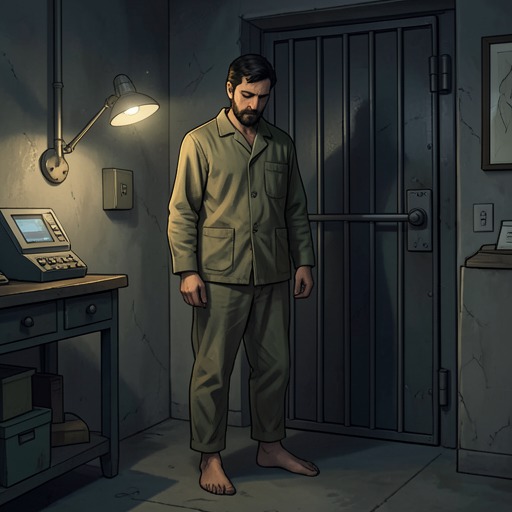
Johannes Halden
The SonJohannes Halden is a long-term prisoner whose past links the drug trade, the corrupt police network, and Ab Lofthus’s death. His decisive role is not simply that of a former informant: after years of keeping a promise that protected the truth about Ab, he finally gives Sonny Lofthus the account that restores his father’s story. His choice to help Sonny escape brings the truth into the open at the cost of his remaining time and health.
Identity and Background
Johannes is an older inmate at Staten Maximum Security Prison. When the narrative introduces him, he is mopping the floor in A Wing and sees Sonny being escorted between two officers. Johannes thanks him for improving his shoulder, and Sonny answers with a thumbs-up. The ordinary warmth of this exchange—an old cleaner and a young prisoner acknowledging a small kindness—establishes the bond that later makes Johannes’s request for help possible.
His criminal history began with smuggling heroin. He agreed to transport two sacks from Songkhla Port, and the decision became the first in a repeated pattern of accepting criminal work. After release from an earlier prison term, he had no family or friends waiting for him and no prospect of returning to work at sea. He turned back to criminals, resumed tramp shipping, and was recruited by Hugo Nestor to drive heroin along the final leg of a route from northern Thailand through Turkey and the Balkans, with Germany serving as a distribution point for Scandinavia. Later he became a confidential informant.
Johannes’s return to prison followed an accumulation of risk-taking that he hoped would end in arrest. At the Swedish border, customs officers stopped his lorry and found it stuffed with heroin. The judge emphasized the large quantity and Johannes’s previous offence; the resulting sentence had begun a decade earlier. He had spent the last four years at Staten, where he treated staff and inmates with respect and received the limited respect accorded to an older prisoner no longer regarded as a threat. The appearance of quiet routine concealed his private sense of guilt.
The Informant and Ab Lofthus
Johannes’s connection to Ab began with Nestor. He overheard Nestor speak by telephone to his superior about needing to get rid of a policeman named Lofthus before that officer ruined their operation. Johannes passed the warning to Ab, including the danger and the need for the police to act quickly. Ab, however, believed that other officers were indebted to Nestor and refused to involve them. He made Johannes swear to keep the conversation secret, and Johannes kept that promise for years.
That silence shaped Johannes’s imprisonment as a form of self-punishment. He had once believed that cooperating with a police officer might give him a clear conscience, but the officer’s death and the threat associated with the name of the Twin pulled him back toward the criminal world. He continued taking larger risks and moving larger loads, partly because he wanted to be caught and atone. Even after arrest, he concealed the betrayal he believed himself guilty of: he had not revealed what he knew about the danger to Ab, or the circumstances in which Ab faced it alone.
When Johannes finally speaks to Sonny, he identifies himself as Ab’s confidential informant and explains that the story Sonny and his mother had been left with was reversed. Ab had not been the police mole who aided traffickers; he had suspected the mole and was trying to act against the network. Johannes’s account gives Sonny a crucial distinction between the confession attributed to his father and the warning Ab had received. Its importance is not only evidentiary: Johannes understands that the message belongs to Sonny, and that telling it is the first release from a secret he had carried since Ab’s death.
Sonny and the Escape
Johannes’s relationship with Sonny begins through small acts of contact in prison. He is startled to hear Sonny’s surname but initially keeps quiet, continuing his work and accepting the small favours that make confinement bearable. When he eventually asks Sonny’s forgiveness, Sonny instead asks whether Johannes would break out of prison for him. Johannes objects that he does not want to escape and has nowhere to go; he expects to be caught and returned. Sonny does not explain further, but Johannes recognizes his desperation and understands the request.
The escape makes their exchange of forgiveness practical rather than merely verbal. Johannes has spent years longing for a clear conscience, and Sonny’s response gives him what he says he needed. He then accepts the consequences of helping the young man leave. His cooperation also gives the criminal network a reason to punish him: Arild Franck keeps his word that Johannes will be left in his cell without medical attention or pain relief.
Johannes’s assistance does not turn his own life around in the conventional sense. He is still confined, still ill, and still exposed to the consequences of his past. What changes is the direction of his final choice: after years of concealment and self-punishment, he uses what freedom he has to help Sonny and disclose the truth about Ab.
Illness, Punishment, and Death
Johannes has small-cell lung cancer, an aggressive disease, and his condition worsens in prison. After the escape, cancer is joined by a tumour in his groin, and ordinary positions bring him pain that he expects to intensify. Franck’s retaliation means that Johannes faces this deterioration in his cell without treatment or relief; medical attention might come only when Franck judged that death was near enough to make a death in the cell inconvenient to record.
At night, the simultaneous locking of Staten’s cell doors marks the prison’s routine closure. Johannes remembers how the footsteps of officers on rounds once comforted long-term prisoners, especially the singing of an older officer at Ullersmo. Now, in the camera-monitored quiet, he wishes that the singer—and Sonny—were there. He does not complain: Sonny has given him forgiveness, and Johannes thinks of this as accompanied by a lullaby.
Sonny has left Johannes heroin obtained from a Bible that belonged to the late prison chaplain Per Vollan, and has shown him how to inject it when the time comes. Johannes holds the syringe, recalling that his life might have been different had he refused the original smuggling job. He knows that the man he was accepted that work repeatedly, even though the man he is now believes he would refuse. The injection first removes his pain; then he experiences the high and imagines the woman whose promised kiss had remained one of the few things he wanted. He closes his eyes and collapses on the bed. The ending binds the beginning of his criminal history to his last hours: the same drug that once drew him into the smuggling route becomes the means by which he escapes, briefly, the pain and isolation of the cell.
Narrative Role and Significance
Johannes’s testimony reorients the mystery around Ab Lofthus. The police have discussed for years a mole who leaked information to the person running much of Oslo’s drug and sex-trafficking activity, but Simon Kefas says that no evidence had established either the mole or the criminal figure known as the Twin. Johannes supplies the personal link between that unresolved suspicion and Ab: Nestor’s warning reached Ab through an informant, and Ab chose to keep his own suspicions from other officers because he feared they too were compromised.
The later account in Ab’s diary confirms the network’s structure from another direction. Ab writes that the traitors are two police officers rather than one, describing how one can have an alibi while the other is active and how their partnership keeps both above suspicion. This detail sharpens the significance of Johannes’s long silence: the danger Ab feared was not an abstract rumour but an arrangement that made ordinary police procedure unreliable. Johannes’s confession supplies the human witness behind a wider pattern of criminal collaboration.
His arc turns on the difference between guilt and responsibility. Johannes cannot undo his part in the drug trade or the fact that he kept the warning secret after Ab died. He can, however, stop protecting the secret and act for Sonny when asked. His late disclosure and assistance do not erase his past; they make his final years an attempt to answer it. In a novel where the truth about Ab has been obscured by a false confession and compromised institutions, Johannes becomes the belated bearer of the message that makes a more accurate account possible.