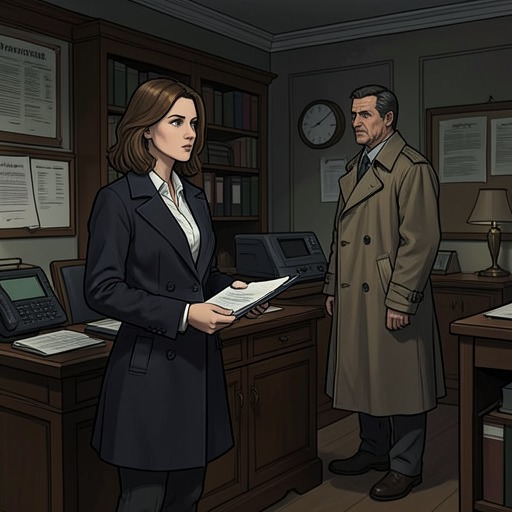
Kalle Farrisen
The SonKalle Farrisen is a street-level drug dealer in Hugo Nestor’s organization, positioned between the daily handling of drugs and cash and the larger criminal network behind their distribution. His history shows how Nestor’s business enforces obedience through violence, while his death connects an apparent robbery to a wider pattern of killings and exposes a past association with Per Vollan and a suspected murder victim.
Identity and Work
Kalle works under Nestor and supervises the sale and preparation of Superboy, a drug he considers unusually pure. At the end of a busy day, he counts the proceeds, stores cash and drugs in a safe, and prepares fresh packets in a small room that serves simultaneously as office, drug factory, and bank. The powder is handled with gauze masks because airborne particles can be lethal. His work is therefore both routine commerce and hazardous production, conducted in a tightly controlled space.
The street operation also depends on a small staff. Kalle works with Pelvis and Cassius, and when the day’s selling is over he directs Pelvis to check the corridor outside their office. He resents the boredom of spending evening after evening selling drugs, but the proceeds and the organization’s expectations keep him at his post. The business is not presented as an independent enterprise: Nestor is his boss, and the money Kalle handles belongs to a chain of command that can impose consequences for mistakes.
Discipline and the Past
Kalle’s caution comes from an earlier robbery. While carrying 300,000 kroner’s worth of heroin intended for sale on Nestor’s behalf, he fell asleep on a bench beside the river and lost the drugs. He did not report the theft to the police. Nestor then gave him a choice of punishments, and Kalle chose the one that would leave him without his eyelids rather than lose both thumbs. Nestor arranged for him to receive money for a taxi to the hospital afterward, a gesture that did not undo the punishment but returned him to the organization’s service.
The episode establishes the terms of Kalle’s relationship with Nestor: error is answered with exemplary violence, while continued usefulness can earn reinstatement. After surgery, Kalle concealed what had happened behind an invented account of an acid accident. When a replacement worker later mocked him in a bar, Kalle attacked him with a broken bottle. Nestor subsequently told him he could have his old job back, approving of his resourcefulness. From then on, Kalle made a habit of checking that everything was under control before allowing himself to close his eyes. His vigilance is thus not simply a dealer’s precaution; it is a learned response to punishment and humiliation within the criminal hierarchy.
That history shapes his conduct during the evening when a woman pleads with him for help. Kalle tells her to come back the next day and leaves. Later, he thinks about calling Vera to say he will be late, or asserting authority at home because he brings in the money. These fragments place his street work alongside an ordinary domestic life, but the work’s demands and the habit of command continue to structure his decisions.
The Fatal Robbery
On the night of his death, Kalle and his staff have sold more Superboy than they usually do over an entire weekend. He and Pelvis finish counting the money and preparing new packets late in the evening. Kalle is still considering whether to contact Vera when he orders Pelvis to check the corridor. The office’s layout leaves little room for escape: the lift is nearby, but a stairwell door has been chained shut, contrary to fire regulations.
A masked intruder enters, and Kalle later wakes on his back to find a man in a hoodie wearing yellow washing-up gloves and pointing a pistol at him. Cassius is lying partly across the doorway, and Kalle can see Cassius’s own gun protruding from beneath him. The intruder demands that Kalle open the safe and gives him seven seconds. This encounter places the apparent robbery within the same space where the organization’s money and drug supply are stored, but the investigation that follows questions whether theft alone can explain the deaths and the loss of such a valuable quantity of drugs.
Kalle is subsequently identified by Simon Kefas and Kari Adel as one of three people found killed. The case has been handed to Kripos without the Oslo Police Homicide Squad being consulted, a decision that Simon resents even as he seeks access to the crime scene. Simon later points out that a robber who had already shot two people would have little reason to waste half a kilo of Superboy, worth half a million kroner, on killing a third victim. The drug left behind becomes a practical contradiction in the robbery theory and a clue that the killings may have served another purpose.
Connections and Criminal History
Kari’s inquiries uncover a connection between Kalle and Per Vollan. A former informant from the Drug Squad says the two men knew each other very well, and their deaths within a short period strike him as suspicious. The relationship is described as unusually close, although the evidence does not specify its full nature. Its disclosure makes Kalle’s death part of a pattern rather than an isolated attack on a dealer.
Kalle’s police file also links him to an earlier murder investigation. He was questioned repeatedly and held in custody in connection with the death of an unidentified young Asian girl, whose dental analysis suggested she was sixteen. A witness had seen a man inject her in a backyard and picked Kalle out of a lineup. Years later, Sonny Lofthus was convicted of killing an unidentified girl, possibly Vietnamese, who died from a drug overdose; at first the police had suspected Kalle. The available evidence therefore distinguishes the two men’s roles in the case: Kalle was an early suspect, while Sonny ultimately served time for the killing. It does not establish that Kalle was responsible.
The investigation’s broader context makes that distinction consequential. Nestor’s organization arranges for a husband who wants his unfaithful wife killed to carry out the murder himself, then takes payment to arrange for someone else to bear the blame. That operation involves corrupt prison personnel and Arild Franck. Simon also confronts Iver Iversen with evidence that Iversen Property helped the Twin launder money from drug dealing and trafficking in exchange for fabricated losses worth hundreds of millions of kroner. These disclosures situate Kalle’s work within a network that joins street distribution to prison corruption, murder-for-hire arrangements, and financial laundering.
Death and Narrative Significance
Simon identifies Nestor as Kalle’s boss when police examine the remains believed to be Nestor’s. That identification links the dead dealer to the organization’s leadership, while the crime-scene sequence and the abandoned Superboy prompt Simon to resist a simple gang-message explanation. Kalle’s death consequently serves as more than the endpoint of his personal story: it helps shift the investigation from a presumed robbery toward the relationships and institutional arrangements that make the killings intelligible.
Kalle’s story also provides a concrete view of how the criminal network maintains itself. He is neither its public face nor its financier; he is a worker handling a product, a safe, and the daily proceeds. Yet the consequences of one mistake remain with him for years, shaping his vigilance and his capacity for violence, while his later death becomes a clue to connections police had not yet mapped. The contrast between his small, repetitive tasks and the far-reaching network around them underscores the structure of the threat: the street operation is only one visible point in a system that extends through criminal bosses, corrupt officials, and legitimate businesses.