Oslo Police Homicide Squad
The SonThe Oslo Police Homicide Squad is the Oslo police unit responsible for murder investigations and the institutional setting for Chief Inspector Simon Kefas’s work. Its investigations unfold amid jurisdictional friction with Kripos and suspicions that police information is reaching the Twin, a criminal power whose network includes drug dealing and human trafficking. The unit’s role is therefore double-edged: it pursues violent crime while confronting the possibility that law enforcement itself has been compromised.
Identity and investigative role
Simon identifies himself at a murder scene as a chief inspector with Homicide, arriving with Kari Adel beneath police tape. The scene is already under pressure from competing authority: Åsmund Bjørnstad of Kripos tells Simon that his service is taking over, consistent with Kripos’s practice of requiring overall tactical and technical responsibility when asked to assist in a murder inquiry.
Simon recognizes that this is not the first time the Homicide Squad and Kripos have clashed over a case. He knows that the practical response would be to accept the handover and return to the Per Vollan investigation, but instead insists on looking around the scene. The exchange establishes a unit whose work is shaped not only by evidence and suspects, but by institutional control over who may investigate.
The mole and the compromised force
The Squad’s murder investigations sit against an older, unresolved suspicion: for years, police officers had circulated rumors that a mole in the force passed information to the person running much of Oslo’s drug and sex-trafficking activity. At the time, no one produced evidence that either the mole or the supposed criminal leader existed. Simon names that figure as the Twin, giving the rumor a specific identity without yet resolving the uncertainty surrounding it.
The later discovery of Ab Lofthus’s diary turns the suspicion into a more precise account of institutional betrayal. The diary describes two corrupt officers working together, not a single traitor: their arrangement lets one have an alibi whenever the other is active, helping both remain beyond suspicion. They have turned a blind eye to drug dealing, human trafficking, and even murder. Their communications with the Twin use separate Hotmail accounts on computers taken from the evidence room, while physical messages are left in concealed drops, including an envelope beneath a bench at Broker’s Restaurant on Bogstadveien. The method is designed to protect the network through both anonymity and compartmentalization.
The diary also shows that the Twin seeks to advance one officer within the police service, offering influence, access to sensitive information, and money in exchange for greater usefulness. The mole’s position is not simply a leak from outside the investigation: it is a route by which criminal interests can seek power within the force itself. Ab’s written uncertainty about confession and the possibility of forgiveness places this corruption in moral as well as procedural terms.
Cases, evidence, and competing demands
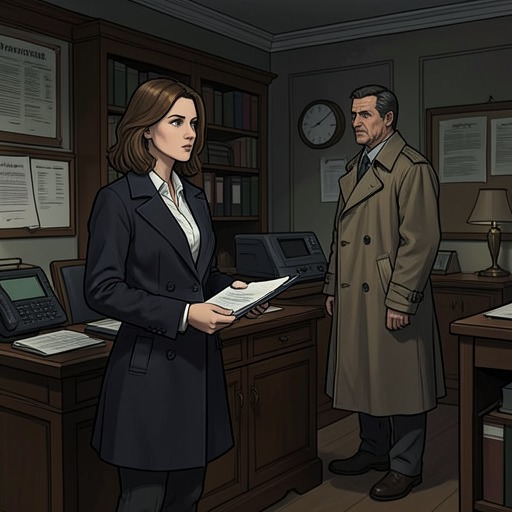
Simon’s work on Per Vollan’s case demonstrates the Squad’s ordinary investigative machinery: he reads witness statements and reports on the Homicide intranet, looking for names and connections that might advance the inquiry. He finds Kari’s reports thorough and formally objective, yet feels that their procedural correctness lacks the passion of an engaged investigator. His attention then turns to Agnete Iversen, whose murder has generated headlines, while the Vollan investigation remains a competing obligation.
The Squad also pursues evidence through details that appear inconclusive until placed in context. In questioning a service that distributes blue trainers, Simon explains that the widespread footwear is generally useless as evidence because it is common among people with criminal records. A new pair, however, can be distinguished by its clear pattern: the Salvation Army had sent its last batch to the relevant institution in March, and Simon asks whether it had distributed size 8½ shoes since then. The exchange illustrates how his inquiries convert an apparently generic trace into a specific question about access and timing.
The unit’s workload is further affected by decisions made above it. The Commissioner has asked Kripos to assist in a case without first consulting the Homicide Squad, effectively giving Kripos control. Simon nevertheless requests the preliminary report and immediate access to the crime scene, asserting that the investigation remains on his unit’s turf even after being told not to get involved. His resistance reflects a recurring tension between formal command and the responsibility he feels toward unresolved cases.
Connections to the criminal network
The criminal system confronting the Squad spans more than street-level violence. In the account of Yngve Morsand’s wife’s murder, Hugo Nestor explains that Morsand wanted to kill his wife himself but arranged through Nestor and Arild Franck for Sonny to take the blame. The plan depended on an organized chain: Franck arranged Sonny’s day release and location, while a corrupt prison officer accompanied him. The account exposes how the apparent evidence against an individual can be manufactured through cooperation between criminals and prison personnel.
Simon’s questioning of Iver Iversen extends the inquiry into finance. He alleges that Iversen Property did business with the Twin, laundering proceeds from drugs and trafficking in return for fictitious losses worth hundreds of millions of kroner. Iversen denies knowing the Twin, but Simon says he has evidence of their collaboration. For the Homicide Squad, the criminal network thus reaches beyond murder scenes into business transactions, police information, and the institutions meant to contain offenders.
The force’s complicity is also made visible through the prison system. Arild Franck, a prison governor, uses his authority over Johannes Halden’s cancer treatment to pressure him for information about Sonny’s location. Elsewhere, Sonny binds Franck to his office chair and takes his wallet and car key. These episodes show the wider setting in which the Squad’s cases develop: prison officials can become active participants in coercive schemes, while the boundaries between investigation, institutional power, and private violence repeatedly collapse.
Narrative significance
The Oslo Police Homicide Squad is more than a procedural backdrop. Its jurisdictional disputes with Kripos, the unresolved mole rumors, and the eventual account of two corrupt officers make the investigation a test of whether police procedure can be trusted when information and authority are compromised from within. The contrast between Kari’s objective reports and Simon’s search for what they leave unstated also gives the Squad two complementary investigative modes: documentation and interpretive suspicion.
The cases connected to the unit reveal a network rather than a solitary criminal antagonist. Information moves through police officers; prison access is manipulated by corrupt staff; murder is arranged through intermediaries; and financial transactions conceal the proceeds of trafficking and drugs. Against that structure, the Squad’s work depends on seeing relations between apparently separate crimes and institutions. Its central difficulty is that the people and systems needed to investigate the network may themselves belong to it.