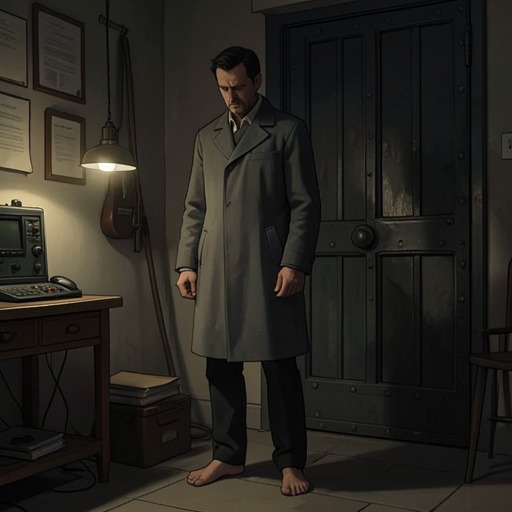
The final confrontation at St. Paul’s Church and Simon’s death
The SonThe final confrontation at St. Paul’s Church and Simon’s death bring the novel’s hidden police betrayal into the open. In the church, Sonny confronts the Twin over Ab Lofthus’s murder; Simon intervenes to save Sonny from a concealed weapon and is shot. The encounter ends with the Twin dead, Simon mortally wounded, and Sonny learning the full truth about the two police moles and his father’s fate.
Discovery at the Church
Simon locates Sonny by reconsidering what he can see: a flash from a brass door handle leads him to the church entrance. Inside, morning mass is due to begin, and candles are burning on the altar. Sonny sits in one side of the confessional with his Uzi aimed through the partition; a bloodstained hand is visible in the adjoining cubicle. The arrangement places Simon at the edge of a confrontation whose outcome appears to rest with Sonny.
The Twin’s Confession
The wounded man behind the curtain admits that he and his twin killed Ab. He says the police mole had warned him that Ab planned to kill the Twin and that the police were closing in. The Twin claims he agreed to make Ab’s death look like suicide, so police would believe Ab was the mole and stop searching for the real informant. When Sonny asks who the mole was, the Twin says he does not know: their communication had been by email. Sonny answers that the Twin will never find out.
Simon’s Intervention and Death
The Twin asks Sonny for mercy, invoking the note Ab had been allowed to write to his family. Sonny lowers his weapon, but Simon sees a gold-plated pistol lighter moving through the curtain. He recognizes that there is no time to warn Sonny and leap-dives into the confessional between them. The Twin fires and hits Simon; Sonny then fires the Uzi through the partition. The Twin staggers from the confessional and collapses in the church. Simon understands that he is dying, but his intervention has prevented Sonny from being shot.
The Mole Revealed
Simon tells Sonny that he was the mole. Sonny already knows: he had learned from his mother that Simon was the Diver, the third friend in the mountain photograph, remembered for diving in where no one else dared. What Franck told Sonny—that Ab had been about to expose Simon—made him conclude that Simon had killed his father first. Sonny had contacted Simon intending to draw him to the meeting and kill him.
The diary changes that conclusion. Sonny discovers that his father was also involved and that there were two traitors, not one. He abandons his plan to kill Simon after recalling Simon’s counsel that a son’s responsibility is not to imitate his father but to be better than him. Simon repeats the final part of that counsel as sirens approach, urging Sonny to live up to it.
Recognition and Forgiveness
The confrontation closes not with an arrest or a reconciliation secured by survival, but with an exchange between a dying policeman and the son whose family he helped destroy. Simon asks how Sonny knew who he was. Sonny explains that, as a boy, he saw a photograph in the family album and asked his mother about the mysterious photographer nicknamed the Diver. She identified Simon as the third of three close friends and explained the nickname by his habit of diving in where others would not. The photograph had preserved a connection Simon’s betrayal could not erase: he had been part of the family’s history even though he was absent from the image itself.
Sonny’s discovery of Ab’s diary supplied the other half of the truth. Franck had told him that Ab was preparing to expose Simon; Sonny therefore concluded that Simon killed his father to prevent that exposure. The diary revealed that Ab himself had been involved with the Twin, and that two police officers—not one—had betrayed their duty. That knowledge overturned Sonny’s original judgment and changed what he intended to do at the church. He had drawn Simon there expecting to kill him, but instead chose to hear the dying man and to follow Simon’s appeal to become better than his father.
Simon asks whether Sonny wants forgiveness, then says he does not deserve it. Sonny answers that nobody does and invokes the distinction between human error and divine forgiveness. He places the photograph of the three friends in Simon’s jacket, telling him that the friends are his too. The gesture does not undo Simon’s complicity in Ab’s death or restore the lives and relationships his actions took from Sonny. It does, however, grant Simon a final place in the shared past he had betrayed, while Sonny’s response marks a refusal to inherit his father’s or Simon’s violence.
Simon’s Intervention and Death
When the Twin pleads for mercy, reminding Sonny that he had let Ab write a note to his family, Sonny lowers the Uzi. Simon sees the gold-plated pistol lighter moving through the curtain and understands that there is no time to warn Sonny and draw his own gun. He dives into the open confessional between Sonny and the partition. The Twin fires and hits Simon; Sonny fires the Uzi through the partition, and the Twin staggers out before collapsing among the pews. Simon’s intervention saves Sonny from the concealed shot, but leaves Simon mortally wounded. The scene turns on a reversal: the policeman who once betrayed Ab acts at the decisive moment to protect Ab’s son.
The Twin’s Confession and the Hidden Network
The church confrontation resolves a mystery Simon had once described as rumor: for years, people had spoken of a police mole passing information to the person who controlled much of Oslo’s drug and sex-trafficking trade, but no proof had established that either the informant or the crime boss existed. Simon identifies the criminal figure as the Twin. Later, his accusation against Iver Iversen supplies another piece of the network’s reach: Iversen Property had done business with the Twin, laundering money from drugs and trafficking in exchange for fictitious losses worth hundreds of millions of kroner. Iversen denies knowing the Twin, but Simon says he has evidence of their collaboration.
Ab’s diary makes the arrangement more specific. Its writer recalls that police officers kept imagining a single traitor, while the real advantage lay in having two: when one was active, the other could provide an alibi, leaving both beyond suspicion. The diary admits that the pair had turned a blind eye to drug dealing, human trafficking, and murder. It also records their use of separate stolen computers and Hotmail accounts, with messages and drops intended to conceal contact. The Twin, meanwhile, believed he was dealing with only one mole and tried to encourage that officer’s advancement into a senior police position, offering access and influence. The church confession’s insistence that the Twin did not know the mole’s identity is therefore consistent with a system built on anonymity, even as Simon’s later admission exposes how thoroughly it had compromised the force.
The same criminal network reaches into the prison system. Nestor’s account of Ab’s murder describes how he and Arild Franck arranged the day release, location, and corrupt escort needed to put Ab in reach of his killers. The killing was staged as a suicide so that Ab would be blamed as the mole and the police would stop looking for the real informant. In a separate accusation against Fidel Lae, Sonny frames the use of dogs against a young girl attempting to escape enslavement as conduct that should be punished. Together, these revelations show why the hidden betrayal cannot be reduced to a single secret relationship: it is a chain of protection, money, prison access, trafficking, and violence, exposed at the church through the consequences it has brought to Sonny and Simon.