Bassworth Psychological Research Library
The Spy Who Came in from the ColdThe Bayswater Library for Psychic Research is the London workplace that gives Alec Leamas a foothold in civilian life after his intelligence career collapses and brings him into contact with Liz Gold. Its chilly, makeshift rooms are more than a backdrop: among shelves, a ladder, and Miss Crail’s enclosed desk, Leamas begins to inhabit the modest routine of a library assistant, while the wider novel’s world of surveillance and concealed identities remains close at hand.
Identity and Setting
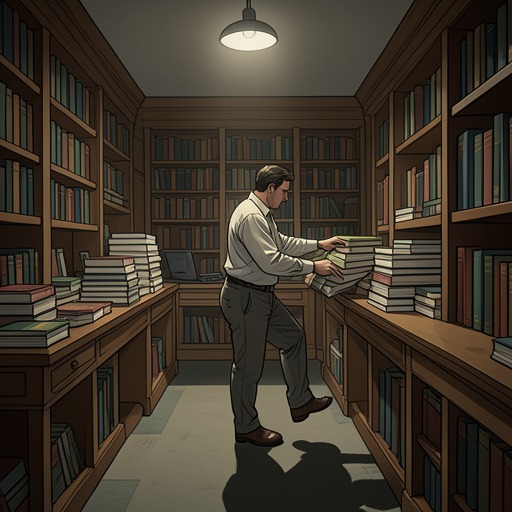
Mr. Pitt presents the library to Leamas as an endowed institution with thousands of volumes, a substantial further bequest, and a need for another helper. He describes the work as easy and the pay as fair, a practical offer to a man drawing unemployment benefit. The name suggests a specialist collection, but the glimpse of its premises is pointedly ungrand: the library resembles a church hall, is very cold, and smells of paraffin from black oil stoves at either end of the room.
At its centre is a cubicle like a witness-box, where the librarian, Miss Crail, sits. The arrangement makes the room feel divided into stations of observation and work rather than offering the warmth of a conventional reading room. The witness-box image also carries an unforced resonance in a novel where testimony, scrutiny, and the interpretation of what people say will become matters of life and death. The scene does not make the library a secret-service site; instead, its ordinary institutional furniture acquires an uneasy echo from the larger narrative.
Leamas’s Arrival
The library enters Leamas’s life through the Labour Exchange. Pitt hands him his dole and a slip of paper, then urges him to try the position, remarking that Leamas is not a stayer. Leamas is surprised that the job will require him to work for a woman; no one at the Exchange had mentioned this. His response registers how unfamiliar and provisional this new civilian arrangement is to him.
When he arrives, Miss Crail is on the telephone, arguing fiercely about concert tickets. Leamas listens briefly and drifts toward the shelves, where he notices a girl sorting large volumes from a ladder. This small sequence introduces the library as a place of work already in progress: its routines are untidy and human, its staff are engaged with practical disputes and books rather than the covert machinery Leamas has left behind.
Liz Gold and the Library’s Role
Leamas introduces himself as the new man, and the girl comes down from the ladder to shake his hand formally. She identifies herself as Liz Gold and asks whether he has met Miss Crail; when he says that the librarian is on the phone, Liz guesses that she is arguing with her mother. The exchange establishes an immediate, everyday familiarity between the two women and places Leamas at the threshold of a social world that is not organized around his former work.
The library’s narrative importance lies in this conjunction of setting and encounter. It supplies Leamas with an ordinary occupation and is where he first meets Liz, but it does not erase the habits or history that he carries into civilian life. Later evidence from the book’s interrogation scenes shows how the supposedly abandoned intelligence world continues to shape events: Leamas’s Copenhagen identity, Robert Lang, becomes part of the case Fiedler examines, and the papers and movements connected with Operation Rolling Stone are scrutinized before the Tribunal. These disclosures do not make the library itself part of that operation; they sharpen the contrast between the modest place where Leamas takes a job and the dangerous networks that remain active around him.
A Civilian Setting Under Pressure
The contrast is also set against the novel’s historical landscape. The Berlin Wall turns the city into a more perilous and clandestine environment: at Checkpoint Charlie, American and Soviet Bloc tanks face one another across a short strip of road, while agents caught by the sudden closure must adapt to hidden radios and secret writing. Leamas’s later crossing through fortified checkpoints, with observation towers, dragons’ teeth, and barbed wire in view, demonstrates how far his world remains from the quiet promise of a library job.
The library therefore marks a change of appearance, not a clean break. Leamas may take a slip from the Labour Exchange and present himself as a new helper, but the novel repeatedly shows how identity can be made and read through documents, aliases, money, and testimony. The cold church-hall room is a credible civilian workplace precisely because it is so unexceptional; its significance comes from the precarious alternative it offers to espionage, and from the relationship with Liz that begins there before the machinery of deception closes in again.